SL 3.6 — Voronoi diagrams(ボロノイ図)
- site、cell、edge、vertex の4つの言葉が読める。
- edge が perpendicular bisector(垂直二等分線)、vertex が(ふつうの図では)3つの site から等距離の点だと分かる。
- 2つの site が与えられたとき、その境界(edge)の式を求められる。
- 2本の edge の式から、vertex の座標を求められる。
- ある点に一番近い site を、図または距離の計算で決められる。
- nearest neighbour interpolation で値を見積もれる。
- site を1つ足したときに図がどう変わるかを説明できる。
- toxic waste dump 問題(どこに置けば全部から一番遠いか)を解ける。
- cell の面積を求められる。
The idea
1. What a Voronoi diagram is(ボロノイ図は「一番近いのはどれか」の地図)
いくつかの点(お店、病院、基地局、観測所など)が地図の上にあるとします。「この場所からは、どれが一番近いか」で地図を塗り分けたものが、Voronoi diagram(ボロノイ図)です。
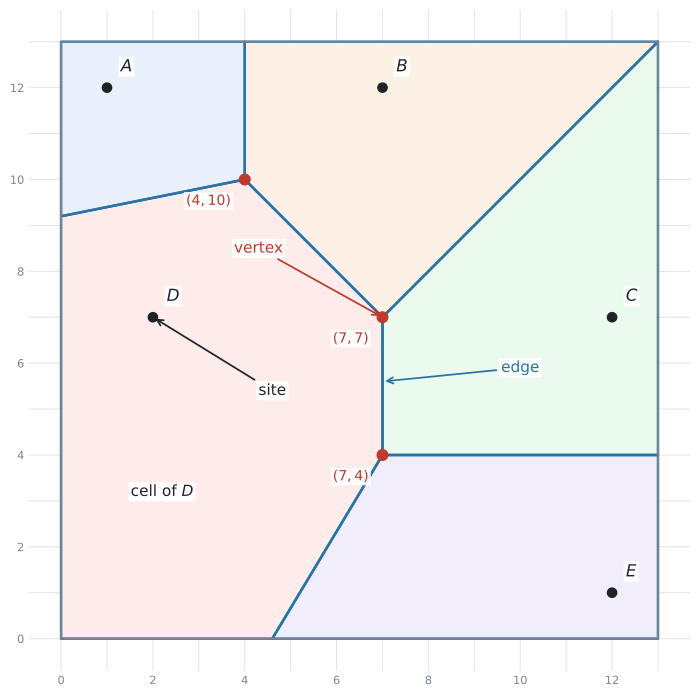
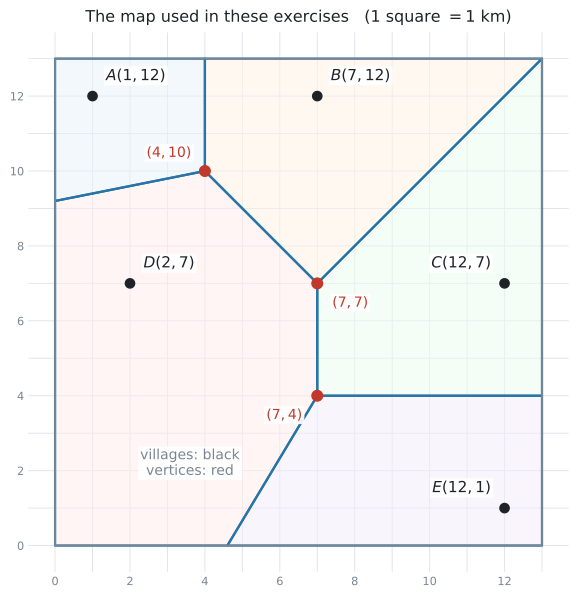
図 1 は、\(5\) つの村 \(A(1,12)\)、\(B(7,12)\)、\(C(12,7)\)、\(D(2,7)\)、\(E(12,1)\) の地図です。地図の範囲は \(0 \le x \le 13\)、\(0 \le y \le 13\) で、\(1\) 目盛りが \(1\) km だとします。このページの例題は、すべてこの地図を使います。
| English | 日本語 | 何のことか |
|---|---|---|
| site | 母点(ぼてん) | もとになる点。\(A\) 〜 \(E\) のこと |
| cell | セル・領域 | 「その site が一番近い」場所の集まり |
| edge | 辺・境界 | \(2\) つの cell の境目。直線の一部 |
| vertex(複数 vertices) | 頂点 | edge が集まる点。ふつうの IB の問題では \(3\) 本 |
Voronoi 図は日本の高校では扱いません。ですから、日本語で覚えても意味がありません。
問題文は Write down the coordinates of the vertex のような英語で出ます。英語のまま覚えてください。
特に site は、ふつうの英語では「場所」ですが、ここではもとの点そのものを指します。
2. Edges and vertices(境界は垂直二等分線、頂点は等距離の点)
ここが、SL 3.5 とのつなぎ目です。公式集に SL 3.6 の欄はなく、使う式(中点・傾き・垂直な傾き・距離)はすべて SL 3.5 と同じです。この項目で新しいのは、計算ではなく言葉と場面の読み取りです。
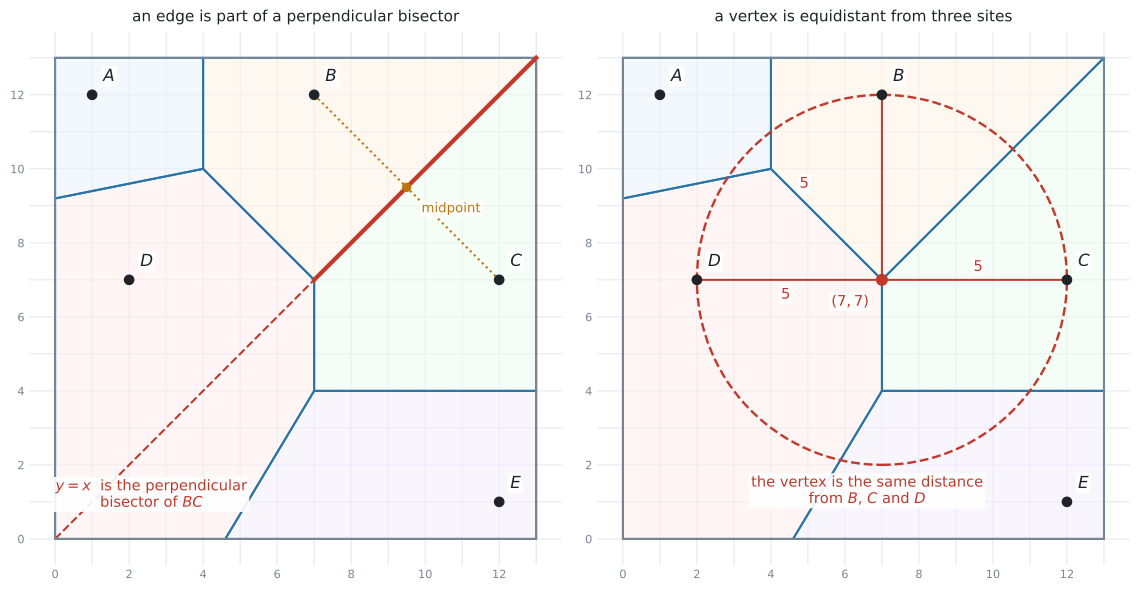
edge は、\(2\) つの site の垂直二等分線の一部です。図 2 の左では、\(B\) と \(C\) の垂直二等分線が \(y = x\) で、そのうち太くかいた部分が実際の edge になっています。
この章で扱うふつうの図では、vertex は \(3\) つの site から等距離にある点です。右の図では、\((7,7)\) から \(B\)、\(C\)、\(D\) までの距離がどれも \(5\) です。距離は、SL 3.5 と同じ式で出します。
\[ d = \sqrt{(x_{1} - x_{2})^{2} + (y_{1} - y_{2})^{2}} \tag{1}\]
だから \((7,7)\) を中心にした半径 \(5\) の円が、\(3\) つの site をちょうど通ります。
edge の上の点は、\(2\) つの site から等距離です。
vertex は、\(2\) 本の edge が交わった点です。ですから
- \(1\) 本目の edge の上 → \(B\) と \(C\) から等距離
- \(2\) 本目の edge の上 → \(B\) と \(D\) から等距離
- 両方の上 → \(B\)、\(C\)、\(D\) の \(3\) つから等距離
そのため、\(3\) 本目の edge(\(C\) と \(D\) の境界)も自動的に同じ点を通ります。 これが「edge が \(3\) 本集まる」ということです。
ふつうの IB の問題では、\(1\) つの vertex に edge が \(3\) 本、cell が \(3\) つ集まります。ただし site の並び方が特別な場合(たとえば正方形の \(4\) 頂点)には、\(4\) つ以上が集まることもあります。
vertex の座標は、2本の式を連立して出します
2つの edge の式を求めて、連立方程式を解く — これだけです。手順は次のとおりです。
| やること | |
|---|---|
| 1 | site を \(2\) つ選んで、その垂直二等分線の式を出す(SL 3.5 の手順) |
| 2 | 別の \(2\) つで、もう \(1\)本の式を出す |
| 3 | \(2\) 本を連立して解く |
| 4 | 出た点から \(3\) つの site までの距離を計算して、等しいことを確かめる |
試験では、垂直二等分線の式を計算するのに必要な site の座標は、問題文に与えられます。定規とコンパスで作図する必要はなく、式を計算して求めます。
例題 1 The map shows five villages \(A(1,12)\), \(B(7,12)\), \(C(12,7)\), \(D(2,7)\) and \(E(12,1)\). The point \(V\) has coordinates \((7,7)\).
(a) Show that \(V\) is the same distance from \(B\), \(C\) and \(D\).
(b) Write down that distance.
(c) State how many cells meet at \(V\).
日本語訳
地図は \(5\) つの村 \(A(1,12)\)、\(B(7,12)\)、\(C(12,7)\)、\(D(2,7)\)、\(E(12,1)\) を示しています。点 \(V\) の座標は \((7,7)\) です。
(a) \(V\) が \(B\)、\(C\)、\(D\) から同じ距離にあることを示しなさい。
(b) その距離を書きなさい。
(c) \(V\) に集まる cell の数を書きなさい。
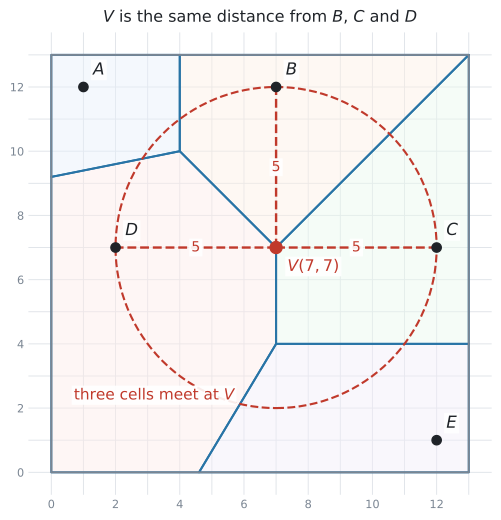
(a) Show that なので、\(3\) つとも計算して並べます。 式 1 です。
\[ VB = \sqrt{(7-7)^{2} + (7-12)^{2}} = \sqrt{0 + 25} = 5 \]
\[ VC = \sqrt{(7-12)^{2} + (7-7)^{2}} = \sqrt{25 + 0} = 5 \]
\[ VD = \sqrt{(7-2)^{2} + (7-7)^{2}} = \sqrt{25 + 0} = 5 \]
\(3\) つとも \(5\) なので、\(V\) は \(B\)、\(C\)、\(D\) から同じ距離にあります。
(b) \(5\) km です。
(c) この図では、\(3\) つの site から等距離の点に cell が \(3\) つ集まります。答えは \(3\) です。
\(B\) と \(V\) は \(x\) 座標が同じなので、\((7-7)^{2} = 0\) です。それでも \(0\) を書いてください。
Show that では、\(\sqrt{(7-7)^{2}+(7-12)^{2}}\) という式そのものが点になります。\(5\) とだけ書くと、どこから出たのか分かりません。
(a) \(VB = \sqrt{(7-7)^{2} + (7-12)^{2}} = 5\)
\(VC = \sqrt{(7-12)^{2} + (7-7)^{2}} = 5\)
\(VD = \sqrt{(7-2)^{2} + (7-7)^{2}} = 5\)
All three distances are equal, so \(V\) is the same distance from \(B\), \(C\) and \(D\).
(b) \(5\) km
(c) \(3\)
例題 2 (a) Find the equation of the edge between the cells of \(B(7,12)\) and \(C(12,7)\).
(b) Find the equation of the edge between the cells of \(B(7,12)\) and \(D(2,7)\).
(c) Hence find the coordinates of the vertex where the cells of \(B\), \(C\) and \(D\) meet.
日本語訳
(a) \(B(7,12)\) と \(C(12,7)\) の cell のあいだの edge の式を求めなさい。
(b) \(B(7,12)\) と \(D(2,7)\) の cell のあいだの edge の式を求めなさい。
(c) これを使って、\(B\)、\(C\)、\(D\) の cell が集まる vertex の座標を求めなさい。
edge は垂直二等分線なので、SL 3.5 の手順そのままです。
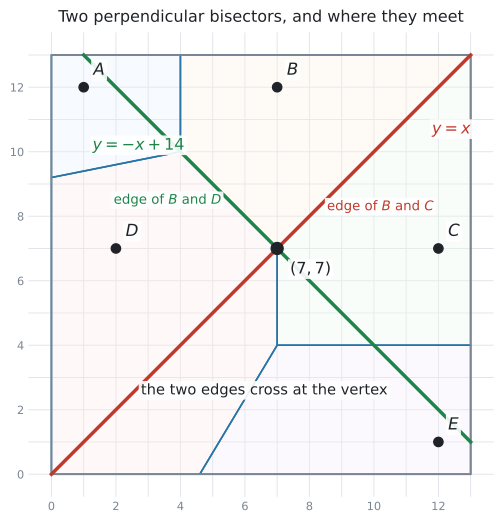
(a) \(B(7,12)\) と \(C(12,7)\) で計算します。
\[ \text{中点} = \left( \frac{7+12}{2}, \ \frac{12+7}{2} \right) = (9.5, \ 9.5) \]
\[ m = \frac{7 - 12}{12 - 7} = \frac{-5}{5} = -1 \quad \Rightarrow \quad m_{\perp} = 1 \]
\[ y - 9.5 = 1(x - 9.5) \quad \Rightarrow \quad y = x \]
(b) \(B(7,12)\) と \(D(2,7)\) です。
\[ \text{中点} = \left( \frac{7+2}{2}, \ \frac{12+7}{2} \right) = (4.5, \ 9.5) \]
\[ m = \frac{7 - 12}{2 - 7} = \frac{-5}{-5} = 1 \quad \Rightarrow \quad m_{\perp} = -1 \]
\[ y - 9.5 = -(x - 4.5) \quad \Rightarrow \quad y = -x + 14 \]
(c) Hence なので、(a) と (b) を連立して解きます。
\[ x = -x + 14 \quad \Rightarrow \quad 2x = 14 \quad \Rightarrow \quad x = 7 \]
\(y = x\) に戻して \(y = 7\) です。vertex は \((7, 7)\) です。
検算。 例題 1 で、この点から \(B\)、\(C\)、\(D\) までの距離がどれも \(5\) だと確かめてあります ✓
\(C\) と \(D\) の垂直二等分線(\(x = 7\))も、同じ点を通ります。ですが、\(2\) 本あれば交点は決まります。
\(3\) 本目を出すのは、検算をしたいときだけです。時間がないときは、距離で確かめるほうが速く済みます。
(a) Midpoint of \(BC = (9.5, 9.5)\); \(m = \dfrac{7-12}{12-7} = -1\), so \(m_{\perp} = 1\)
\(y - 9.5 = 1(x - 9.5)\), so \(y = x\)
(b) Midpoint of \(BD = (4.5, 9.5)\); \(m = \dfrac{7-12}{2-7} = 1\), so \(m_{\perp} = -1\)
\(y - 9.5 = -(x - 4.5)\), so \(y = -x + 14\)
(c) \(x = -x + 14\), so \(x = 7\) and \(y = 7\). The vertex is \((7, 7)\).
3. The nearest site(一番近い母点をさがす)
地図の上のある点に、どの site が一番近いかを決める問題です。Determine which site is closest to the point ... は、この項目でよく出る設問です。やり方は \(2\) 通りあります。
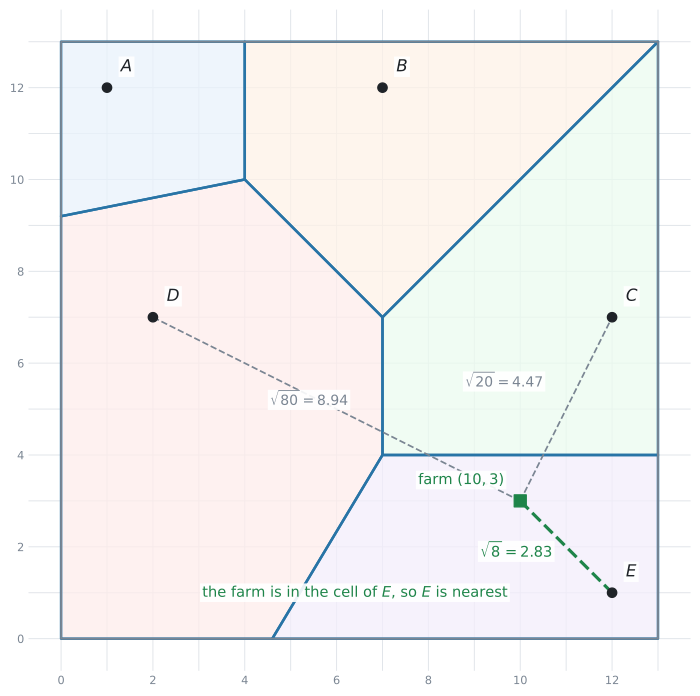
- 図から読む … その点がどの cell の中にあるかを見ます。速いですが、「図より \(E\)」とだけ書くと根拠が残りません
- 距離を計算する … 式 1 で全部の距離を出して、一番小さいものを選びます
Write down… 図から読むだけ。計算は要りませんBy finding the distancesと指定されたら … 指定された距離を計算して並べ、比べます。 やり方まで指示されているので、そのとおりにしますDetermineだけのとき … 図・距離・境界線などを使って、答えが \(1\) つに決まる十分な根拠を示します
どちらの場合も、結論だけを書かないのが大事です。何を根拠にそう決めたのかが、答案に残るようにしてください。
4. Nearest neighbour interpolation(最近傍補間)
同じ cell の中の場所は、その site と同じ値だと見なすという見積もり方があります。これを nearest neighbour interpolation(最近傍補間)といいます。
site に値がついている場面で使います。たとえば、村ごとに雨量計があって、それぞれの村の雨量が分かっているとします。村と村のあいだにある地点では測っていませんが、一番近い村と同じだと見なして答える、という考え方です。
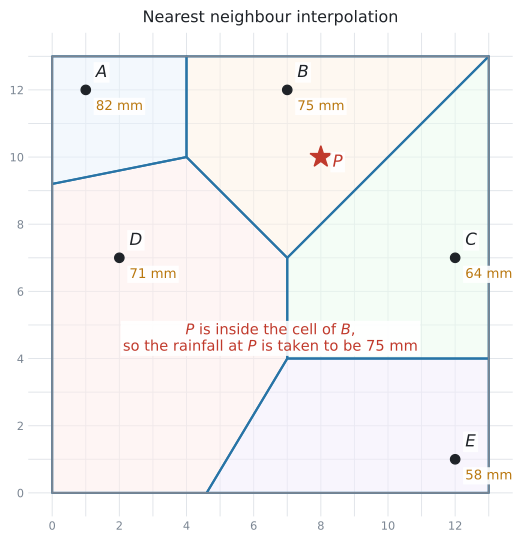
やることは、たった \(2\) 段階です。
- その点がどの cell の中にあるかを決める
- その site の値を、そのまま答えにする
図 6 では、地点 \(P(8,10)\) は \(B\) の cell の中にあります。ですから \(P\) の雨量は、\(B\) で測った \(75\) mm と見積もります。
平均を取ったり、距離で重みを付けたりはしません。
図 6 の \(P\) のまわりには \(A\)、\(C\)、\(D\) もありますが、\(82\)、\(64\)、\(71\) と \(75\) を平均して \(73\) と答えるのは、別の方法です。この項目では、一番近い \(1\) つだけを見ます。
例題 3 The rainfall last month, measured at each village, is shown below.
| Village | \(A\) | \(B\) | \(C\) | \(D\) | \(E\) |
|---|---|---|---|---|---|
| Rainfall (mm) | \(82\) | \(75\) | \(64\) | \(71\) | \(58\) |
(a) A farm is at the point \((10,3)\). By finding the distances from the farm to \(C\), \(D\) and \(E\), determine which village is nearest to the farm.
(b) Use nearest neighbour interpolation to estimate the rainfall at the farm.
(c) Give one reason why this estimate may not be reliable.
日本語訳
先月の雨量を、それぞれの村で測った結果です。見出しの Village は「村」、Rainfall は「雨量」です。
(a) 農場が点 \((10,3)\) にあります。農場から \(C\)、\(D\)、\(E\) までの距離を求めることで、農場に一番近い村を判断しなさい。
(b) nearest neighbour interpolation を使って、農場の雨量を見積もりなさい。
(c) この見積もりが信頼できるとは限らない理由を \(1\) つ挙げなさい。
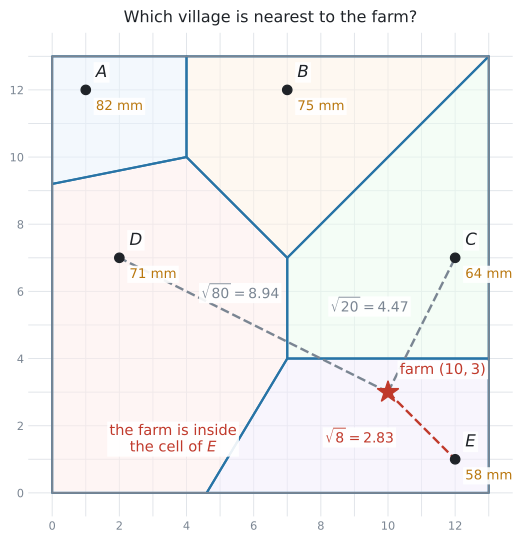
(a) By finding the distances と指定されているので、距離を計算して並べます。
\[ \text{farm to } C = \sqrt{(10-12)^{2} + (3-7)^{2}} = \sqrt{4 + 16} = \sqrt{20} = 4.47\ldots \]
\[ \text{farm to } D = \sqrt{(10-2)^{2} + (3-7)^{2}} = \sqrt{64 + 16} = \sqrt{80} = 8.94\ldots \]
\[ \text{farm to } E = \sqrt{(10-12)^{2} + (3-1)^{2}} = \sqrt{4 + 4} = \sqrt{8} = 2.83\ldots \]
一番小さいのは \(\sqrt{8}\) なので、\(E\) が一番近い村です。
(b) その cell の site の値を、そのまま使います。\(E\) の雨量は \(58\) mm なので、農場の見積もりも \(58\) mm です。
(c) 言葉で答える設問です。
試験ではこう書く
The estimate uses only the value at \(E\), and the farm is \(2.83\) km away from \(E\).
The rainfall may change between the two places, so the estimate could be quite different from the true value.
(この見積もりは \(E\) の値だけを使っていますが、農場は \(E\) から \(2.83\) km 離れています。そのあいだで雨量が変わるかもしれないので、本当の値とはかなり違う可能性があります。)
\(\dfrac{64 + 58}{2} = 61\) のように、近い村2つの平均を書いてしまう誤りがあります。
nearest neighbour interpolation は、一番近い \(1\) つの値をそのまま使う方法です。名前のとおりです。
(a) \(\sqrt{(10-12)^{2}+(3-7)^{2}} = \sqrt{20} = 4.47\) km (3 s.f.)
\(\sqrt{(10-2)^{2}+(3-7)^{2}} = \sqrt{80} = 8.94\) km (3 s.f.)
\(\sqrt{(10-12)^{2}+(3-1)^{2}} = \sqrt{8} = 2.83\) km (3 s.f.)
\(E\) is the nearest village.
(b) \(58\) mm
(c) The estimate uses only the value at \(E\), and the farm is \(2.83\) km away from \(E\). The rainfall may change between the two places, so the estimate could be quite different from the true value.
5. Adding a site(母点を 1 つ足す)
すでにある Voronoi 図に、site を \(1\) つ足す問題も出ます。新しい店ができた、新しい基地局が建った、という場面です。
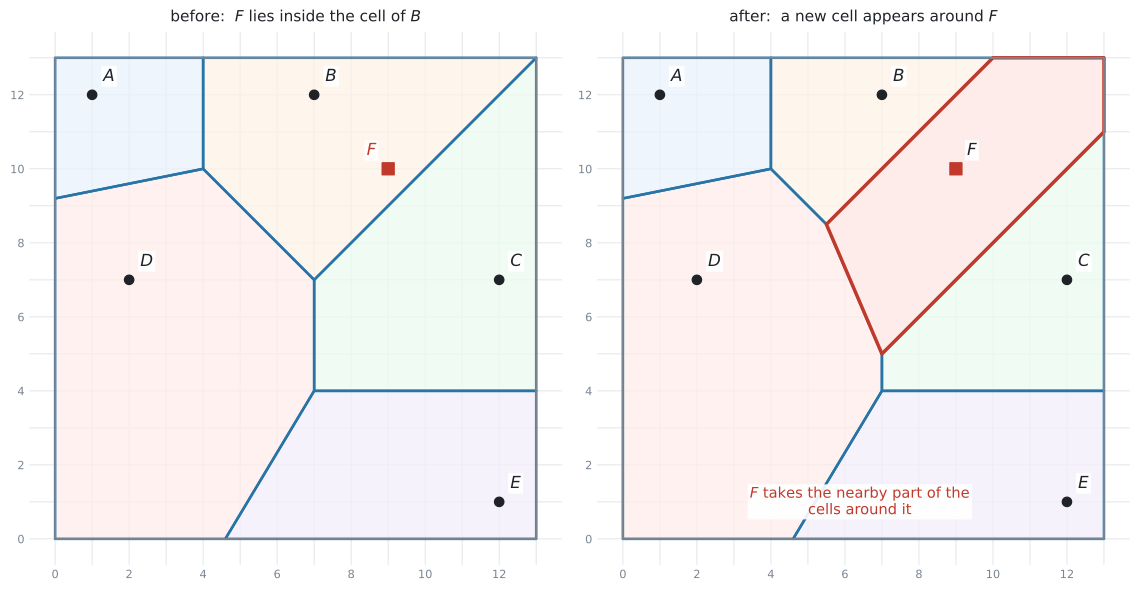
新しい site \(F\) を足すと、\(F\) のまわりに新しい cell ができます。その cell は、まわりの cell から少しずつ取ってきたものです。
- \(F\) の cell が現れる
- \(F\) のとなりだった cell は、小さくなります
- \(F\) から遠い cell は、変わりません
境界の式の出し方は、いままでと同じです。\(F\) と、となりの site の垂直二等分線を出します。
site を足したとき、どの cell も大きくはなりません。 小さくなるか、そのままかのどちらかです。
新しい site は、まわりから場所を取るだけだからです。
例題 4 A new village \(F\) is built at the point \((9,10)\).
(a) State the village whose cell contains the point \((9,10)\) before \(F\) is built.
(b) Find the equation of the edge between the cells of \(B\) and \(F\) in the new Voronoi diagram.
(c) Describe what happens to the cell of \(B\) when \(F\) is added.
日本語訳
新しい村 \(F\) が点 \((9,10)\) に作られます。
(a) \(F\) ができる前に、点 \((9,10)\) を含んでいた cell の村を書きなさい。
(b) 新しい Voronoi 図での、\(B\) と \(F\) の cell のあいだの edge の式を求めなさい。
(c) \(F\) が加わったとき、\(B\) の cell がどうなるかを述べなさい。
(a) State なので、図を見て答えます。図 8 の左を見ると、\((9,10)\) は \(B\) の cell の中にあります。
念のため計算で確かめるなら、\(B(7,12)\) までが \(\sqrt{4+4} = \sqrt{8} = 2.83\)、\(C(12,7)\) までが \(\sqrt{9+9} = \sqrt{18} = 4.24\) で、\(B\) のほうが近いことが分かります。
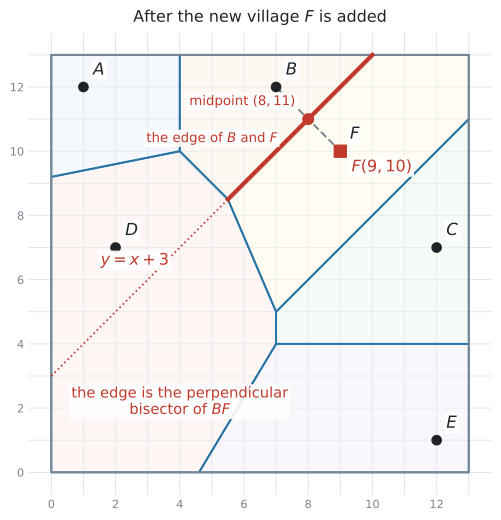
(b) \(B(7,12)\) と \(F(9,10)\) の垂直二等分線です。
\[ \text{中点} = \left( \frac{7+9}{2}, \ \frac{12+10}{2} \right) = (8, \ 11) \]
\[ m = \frac{10 - 12}{9 - 7} = \frac{-2}{2} = -1 \quad \Rightarrow \quad m_{\perp} = 1 \]
\[ y - 11 = 1(x - 8) \quad \Rightarrow \quad y = x + 3 \]
(c) 言葉で答えます。
試験ではこう書く
The cell of \(B\) becomes smaller.
The part of it that is nearer to \(F\) than to \(B\) now belongs to the cell of \(F\).
(\(B\) の cell は小さくなります。\(B\) よりも \(F\) に近い部分が、\(F\) の cell に移ります。)
Describe なので、どこが、なぜ移るのかまで書いてください。
「\(B\) より \(F\) に近い部分が \(F\) の cell になる」の一言が入っていれば、意味が伝わります。
(a) \(B\)
(b) Midpoint of \(BF = (8, 11)\); \(m = \dfrac{10-12}{9-7} = -1\), so \(m_{\perp} = 1\)
\(y - 11 = 1(x - 8)\), so \(y = x + 3\)
(c) The cell of \(B\) becomes smaller. The part of it that is nearer to \(F\) than to \(B\) now belongs to the cell of \(F\).
6. The toxic waste dump problem(有害廃棄物処分場の問題)
toxic waste dump(有害廃棄物処分場)は、よく出る問題です。
どの site からもできるだけ遠い場所を、決められた範囲の中から選びなさい。
処分場、ごみ処理場、騒音の出る工場など、近くにあってほしくないものを置く場面です。
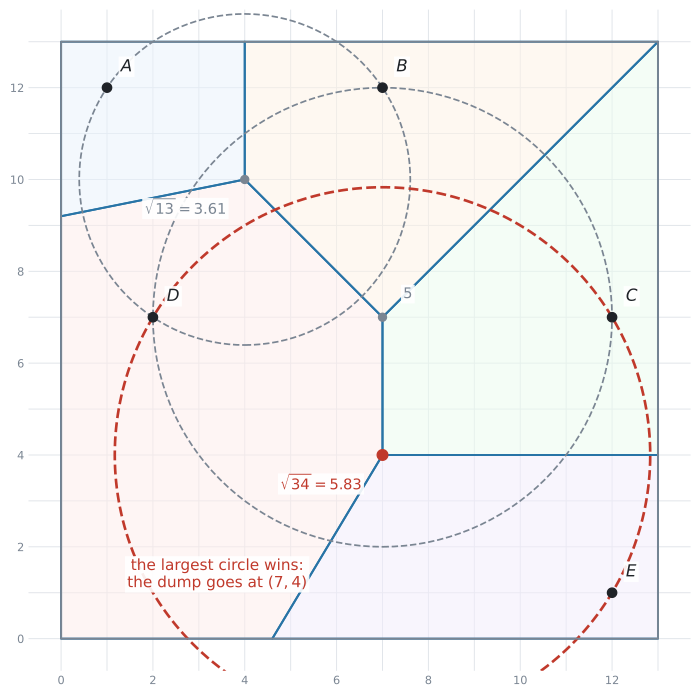
図 10 では、一番大きい円の中心は \((7,4)\) なので、処分場は \((7,4)\) に置きます。
手順は3つです
| やること | |
|---|---|
| 1 | すべての vertex の座標を書き出す |
| 2 | それぞれについて、一番近い site までの距離を計算する |
| 3 | その距離が一番大きい vertex を選ぶ |
試験では、答えは必ず vertex(edge が \(3\) 本交わる点)にあるように作られています。 探す場所は vertex だけです。
考え方としては、図 10 の円を見てください。それぞれの vertex を中心に、一番近い site まで届く円をかいてあります。この円の中には site が \(1\) つも入っていません。円が大きいほど、まわりに何もないということです。だから一番大きい円の中心が答えになります。
「見た感じ真ん中あたり」で選ばないでください。全部の vertex について距離を出して、並べてから選びます。
答案には、調べた vertex を全部書いてください。 比較したことが見えないと、その vertex を選んだ根拠が示せません。
例題 5 A waste site is to be built inside the map, as far as possible from all five villages. The Voronoi diagram has vertices at \((4,10)\), \((7,7)\) and \((7,4)\).
(a) For each vertex, find the distance to its nearest village.
(b) Hence state where the waste site should be built, and how far it is from the nearest village.
(c) The waste site must be at least \(5\) km from every village. State whether your answer to part (b) meets this condition, giving a reason.
日本語訳
廃棄物処理場を、地図の中で \(5\) つの村すべてからできるだけ遠い場所に作ります。Voronoi 図の vertex は \((4,10)\)、\((7,7)\)、\((7,4)\) にあります。
(a) それぞれの vertex について、一番近い村までの距離を求めなさい。
(b) これを使って、処理場をどこに作るべきかと、一番近い村までの距離を書きなさい。
(c) 処理場は、すべての村から少なくとも \(5\) km 離れていなければなりません。(b) の答えがこの条件を満たすかどうかを、理由を付けて書きなさい。
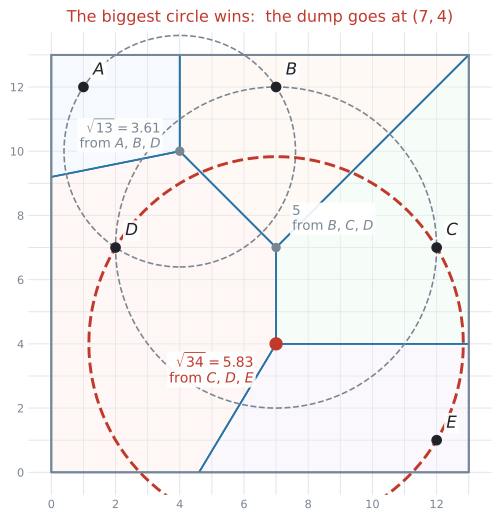
(a) この図では vertex は \(3\) つの site から等距離なので、その \(3\) つのうち \(1\) つとの距離を出せば済みます。
\((4,10)\) は \(A\)、\(B\)、\(D\) から等距離です。\(A(1,12)\) で計算します。
\[ \sqrt{(4-1)^{2} + (10-12)^{2}} = \sqrt{9 + 4} = \sqrt{13} = 3.605\ldots \]
\((7,7)\) は \(B\)、\(C\)、\(D\) から等距離です。\(B(7,12)\) で計算します。
\[ \sqrt{(7-7)^{2} + (7-12)^{2}} = \sqrt{0 + 25} = 5 \]
\((7,4)\) は \(C\)、\(D\)、\(E\) から等距離です。\(C(12,7)\) で計算します。
\[ \sqrt{(7-12)^{2} + (4-7)^{2}} = \sqrt{25 + 9} = \sqrt{34} = 5.830\ldots \]
(b) 一番大きいものを選びます。\(\sqrt{34} > 5 > \sqrt{13}\) なので、答えは \((7,4)\) です。
処理場は \((7,4)\) に作るべきで、一番近い村までの距離は \(5.83\) km(有効数字3桁)です。
(c) \(5.83 > 5\) なので、条件を満たします。
試験ではこう書く
Yes.
The nearest villages (\(C\), \(D\) and \(E\)) are \(\sqrt{34} = 5.83\) km away, which is more than \(5\) km.
\((7,4)\) だけを計算して「これが答えです」と書くと、比べたことが見えません。
\(3\) つとも並べて書くことが、そのまま Hence の根拠になります。
この図では vertex は \(3\) つの site から等距離なので、\(3\) つとも計算する必要はありません。\(1\) つで出して、残りは同じだと書けば済みます。
ただし、「どの \(3\) つの site から等距離なのか」は答案に書いてください。
(a) At \((4,10)\): \(\sqrt{(4-1)^{2}+(10-12)^{2}} = \sqrt{13} = 3.61\) km (3 s.f.) — from \(A\), \(B\) and \(D\)
At \((7,7)\): \(\sqrt{(7-7)^{2}+(7-12)^{2}} = 5\) km — from \(B\), \(C\) and \(D\)
At \((7,4)\): \(\sqrt{(7-12)^{2}+(4-7)^{2}} = \sqrt{34} = 5.83\) km (3 s.f.) — from \(C\), \(D\) and \(E\)
(b) The waste site should be built at \((7,4)\), which is \(5.83\) km from the nearest village.
(c) Yes. The nearest villages (\(C\), \(D\) and \(E\)) are \(\sqrt{34} = 5.83\) km away, which is more than \(5\) km.
7. Area of a cell(セルの面積)
cell の面積を求める問題も出ます。cell は多角形なので、面積は次のように出します。
- 三角形・長方形・台形に切り分けて足す
- 大きい長方形から、はみ出した三角形を引く
外側の cell は、Voronoi の edge だけでは閉じません。地図のわく(\(0 \le x \le 13\) など)も、cell の境界の一部です。
問題文に「地図の範囲」が書かれていたら、それも辺として使うという合図です。
Why it works
なぜ Voronoi 図の境界が、垂直二等分線になるのかを説明します。
いま、地図の上のある点 \(P\) を考えます。\(P\) が「\(A\) の cell」に入るのは、\(A\) が他のどの site よりも近いときです。
\(A\) と \(B\) の \(2\) つだけで考えると、地図は \(3\) つに分かれます。
- \(A\) のほうが近い場所
- \(B\) のほうが近い場所
- ちょうど同じ距離の場所
この \(3\) つめが、SL 3.5 で見た「\(A\) と \(B\) から等距離の点の集まり」、つまり \(AB\) の垂直二等分線です。
site が \(3\) つ以上あるときも、考え方は変わりません。site を \(2\) つずつ組にして、そのたびに地図を半分に分けるだけです。\(A\) の cell は、「\(A\) のほうが \(B\) より近い側」と「\(A\) のほうが \(C\) より近い側」と…を全部重ねた部分になります。
半分に切る線がいつも直線なので、cell はいつも多角形になります。曲がった境界は出てきません。
Common errors
site はもとの点(村や店)、vertex は edge が集まる点(ふつうの問題では \(3\) 本)です。別のものです。
問題文の the vertex nearest to A を「\(A\) そのもの」と読んでしまうと、まったく違う答えになります。
site の座標は問題文から読み取ります。vertex は自分で求めます。 ここで見分けてください。
edge は、\(2\) つの site を結ぶ線ではありません。\(2\) つの site の垂直二等分線、つまり直交する線の一部です。
\(AB\) の式を求めてしまう答案がありますが、それは cell の境界ではありません。
site を結ぶ線分は、答案には出てきません。
連立方程式を解き間違えても、それらしい座標が出てしまいます。
\(3\) つの site までの距離を計算すれば、等しくなければ間違いだと分かります。\(1\) 行足すだけで、その先の設問を全部救えます。
Determine なのに、根拠を書かずに答える
Determine which site is closest に「図より \(E\)」とだけ書くと、答えが \(1\) つに決まる根拠が示せていません。
By finding the distances と指定されていれば、距離を計算して並べます。 指定がなくても、どの cell に入っているか・どの境界線のどちら側かなど、決め手を書いてください(第3節)。Write down のときだけ、図から読んで書くだけで済みます。
近い \(2\) つの値を足して \(2\) で割る、距離で重みを付ける、といった計算をしてしまう誤りです。
一番近い \(1\) つの値を、そのまま書きます。 計算はありません。
the solution point will always be at an intersection of three edges は、「vertex のどれかが答え」という意味であって、「どの vertex でもよい」ではありません。
全部の vertex について距離を出して、一番大きいものを選びます。
新しい site は、まわりから場所を取るだけです。大きくなる cell はありません。
\(F\) の cell が新しくできて、まわりの cell が小さくなる、という書き方をしてください。
外側の cell は、Voronoi の edge だけでは閉じません。 地図のわく(\(x = 0\)、\(y = 13\) など)も辺として使います。
わくを忘れると、多角形が開いたままになり、面積が出せません。まず多角形の頂点を全部書き出してから、面積を計算してください。
距離は km、面積は km\(^2\)、雨量は mm です。問題文の単位に合わせてください。
地図の問題では、each unit represents 1 km のような一文が最初に置かれています。見落とさないでください。
Using your GDC (TI-Nspire CX II)
この項目では、電卓は距離の計算と、連立方程式の確認に使います。図そのものは紙にかきます。
1. Distances in one line(距離は \(1\) 行で入れる)
式 1 は、平方根のテンプレートに入れて \(1\) 行で計算します。
\(\sqrt{\left(10 - 12\right)^{2} + \left(3 - 7\right)^{2}}\)
\(\sqrt{20} = 4.4721\ldots\) と返ります。途中で \(20\) を書き出して打ち直さないでください。
2. Comparing distances(比べるだけなら \(\sqrt{\ }\) は要らない)
「どちらが近いか」を知りたいだけなら、\(\sqrt{\ }\) の中身どうしを比べれば十分です。
\(20\)、\(80\)、\(8\) のうち \(8\) が最小なので、\(E\) が一番近いことが分かります。
平方根は、値が大きいほど元の数も大きいからです。ただし、答案には距離そのもの(\(\sqrt{8} = 2.83\))を書いてください。
3. Simultaneous equations(連立方程式は Solve System of Linear Equations で)
\(2\) 本の edge の式から vertex を出すとき、手で解いても構いませんが、電卓でも確認できます。
menu → Algebra → Solve System of Linear Equations\(y = x\) と \(y = -x + 14\) を、\(-x + y = 0\) と \(x + y = 14\) の形に直してから入れます。
\(y = x\) と \(y = -x + 14\) のような形なら、代入して \(1\) 行で終わります。
電卓に入れる形(\(ax + by = c\))に直す手間のほうが大きい、ということがよくあります。検算に使うのがちょうどよい使い方です。
4. Checking on a graph(Graphs ページで図を確かめる)
edge の式を \(f1(x)\)、\(f2(x)\) に入れると、交点が本当に vertex になっているかが目で見えます。
menu → Analyze Graph → Intersection交点をはさむように、lower bound? と upper bound? の \(2\) 回、enter を押します(→ SL 2.4)。
TI-Nspire に「Voronoi」というメニューはありません。図は問題用紙に印刷されているか、自分でかきます。
電卓が助けてくれるのは、距離と交点の計算だけです。
5. Areas(面積は切り分けてから)
cell の面積は、多角形の頂点を書き出して、三角形や台形に切り分けて足します。電卓は最後の足し算に使うだけです。
Exercises
村 \(A(1,12)\)、\(B(7,12)\)、\(C(12,7)\)、\(D(2,7)\)、\(E(12,1)\)。地図の範囲は \(0 \le x \le 13\)、\(0 \le y \le 13\) で、\(1\) 目盛りは \(1\) km です。Voronoi 図の vertex は \((4,10)\)、\((7,7)\)、\((7,4)\) にあります。
1 図 12 Consider the vertex at \((4,10)\).
(a) Write down the three villages that are the same distance from this vertex.
(b) Find that distance, correct to three significant figures.
日本語訳
vertex \((4,10)\) について考えます。
(a) この vertex から同じ距離にある \(3\) つの村を書きなさい。
(b) その距離を、有効数字3桁で求めなさい。
(a) \(A\), \(B\) and \(D\)
(b) \(\sqrt{(4-1)^{2} + (10-12)^{2}} = \sqrt{13} = 3.61\) km (3 s.f.)
(a) は図から読みます。\((4,10)\) に集まっている cell は \(A\)、\(B\)、\(D\) の \(3\) つです。
(b) はどの村で計算しても同じです。\(B(7,12)\) なら \(\sqrt{9+4} = \sqrt{13}\)、\(D(2,7)\) なら \(\sqrt{4+9} = \sqrt{13}\) ✓
\(3\) つとも同じになることが、vertex であることの確認になります。
2 図 12 (a) Find the equation of the edge between the cells of \(A(1,12)\) and \(B(7,12)\).
(b) Find the equation of the edge between the cells of \(C(12,7)\) and \(E(12,1)\).
日本語訳
(a) \(A(1,12)\) と \(B(7,12)\) の cell のあいだの edge の式を求めなさい。
(b) \(C(12,7)\) と \(E(12,1)\) の cell のあいだの edge の式を求めなさい。
(a) \(A\) and \(B\) have the same \(y\)-coordinate, so \(AB\) is horizontal.
Midpoint \(= (4, 12)\), so the edge is \(x = 4\)
(b) \(C\) and \(E\) have the same \(x\)-coordinate, so \(CE\) is vertical.
Midpoint \(= (12, 4)\), so the edge is \(y = 4\)
どちらも SL 3.5 のたて・よこの特別な形です。gradient(傾き)の計算は要りません。
(a) \(y\) が両方 \(12\) → よこ向き → edge はたての線 \(x = \ldots\)。中点の \(x\) は \(\dfrac{1+7}{2} = 4\)。
(b) \(x\) が両方 \(12\) → たて向き → edge はよこの線 \(y = \ldots\)。中点の \(y\) は \(\dfrac{7+1}{2} = 4\)。
図で確かめると、たしかに \(x=4\) と \(y=4\) の線が引かれています ✓
3 図 12 The edge between the cells of \(C\) and \(E\) is \(y = 4\).
(a) Find the equation of the edge between the cells of \(C(12,7)\) and \(D(2,7)\).
(b) Hence find the coordinates of the vertex where the cells of \(C\), \(D\) and \(E\) meet.
(c) Verify that this vertex is the same distance from \(C\), \(D\) and \(E\).
日本語訳
\(C\) と \(E\) の cell のあいだの edge は \(y = 4\) です。
(a) \(C(12,7)\) と \(D(2,7)\) の cell のあいだの edge の式を求めなさい。
(b) これを使って、\(C\)、\(D\)、\(E\) の cell が集まる vertex の座標を求めなさい。
(c) この vertex が \(C\)、\(D\)、\(E\) から同じ距離にあることを確かめなさい。
(a) \(C\) and \(D\) have the same \(y\)-coordinate, so \(CD\) is horizontal.
Midpoint \(= (7, 7)\), so the edge is \(x = 7\)
(b) The edges \(x = 7\) and \(y = 4\) meet at \((7, 4)\).
(c) \(\sqrt{(7-12)^{2} + (4-7)^{2}} = \sqrt{34}\)
\(\sqrt{(7-2)^{2} + (4-7)^{2}} = \sqrt{34}\)
\(\sqrt{(7-12)^{2} + (4-1)^{2}} = \sqrt{34}\)
All three are \(\sqrt{34} = 5.83\) km (3 s.f.), so the vertex is the same distance from \(C\), \(D\) and \(E\).
(b) は連立というほどのものではありません。\(x = 7\) と \(y = 4\) なので、そのまま \((7,4)\) です。
たて・よこの edge が交わるときは、この形になります。
(c) は Verify なので、\(3\) つとも計算して書きます。 \(\sqrt{34}\) が \(3\) つ並べば終わりです。
4 図 12 A hiker is at the point \(H(3,3)\). By finding the distances from \(H\) to each of the five villages, determine which village is nearest to the hiker.
日本語訳
ハイカーが点 \(H(3,3)\) にいます。\(H\) から \(5\) つの村それぞれまでの距離を求めることで、ハイカーに一番近い村を判断しなさい。
\(HA = \sqrt{(3-1)^{2}+(3-12)^{2}} = \sqrt{85} = 9.22\) km (3 s.f.)
\(HB = \sqrt{(3-7)^{2}+(3-12)^{2}} = \sqrt{97} = 9.85\) km (3 s.f.)
\(HC = \sqrt{(3-12)^{2}+(3-7)^{2}} = \sqrt{97} = 9.85\) km (3 s.f.)
\(HD = \sqrt{(3-2)^{2}+(3-7)^{2}} = \sqrt{17} = 4.12\) km (3 s.f.)
\(HE = \sqrt{(3-12)^{2}+(3-1)^{2}} = \sqrt{85} = 9.22\) km (3 s.f.)
\(HD\) is the smallest, so \(D\) is the nearest village.
By finding the distances ... to each of the five villages と書いてあるので、\(5\) つとも計算します。 \(1\) つでも抜けると、それが一番近くない理由が示せません。
\(\sqrt{\ }\) の中身だけで比べると、\(85\)、\(97\)、\(97\)、\(17\)、\(85\) で \(17\) が最小です。これが一番速い比べ方です。
図でも確かめられます。\(H(3,3)\) は \(D\) の cell(大きな左側の領域)の中にあります ✓
\(A\) と \(E\) が同じ \(\sqrt{85}\)、\(B\) と \(C\) が同じ \(\sqrt{97}\) になるのは、たまたまです。
5 図 12 The rainfall last month at each village was: \(A\) \(82\) mm, \(B\) \(75\) mm, \(C\) \(64\) mm, \(D\) \(71\) mm, \(E\) \(58\) mm. Use nearest neighbour interpolation to estimate the rainfall at each of the following points.
(a) \((11,2)\)
(b) \((5,11)\)
日本語訳
先月のそれぞれの村の雨量は、\(A\) が \(82\) mm、\(B\) が \(75\) mm、\(C\) が \(64\) mm、\(D\) が \(71\) mm、\(E\) が \(58\) mm でした。nearest neighbour interpolation を使って、次の各点の雨量を見積もりなさい。
(a) \((11,2)\)
(b) \((5,11)\)
(a) \((11,2)\) lies in the cell of \(E\), so the estimate is \(58\) mm.
(b) \((5,11)\) lies in the cell of \(B\), so the estimate is \(75\) mm.
どちらも図を見るだけで決まります。計算は要りません。
心配なら距離で確かめられます。
- \((11,2)\) から \(E(12,1)\) は \(\sqrt{1+1} = \sqrt{2} = 1.41\)。ほかの村よりずっと近いです
- \((5,11)\) から \(B(7,12)\) は \(\sqrt{4+1} = \sqrt{5} = 2.24\)。\(A(1,12)\) までは \(\sqrt{16+1} = \sqrt{17} = 4.12\) なので \(B\) のほうが近いです
答えは村の値そのままです。\(58\) と \(75\) を書き写すだけです。
6 図 12 A new village \(F\) is built at the point \((6,3)\).
(a) State the village whose cell contains the point \((6,3)\) before \(F\) is built.
(b) Find the equation of the edge between the cells of \(D(2,7)\) and \(F(6,3)\).
(c) Explain what happens to the area of the cell of \(D\) when \(F\) is added.
日本語訳
新しい村 \(F\) が点 \((6,3)\) に作られます。
(a) \(F\) ができる前に、点 \((6,3)\) を含んでいた cell の村を書きなさい。
(b) \(D(2,7)\) と \(F(6,3)\) の cell のあいだの edge の式を求めなさい。
(c) \(F\) が加わったとき、\(D\) の cell の面積がどうなるかを説明しなさい。
(a) \(D\)
(b) Midpoint of \(DF = \left(\dfrac{2+6}{2}, \dfrac{7+3}{2}\right) = (4, 5)\)
\(m = \dfrac{3-7}{6-2} = -1\), so \(m_{\perp} = 1\)
\(y - 5 = 1(x - 4)\), so \(y = x + 1\)
(c) The area of the cell of \(D\) becomes smaller, because the part of it that is nearer to \(F\) than to \(D\) now belongs to the cell of \(F\).
(a) 図で \((6,3)\) を探すと、\(D\) の cell(大きな左側の領域)の中にあります。
(b) はいつもの垂直二等分線です。\(m = -1\) なので \(m_{\perp} = 1\)。検算:中点 \((4,5)\) を \(y = x+1\) に入れると \(5 = 4+1\) ✓
(c) \(F\) は \(D\) の cell の中に作られたので、\(D\) が必ず場所を取られます。 「小さくなる」だけでなく「\(F\) に近い部分が移る」まで書いてください。
7 図 12 A noisy factory is to be built at one of the vertices of the Voronoi diagram. It must be at least \(4\) km from every village. State which vertices satisfy this condition, giving a reason.
日本語訳
騒音の出る工場を、Voronoi 図の vertex のどれかに建てます。工場は、すべての村から少なくとも \(4\) km 離れていなければなりません。この条件を満たす vertex を書き、理由を付けなさい。
At \((4,10)\): distance \(= \sqrt{13} = 3.61\) km, which is less than \(4\) km.
At \((7,7)\): distance \(= 5\) km, which is more than \(4\) km.
At \((7,4)\): distance \(= \sqrt{34} = 5.83\) km, which is more than \(4\) km.
The vertices \((7,7)\) and \((7,4)\) satisfy the condition.
toxic waste dump の手順と同じですが、一番大きいものを選ぶのではなく、条件を満たすものを全部答えます。
\((4,10)\) は \(\sqrt{13} = 3.61 < 4\) なので外れます。ここを落とさないでください。
giving a reason なので、\(3\) つとも距離を書いてから結論を書きます。答えの \(2\) つだけでは、なぜその \(2\) つなのかが示せません。
8 図 12 The cell of village \(C\) is bounded by the edges \(x = 7\), \(y = 4\) and \(y = x\), and by the edge of the map \(x = 13\).
(a) Write down the coordinates of the four corners of the cell of \(C\).
(b) Find the area of the cell of \(C\).
日本語訳
村 \(C\) の cell は、edge \(x = 7\)、\(y = 4\)、\(y = x\) と、地図のふち \(x = 13\) で囲まれています。
(a) \(C\) の cell の \(4\) つの角の座標を書きなさい。
(b) \(C\) の cell の面積を求めなさい。
(a) \((7,4)\), \((13,4)\), \((13,13)\) and \((7,7)\)
(b) The cell is a trapezium with parallel sides \(x = 7\) (from \(y=4\) to \(y=7\), length \(3\)) and \(x = 13\) (from \(y=4\) to \(y=13\), length \(9\)), a distance \(6\) apart.
Area \(= \dfrac{1}{2}(3 + 9)(6) = 36\) km\(^2\)
(a) 角は、境界どうしの交点です。
- \(x=7\) と \(y=4\) → \((7,4)\)
- \(y=4\) と \(x=13\) → \((13,4)\)
- \(x=13\) と \(y=x\) → \((13,13)\)
- \(y=x\) と \(x=7\) → \((7,7)\)
(b) \(2\) つのたての辺(\(x=7\) と \(x=13\))が平行なので、台形(trapezium)です。台形の面積は \(\dfrac{1}{2}(a+b)h\) で、公式集の Prior learning の欄にあります。
別解:\((7,4)\)、\((13,4)\)、\((13,13)\) の三角形(面積 \(\dfrac{1}{2}\times 6 \times 9 = 27\))と、\((7,4)\)、\((13,13)\)、\((7,7)\) の三角形(面積 \(\dfrac{1}{2}\times 3 \times 6 = 9\))に分けても \(27 + 9 = 36\) ✓
9 Two radio transmitters are at \(P(1,4)\) and \(Q(7,6)\). A radio always picks up the nearer transmitter. Find the equation of the boundary between the region that picks up \(P\) and the region that picks up \(Q\).
日本語訳
\(2\) つの無線送信機が \(P(1,4)\) と \(Q(7,6)\) にあります。ラジオはいつも近いほうの送信機を受信します。\(P\) を受信する領域と \(Q\) を受信する領域の境界の式を求めなさい。
Midpoint \(= \left(\dfrac{1+7}{2}, \dfrac{4+6}{2}\right) = (4, 5)\)
\(m = \dfrac{6-4}{7-1} = \dfrac{2}{6} = \dfrac{1}{3}\), so \(m_{\perp} = -3\)
\(y - 5 = -3(x - 4)\)
\(y = -3x + 17\)
site が \(2\) つだけの Voronoi 図です。cell は \(2\) つ、edge は \(1\) 本、vertex はありません。
「境界」と書いてあれば、Voronoi という言葉がなくても垂直二等分線です。
\(m = \dfrac{1}{3}\) をひっくり返して \(3\)、符号を変えて \(-3\) です。
検算:\(\dfrac{1}{3} \times (-3) = -1\) ✓ 中点 \((4,5)\) を入れると \(-3(4) + 17 = 5\) ✓
10 Explain why nearest neighbour interpolation may give a poor estimate at a point that lies very close to an edge of a Voronoi diagram.
日本語訳
Voronoi 図の edge のすぐ近くにある点では、nearest neighbour interpolation が良くない見積もりになることがある理由を説明しなさい。
A point on an edge is the same distance from two sites, so the two sites are equally close. Nearest neighbour interpolation still uses only one of them, and the two sites may have very different values. Moving the point a short distance across the edge would change the estimate to the other value.
edge の上の点は、\(2\) つの site から等距離です。ですから「一番近い \(1\) つ」を選ぶ理由が、ほとんどありません。
それなのに、edge をほんの少し越えただけで、見積もりが別の村の値にがらりと変わります。 実際の雨量がそんなふうに急に変わるとは考えにくいので、この方法は境界の近くで弱くなります。
この手の設問では、「等距離」と「値が急に変わる」の \(2\) 点を書けば十分です。
11 図 12 A new village \(G\) is built at the point \((10,11)\).
(a) State the village whose cell contains the point \((10,11)\) before \(G\) is built.
(b) Find the equation of the edge between the cells of \(B(7,12)\) and \(G(10,11)\).
(c) In the new diagram, the cell of \(G\) shares an edge with the cells of \(B\) and \(C\) only. State what happens to the areas of the cells of \(A\), \(D\) and \(E\).
日本語訳
新しい村 \(G\) が点 \((10,11)\) に作られます。
(a) \(G\) ができる前に、点 \((10,11)\) を含んでいた cell の村を書きなさい。
(b) \(B(7,12)\) と \(G(10,11)\) の cell のあいだの edge の式を求めなさい。
(c) 新しい図では、\(G\) の cell は \(B\) と \(C\) の cell とだけ edge を共有します。\(A\)、\(D\)、\(E\) の cell の面積がどうなるかを書きなさい。
(a) \(B\)
(b) Midpoint of \(BG = \left(\dfrac{7+10}{2}, \dfrac{12+11}{2}\right) = (8.5, 11.5)\)
\(m = \dfrac{11-12}{10-7} = -\dfrac{1}{3}\), so \(m_{\perp} = 3\)
\(y - 11.5 = 3(x - 8.5)\)
\(y = 3x - 14\)
(c) The areas of the cells of \(A\), \(D\) and \(E\) do not change, because \(G\) is not next to any of them.
(b) で中点が \((8.5, 11.5)\) と小数になりますが、そのまま使って構いません。 展開すると \(y = 3x - 25.5 + 11.5 = 3x - 14\) で、きれいな式になります。
検算:中点 \((8.5, 11.5)\) を入れると \(3(8.5) - 14 = 25.5 - 14 = 11.5\) ✓ 傾きの積は \(-\dfrac{1}{3} \times 3 = -1\) ✓
(c) 新しい site は、となりの cell からしか場所を取りません。 \(G\) のとなりは \(B\) と \(C\) だけなので、\(A\)、\(D\)、\(E\) は変わりません。
「小さくなる」と書いてしまう答案が多いところです。site を足すと全部の cell が小さくなる、ということはありません。