SL 5.1 — Introduction to limits and the derivative(極限と導関数の考え方)
- limit(極限)が何を表しているかが分かり、表やグラフから極限の値を見積もれる。
- 曲線の tangent(接線)の gradient(傾き)が、弦の傾きの極限として決まることが分かる。
- derivative(導関数)を、傾きの関数として読める。
- derivative を、rate of change(変化率)として読める。
- \(\dfrac{dy}{dx}\)、\(f'(x)\)、\(\dfrac{dV}{dr}\)、\(\dfrac{ds}{dt}\) の記号が読める。
- derivative の単位を答えられる。
- 表から変化率を見積もり、その意味を英語で書ける。
- グラフを見て、\(f'(x)\) が正か・\(0\) か・負かを言える。
The idea
Topic 2 や Topic 4 では、グラフや model(モデル)を使って \(2\) つの量の関係を調べました。ここからは、その関係がある瞬間にどれくらいの速さで変化しているかを考えます。
この項目は、calculus(微分積分)の入口です。新しい計算は出てきませんが、新しい見方が3つ出てきます。
- limit(極限) … 「近づいていく先」
- derivative(導関数) … 「傾きの関数」
- rate of change(変化率) … 「変化の速さ」
この \(3\) つは、別の概念です。 ただし、つながっています。limit を使って接線の傾きを考え、その傾きを関数としてまとめたものが derivative です。そして derivative は、現実の場面では rate of change として解釈できます。 順に見ていきます。
この項目には計算の公式が出てこないので、公式集にも 5.1 の欄はありません。ここは考え方と記号の項目です。
1. Limits(極限は「近づいていく先」)
次の関数を考えます。
\[ f(x) = \frac{x^{2} - 9}{x - 3} \]
\(x = 3\) を入れると分母が \(0\) になるので、\(f(3)\) は存在しません。 ですが、\(x\) を \(3\) に近づけていくと、\(f(x)\) の値はどうなるでしょうか。
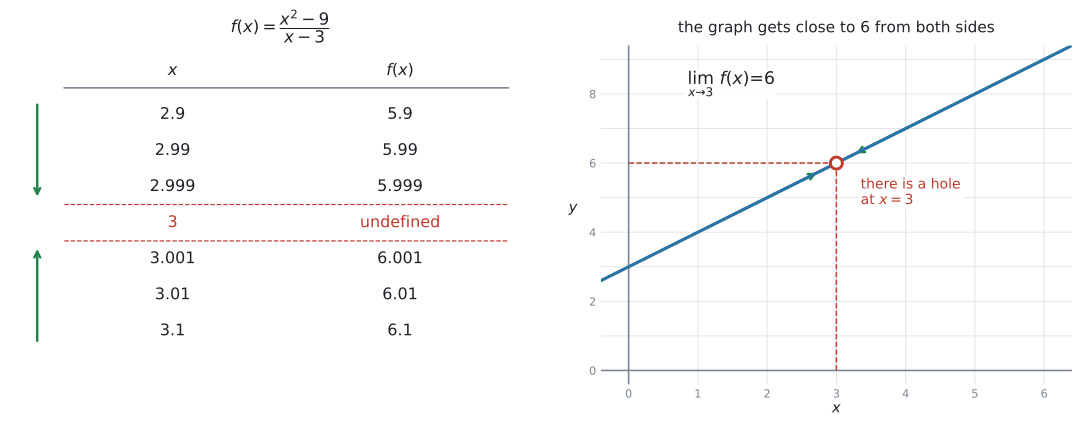
左の表を見てください。\(x\) を上からも下からも \(3\) に近づけると、\(f(x)\) はどちらからも \(6\) に近づいています。 これを、次のように書きます。
\[ \lim_{x \to 3} f(x) = 6 \tag{1}\]
読み方は「リミット、\(x\) が \(3\) に近づくときの \(f(x)\)」です。\(x \to 3\) は「\(x\) が \(3\) に近づく」という意味で、「\(x\) が \(3\) になる」ではありません。
- \(f(3)\) … \(x\) がちょうど \(3\) のときの値。この例では存在しません
- \(\lim\limits_{x \to 3} f(x)\) … \(x\) が \(3\) に近づいた先の値。この例では \(6\)
グラフの \(x = 3\) のところに穴(hole)があいているのが、この違いです。穴はあいているのに、行き先は決まっています。
\(x = 3.1, 3.01, 3.001\) だけでは足りません。\(x = 2.9, 2.99, 2.999\) の側も書いてください。
両側から同じ値に近づいて、はじめて極限が決まります。試験でも、表は両側ぶん与えられます。
AI SL では、極限を式で計算する方法は求められません(日本の数学 III のような極限の計算は出てきません)。表やグラフから極限の値を見積もれれば十分です。
例題 1 The function \(f\) is given by \(f(x) = \dfrac{x^{2}-9}{x-3}\). The graph of \(f\) is shown below.
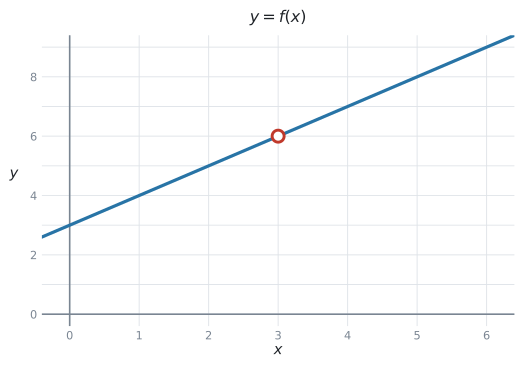
(a) Explain why \(f(3)\) does not exist.
(b) Complete the table below, giving each value correct to three decimal places.
| \(x\) | \(2.9\) | \(2.99\) | \(2.999\) | \(3.001\) | \(3.01\) | \(3.1\) |
|---|---|---|---|---|---|---|
| \(f(x)\) |
(c) Hence write down the value of \(\displaystyle\lim_{x \to 3} f(x)\).
日本語訳
関数 \(f\) が \(f(x) = \dfrac{x^{2}-9}{x-3}\) で与えられています。
(a) \(f(3)\) が存在しない理由を説明しなさい。
(b) 下の表を、それぞれ小数第3位まで求めて完成させなさい。
(c) これを使って、\(\displaystyle\lim_{x \to 3} f(x)\) の値を書きなさい。
(a) Explain why なので、理由を一文で書きます。
\(x = 3\) を入れると、分母が \(3 - 3 = 0\) になります。\(0\) で割ることはできません。
(b) \(x\) の値を \(1\) つずつ入れます(GDCの使い方)。電卓に \(\dfrac{x^{2}-9}{x-3}\) を打ち込んで、\(x\) を変えていくだけです。
| \(x\) | \(2.9\) | \(2.99\) | \(2.999\) | \(3.001\) | \(3.01\) | \(3.1\) |
|---|---|---|---|---|---|---|
| \(f(x)\) | \(5.900\) | \(5.990\) | \(5.999\) | \(6.001\) | \(6.010\) | \(6.100\) |
(c) 表の値は、左からも右からも \(6\) に近づいています。
\[ \lim_{x \to 3} f(x) = 6 \]
(a) で「存在しない」と答えたのに、(c) で \(6\) と答える — 矛盾しているように見えるかもしれません。
ですが、この \(2\) つは別のものです。\(x = 3\) そのものでは値がなく、\(x = 3\) に近づいた先では \(6\) です。
グラフでいえば、穴があいているだけです。
(a) When \(x = 3\) the denominator is \(3 - 3 = 0\), and division by zero is not possible, so \(f(3)\) does not exist.
(b) \(5.900\), \(5.990\), \(5.999\), \(6.001\), \(6.010\), \(6.100\)
(c) \(\displaystyle\lim_{x \to 3} f(x) = 6\)
2. The gradient of a curve(曲線の傾きは弦の傾きの極限)
直線の傾きは、SL 2.1 で習ったとおり「たての変化 \(\div\) よこの変化」で出せます。では、曲線の傾きはどうやって決めるのでしょうか。
曲線は、場所によって傾きが違います。ですから「曲線の傾き」ではなく、「曲線上のある点での傾き」を考えます。
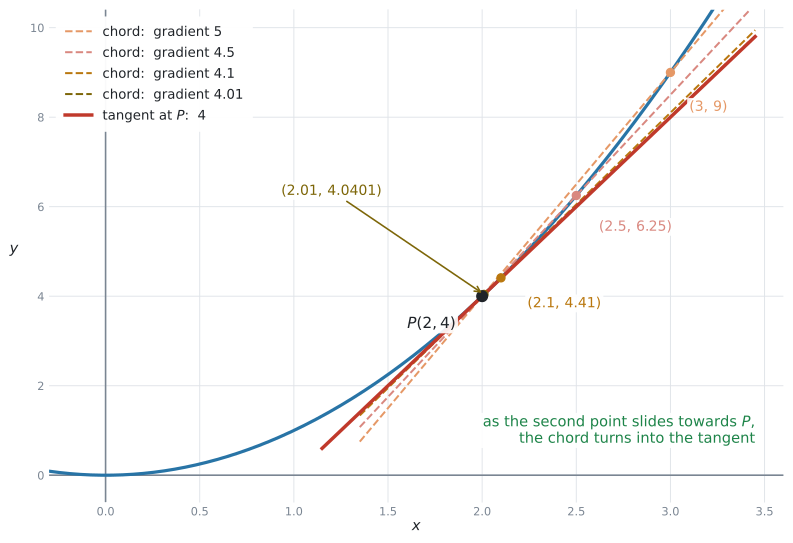
\(y = x^{2}\) の上の点 \(P(2, 4)\) で考えます。\(P\) ともう \(1\) つの点を結んだ直線を chord(弦)といいます。弦の傾きなら、\(2\) 点があるので計算できます。
| もう1つの点 | 弦の傾き |
|---|---|
| \((3, \ 9)\) | \(\dfrac{9-4}{3-2} = 5\) |
| \((2.5, \ 6.25)\) | \(\dfrac{6.25-4}{2.5-2} = 4.5\) |
| \((2.1, \ 4.41)\) | \(\dfrac{4.41-4}{2.1-2} = 4.1\) |
| \((2.01, \ 4.0401)\) | \(\dfrac{4.0401-4}{2.01-2} = 4.01\) |
もう \(1\) つの点を \(P\) に近づけていくと、弦の傾きは \(5 \to 4.5 \to 4.1 \to 4.01 \to \cdots\) と、\(4\) に近づきます。
このとき、弦は tangent(接線)に近づいていきます。だから、
\(P\) での曲線の傾き \(=\) 接線の傾き \(=\) 弦の傾きの極限 \(= 4\)
点が \(1\) つしかないと、傾きの式 \(\dfrac{y_{2}-y_{1}}{x_{2}-x_{1}}\) は \(\dfrac{0}{0}\) になってしまいます。
そこで、いったん \(2\) 点で計算しておいて、あとから近づけるという方法を使います。これが微分の出発点です。
例題 2 The point \(P\) lies on the curve \(y = x^{2}\) and has coordinates \((2, 4)\). The point \(Q\) also lies on the curve.
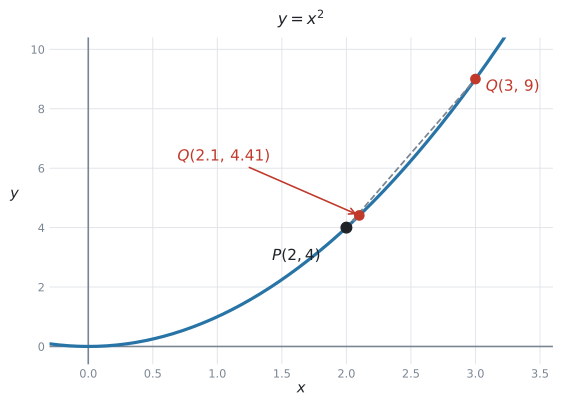
(a) Find the gradient of the chord \(PQ\) when \(Q\) is the point \((3, 9)\).
(b) Find the gradient of the chord \(PQ\) when \(Q\) is the point \((2.1, 4.41)\).
(c) The table shows the gradient of \(PQ\) for several positions of \(Q\).
| \(x\)-coordinate of \(Q\) | \(3\) | \(2.5\) | \(2.1\) | \(2.01\) | \(2.001\) |
|---|---|---|---|---|---|
| gradient of \(PQ\) | \(5\) | \(4.5\) | \(4.1\) | \(4.01\) | \(4.001\) |
Write down the gradient of the curve at \(P\).
日本語訳
点 \(P\) は曲線 \(y = x^{2}\) 上にあり、座標は \((2,4)\) です。点 \(Q\) もこの曲線上にあります。
(a) \(Q\) が点 \((3, 9)\) のときの、弦 \(PQ\) の傾きを求めなさい。
(b) \(Q\) が点 \((2.1, 4.41)\) のときの、弦 \(PQ\) の傾きを求めなさい。
(c) 表は、\(Q\) をいくつかの位置に取ったときの \(PQ\) の傾きです。見出しの \(x\)-coordinate of \(Q\) は「\(Q\) の \(x\) 座標」です。\(P\)における曲線の傾きを書きなさい。
(a)(b) 弦は \(2\) 点を結んだ直線なので、SL 2.1 の傾きの式が使えます。
\[ \text{(a)} \quad m = \frac{9 - 4}{3 - 2} = \frac{5}{1} = 5 \]
\[ \text{(b)} \quad m = \frac{4.41 - 4}{2.1 - 2} = \frac{0.41}{0.1} = 4.1 \]
(c) 表の傾きは \(5 \to 4.5 \to 4.1 \to 4.01 \to 4.001\) と、\(4\) に近づいています。
\(Q\) が \(P\) に近づくと弦は接線に近づくので、\(P\) での曲線の傾きは \(4\) です。
表の最後の値が答えではありません。答えは、その先にある行き先です。
\(5, 4.5, 4.1, 4.01, 4.001, \ldots\) と続いていったら、どこに着くか — それが \(4\) です。
(a) \(m = \dfrac{9-4}{3-2} = 5\)
(b) \(m = \dfrac{4.41-4}{2.1-2} = 4.1\)
(c) The gradient of the curve at \(P\) is \(4\).
3. The derivative as a gradient function(導関数は「傾きの関数」)
いまは \(P(2,4)\) という \(1\) 点で考えましたが、曲線のどの点でも同じことができます。
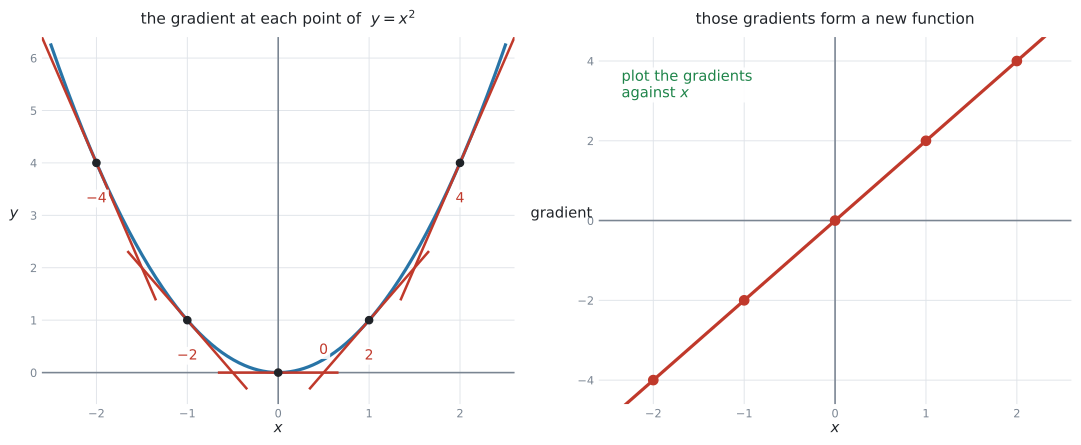
図 5 の左は \(y = x^{2}\) の各点での傾き、右はその傾きを \(x\) に対してプロットしたグラフで、傾きが新しい関数になっています。
\(y = x^{2}\) でやってみると、こうなります。
| \(x\) | \(-2\) | \(-1\) | \(0\) | \(1\) | \(2\) |
|---|---|---|---|---|---|
| その点での傾き | \(-4\) | \(-2\) | \(0\) | \(2\) | \(4\) |
\(x\) を決めると、傾きが \(1\) つ決まります。これは関数です。 この新しい関数を、もとの関数の derivative(導関数)といいます。
表 2 を見ると、傾きはいつも \(x\) の \(2\) 倍になっています。つまり \(y = x^{2}\) の導関数は \(2x\) です。
上の \(2x\) は、表から見つけたものです。公式で計算したわけではありません。
\(f(x) = ax^{n}\) から \(f'(x)\) を出す公式は、SL 5.3 で習います。この項目では、導関数とは何なのかを分かることが目的です。
導関数の記号と読み方
導関数は、次のような記号で表します。どれも同じ「導関数」ですが、文字が変わると、何の変化率なのかが変わります。
| 記号 | 読み方 | 意味 |
|---|---|---|
| \(f'(x)\) | エフ・ダッシュ・エックス(英語では f prime x) |
\(f(x)\) の導関数 |
| \(\dfrac{dy}{dx}\) | ディー・ワイ・ディー・エックス | \(x\) が変わったときの \(y\) の変化率 |
| \(\dfrac{dV}{dr}\) | ディー・ブイ・ディー・アール | \(r\) が変わったときの \(V\) の変化率 |
| \(\dfrac{ds}{dt}\) | ディー・エス・ディー・ティー | \(t\) が変わったときの \(s\) の変化率 |
AI SL では、ふつうの分数のように約分せず、全体を \(1\) つの変化率の記号として扱います。
下が「何で割ったか」、上が「何が変わったか」と読んでください。\(\dfrac{dV}{dr}\) なら「\(r\) が変わったときの \(V\)」です。
4. The derivative as a rate of change(導関数は「変化率」)
AI で一番よく出るのは、導関数(derivative)を傾きとしてではなく、変化率として読み解くことです。
\(\dfrac{ds}{dt}\) で、\(s\) が距離(m)、\(t\) が時間(秒)だとします。すると \(\dfrac{ds}{dt}\) は「\(1\) 秒あたり何 m 進むか」、つまり速さです。
単位は、記号を見れば決まります
\(\dfrac{ds}{dt}\) の単位は、\(s\) の単位 \(\div\) \(t\) の単位です。記号の形がそのまま単位の形になっています。
| 記号 | \(s\)、\(t\) などの単位 | 導関数の単位 | 意味 |
|---|---|---|---|
| \(\dfrac{ds}{dt}\) | m、秒 | m/秒 | 速さ |
| \(\dfrac{dT}{dt}\) | \(^\circ\)C、分 | \(^\circ\)C/分 | 温度の変わる速さ |
| \(\dfrac{dV}{dr}\) | cm\(^3\)、cm | cm\(^2\) | 半径を増やしたときの体積の増え方 |
| \(\dfrac{dC}{dn}\) | ドル、個 | ドル/個 | \(1\) 個増やしたときの費用の増え方 |
| \(\dfrac{dP}{dt}\) | 人、年 | 人/年 | 人口の増える速さ |
State the units of dV/dr. のような設問では、\(V\) の単位を \(r\) の単位で割ります。
\(\dfrac{\text{cm}^{3}}{\text{cm}} = \text{cm}^{2}\) です。ここで止まらずに、\(\text{cm}^2\) まで直してください。
符号と大きさの読み方
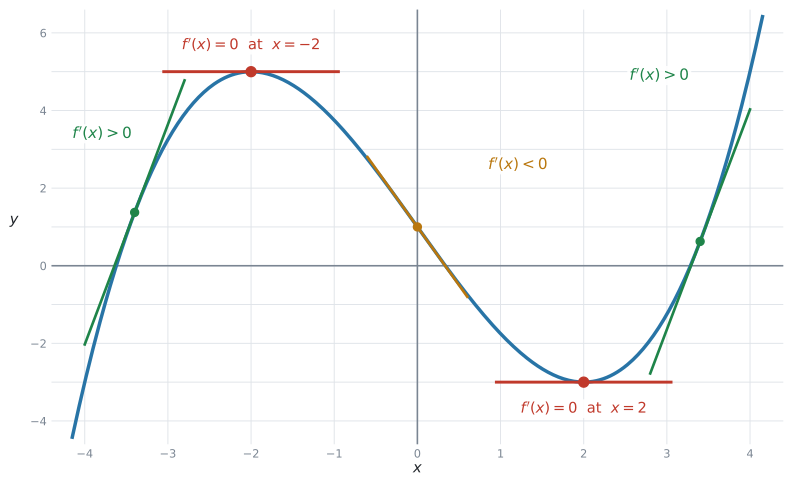
- \(f'(x) > 0\) … 増えている(グラフは右上がり)
- \(f'(x) = 0\) … その瞬間は増えも減りもしていない(グラフは水平)
- \(f'(x) < 0\) … 減っている(グラフは右下がり)
大きさも意味を持ちます。\(\dfrac{dT}{dt} = -5\) と \(\dfrac{dT}{dt} = -1\) なら、前者のほうが速く冷えています。
(この見方は、SL 5.2 でくわしく扱います。)
例題 3 (a) A sphere has volume \(V\) cm\(^3\) and radius \(r\) cm. Write down what \(\dfrac{dV}{dr}\) represents, and state its units.
(b) A car has travelled \(s\) metres after \(t\) seconds. When \(t = 10\), \(\dfrac{ds}{dt} = 18\). Interpret this value in the context of the question.
日本語訳
(a) 球の体積が \(V\) cm\(^3\)、半径が \(r\) cm です。\(\dfrac{dV}{dr}\) が何を表すかを書き、その単位を答えなさい。
(b) 車は \(t\) 秒後に \(s\) m 進んでいます。\(t = 10\) のとき \(\dfrac{ds}{dt} = 18\) です。この値を問題の文脈で解釈しなさい。
(a) 記号の下が「何で割ったか」、上が「何が変わったか」です。\(\dfrac{dV}{dr}\) は、半径が変わったときの体積の変化率です。
単位は \(V\) の単位を \(r\) の単位で割ります。
\[ \frac{\text{cm}^{3}}{\text{cm}} = \text{cm}^{2} \]
試験ではこう書く
\(\dfrac{dV}{dr}\) is the rate of change of the volume with respect to the radius.
The units are cm\(^2\).
(b) Interpret なので、数値をそのまま言いかえるのではなく、場面の言葉で書きます。
\(\dfrac{ds}{dt}\) は距離を時間で割ったものなので、速さです。単位は m/秒です。
試験ではこう書く
After \(10\) seconds, the car is travelling at \(18\) metres per second.
(\(10\) 秒後、車は毎秒 \(18\) m の速さで走っています。)
Interpret の答えには、必ず \(3\) つを入れてください
- いつ(\(t = 10\) のとき、\(10\) 秒後に)
- 何が(車の進む速さが)
- どれだけ(\(18\) m/秒)
「\(18\) です」だけでは点になりません。\(3\) つそろって \(1\) 文です。
(a) \(\dfrac{dV}{dr}\) is the rate of change of the volume with respect to the radius.
Units: cm\(^2\)
(b) After \(10\) seconds, the car is travelling at \(18\) metres per second.
例題 4 The diagram shows the graph of a function \(f\).
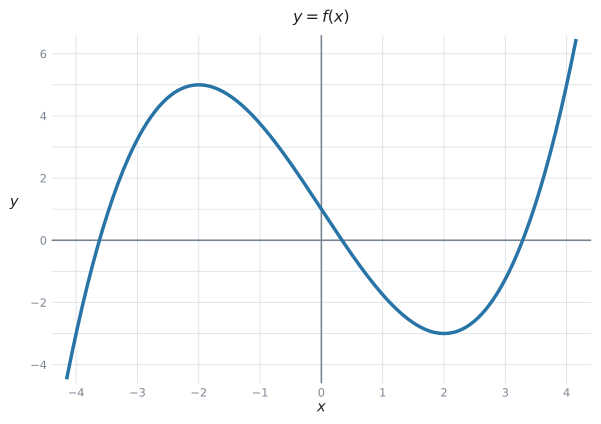
(a) Write down the two values of \(x\) for which \(f'(x) = 0\).
(b) State whether \(f'(0)\) is positive or negative, giving a reason.
(c) State whether \(f'(3)\) is positive or negative, giving a reason.
日本語訳
図は関数 \(f\) のグラフです。
(a) \(f'(x) = 0\) となる \(x\) の値を \(2\) つ書きなさい。
(b) \(f'(0)\) が正か負かを、理由を付けて書きなさい。
(c) \(f'(3)\) が正か負かを、理由を付けて書きなさい。
同じ形のグラフが 図 6 にもあります。そちらには、答えの見方が書き込んであります。
(a) \(f'(x) = 0\) は、接線が水平になっているところです。図 7 では、盛り上がったところのいちばん上(ピーク)と、くぼんだところの底の \(2\) か所で、\(x\) の値は \(-2\) と \(2\) です。目盛りの上にちょうど乗っているので、読み取るだけで済みます。
(b) \(x = 0\) のあたりで、グラフは右下がりです。
試験ではこう書く
Negative, because the graph is decreasing at \(x = 0\).
(c) \(x = 3\) のあたりでは、グラフは右上がりです。
試験ではこう書く
Positive, because the graph is increasing at \(x = 3\).
giving a reason は「増えているか減っているか」で足ります
むずかしい理由は要りません。increasing か decreasing のどちらかを書けば十分です。
the gradient of the tangent is negative でも構いません。
(a) \(x = -2\) and \(x = 2\)
(b) Negative, because the graph is decreasing at \(x = 0\).
(c) Positive, because the graph is increasing at \(x = 3\).
5. Estimating a rate of change(表から変化率を見積もる)
試験でよく出る形です。関数の式は与えられず、表だけが与えられます。
やり方は第2節と同じで、弦の傾きを計算します。
\[ \text{変化率の見積もり} = \frac{y \text{ の変化}}{x \text{ の変化}} \tag{2}\]
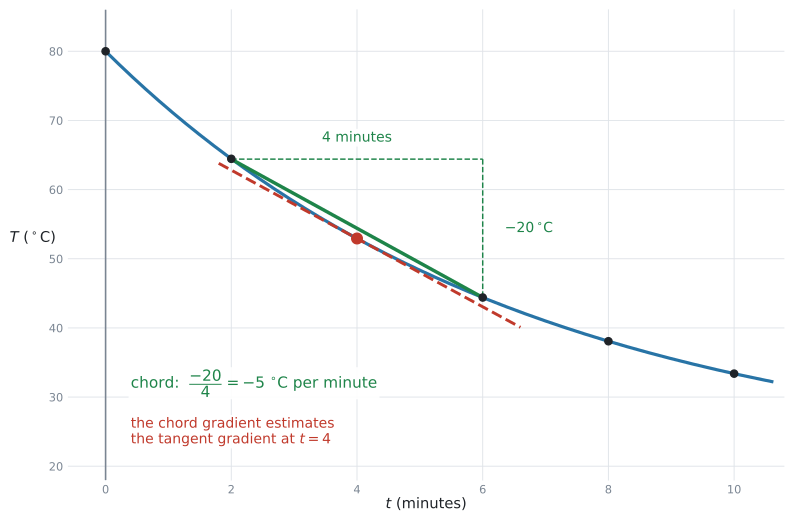
\(t = 4\) での変化率を知りたいとき、\(t = 4\) と \(t = 6\) の \(2\) 点よりも、\(t = 2\) と \(t = 6\) の \(2\) 点のほうが良い見積もりになります。
知りたい点がまん中に来るように選ぶ、と覚えてください。図 8 の緑の弦が、赤い接線とほぼ平行になっているのが分かります。
弦の傾きは、接線の傾きとぴったり同じではありません。 ですから答えを書くときは、estimate(見積もり)だと分かる言い方にしてください。
Estimate the rate of change と聞かれているときは、それで正解です。ぴったりの値を出そうとしなくて構いません。
例題 5 A cup of coffee is left to cool. Its temperature \(T\ ^\circ\)C is measured every two minutes, where \(t\) is the time in minutes.
| \(t\) (minutes) | \(0\) | \(2\) | \(4\) | \(6\) | \(8\) | \(10\) |
|---|---|---|---|---|---|---|
| \(T\) (\(^\circ\)C) | \(80.0\) | \(64.4\) | \(52.9\) | \(44.4\) | \(38.1\) | \(33.4\) |
(a) Use the values at \(t = 2\) and \(t = 6\) to estimate \(\dfrac{dT}{dt}\) when \(t = 4\).
(b) State the units of \(\dfrac{dT}{dt}\).
(c) Interpret your answer to part (a) in the context of the question.
(d) Explain why your answer to part (a) is only an estimate.
日本語訳
コーヒーを放置して冷まします。温度 \(T\ ^\circ\)C を \(2\) 分ごとに測ります。\(t\) は分単位の時間です。
(a) \(t = 2\) と \(t = 6\) の値を使って、\(t = 4\) のときの \(\dfrac{dT}{dt}\) を見積もりなさい。
(b) \(\dfrac{dT}{dt}\) の単位を書きなさい。
(c) (a) の答えを、問題の文脈で解釈しなさい。
(d) (a) の答えが見積もりにすぎない理由を説明しなさい。
(a) 弦の傾きを計算します。図 8 が、この問題の表をグラフにしたものです。\(t = 2\) のとき \(T = 64.4\)、\(t = 6\) のとき \(T = 44.4\) です。
\[ \frac{dT}{dt} \approx \frac{44.4 - 64.4}{6 - 2} = \frac{-20}{4} = -5 \]
答えは \(-5\) です。 マイナスを落とさないでください。冷めているので、温度は減っています。
(b) \(T\) の単位 \(\div\) \(t\) の単位なので、\(^\circ\)C per minute(\(^\circ\)C/分)です。
(c) Interpret なので、場面の言葉で書きます。
試験ではこう書く
After \(4\) minutes, the temperature of the coffee is falling at about \(5\ ^\circ\)C per minute.
(\(4\) 分後、コーヒーの温度は \(1\) 分あたり約 \(5\ ^\circ\)C の速さで下がっています。)
(d)
試験ではこう書く
The calculation gives the gradient of the chord between \(t = 2\) and \(t = 6\), not the gradient of the tangent at \(t = 4\).
The two are close but not equal.
(この計算は \(t = 2\) から \(t = 6\) までの弦の傾きであって、\(t = 4\) での接線の傾きではありません。\(2\) つは近いですが、等しくはありません。)
falling や decreasing を落とさないでください
「\(-5\ ^\circ\)C per minute です」とだけ書くと、マイナスの意味を説明していません。
英語では、次のどちらかの形にします。
- falling at \(5\ ^\circ\)C per minute(\(5\) の速さで下がっている)
- changing at \(-5\ ^\circ\)C per minute(\(-5\) の割合で変化している)
falling と書いたら、数はプラスの \(5\) にします。 両方マイナスにすると、二重否定になってしまいます。
(a) \(\dfrac{dT}{dt} \approx \dfrac{44.4 - 64.4}{6 - 2} = -5\)
(b) \(^\circ\)C per minute
(c) After \(4\) minutes, the temperature of the coffee is falling at about \(5\ ^\circ\)C per minute.
(d) The calculation gives the gradient of the chord between \(t = 2\) and \(t = 6\), not the gradient of the tangent at \(t = 4\). The two are close but not equal.
Why it works
なぜ「弦の傾きを近づける」というやり方で、接線の傾きが決まるのかを説明します。
曲線を、どんどん拡大していくところを想像してください。
\(y = x^{2}\) のグラフを、点 \((2,4)\) のまわりで拡大していくと、だんだんまっすぐに見えてきます。 さらに拡大すると、目で見るかぎり直線と区別がつかなくなります。
その「まっすぐに見えている直線」が、接線です。
弦は、\(2\) 点を結んだ直線です。\(2\) 点が近づくほど、その \(2\) 点のあいだの曲線は「まっすぐな部分」に近づきます。だから、弦は接線に近づいていきます。
これが、「傾き \(=\) 弦の傾きの極限」の意味です。極限という言葉が要るのは、\(2\) 点をぴったり重ねてしまうと傾きが計算できなくなるからです。重ねずに、いくらでも近づける。その行き先を見る、というのが極限の考え方です。
Common errors
「\(x\) が \(a\) に近づく」と「\(x\) が \(a\) になる」は違います。
\(f(a)\) が存在しなくても、極限は存在することがあります。むしろ、そういう場面でこそ極限を使います。
表を作ったとき、\(x = a\) の行は空欄(または undefined)になります。それでも上下の行から行き先は読めます。
\(5, 4.5, 4.1, 4.01, 4.001\) を見て「\(4.001\)」と書いてしまう誤りです。
答えは、その先にある行き先です。\(4\) です。
見分け方は、近づいていく先がきれいな数になっているかです。\(4.001\) のような数が答えになることは、まずありません。
AI SL では、\(dy\) と \(dx\) に分けたり約分したりはしません。全体で \(1\) つの変化率の記号として扱います。
\(\dfrac{dV}{dr}\) の \(d\) を約分して \(\dfrac{V}{r}\) にする、という誤りを見ることがあります。まったく別のものです。
減っている場面では、導関数は負になります。\(\dfrac{44.4 - 64.4}{4}\) の分子は \(-20\) です。
引き算の順番にも気をつけてください。あとの値 \(-\) 前の値です。\(\dfrac{64.4 - 44.4}{4} = +5\) としてしまうと、符号が逆になります。
Interpret の答えに、単位や文脈を書かない
「\(-5\) です」では点になりません。いつ・何が・どれだけの \(3\) つが要ります。
After \(4\) minutes, the temperature is falling at about \(5\ ^\circ\)C per minute.
この形を、そのまま覚えてしまうのが早いです。
\(\dfrac{dV}{dr}\) の単位を cm\(^3\) と書いてしまう誤りです。
割り算をしてください。 \(\dfrac{\text{cm}^{3}}{\text{cm}} = \text{cm}^{2}\) です。
\(\dfrac{ds}{dt}\) なら m ではなく m/秒、\(\dfrac{dC}{dn}\) ならドルではなく ドル/個です。
\(t = 4\) での変化率を、\(t = 4\) と \(t = 6\) だけで出すと、少しずれます。
知りたい点をはさむように選んでください。 \(t = 2\) と \(t = 6\) のほうが良い見積もりになります。
ただし、問題文がどの \(2\) 点を使うか指定していたら、それに従ってください。
\(y = x^{2}\) だから \(\dfrac{dy}{dx} = 2x\)、と書きたくなるかもしれません。
SL 5.1 の問題では、それは求められていません。 表やグラフから読み取るように指示されています。
指示が Use the table や From the graph なら、そのとおりにしてください。 公式で出した答えは、指示に従っていないぶん点を落とします。
Using your GDC (TI-Nspire CX II)
この項目では、電卓は表を作る道具として使います。
1. Making a table(関数を入れて表を出す)
Graphs ページで \(f1(x)\) に式を入れてから、表に切り替えます。
ctrl + Tこれで画面がグラフと表の2分割になります。
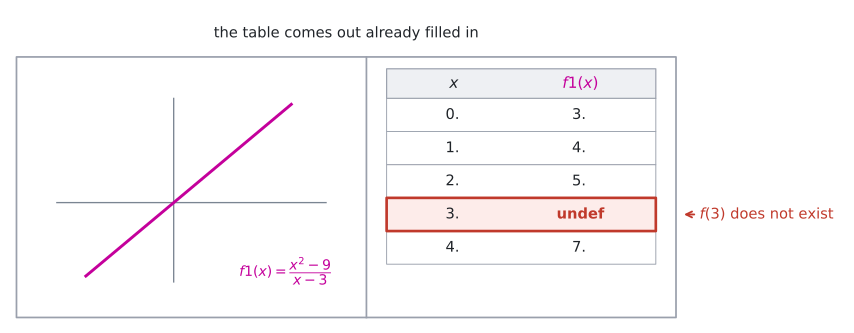
ctrl + T を押したあとの2分割の画面
表は、はじめから埋まった状態で出てきます。 空の表が出て自分で打ち込む、のではありません。\(x\) は \(0\)、\(1\)、\(2\)、\(3\)、\(4\) … と \(1\) きざみで、\(f(x)\) の値もすでに計算されています。
\(x = 3\) の行を見てください。 \(f(x)\) のところが undef(undefined)になっています。これが、例題 1 の (a) で答える「\(f(3)\) は存在しない」です。電卓も同じことを言っています。
\(x\) を自分で決めたいときは
極限の表は \(2.9\)、\(2.99\)、\(2.999\) と刻みが等間隔ではありません。 出てきたままの表では作れないので、設定を変えます。
menu → Table → Edit Table SettingsIndependent を Ask にすると、\(x\) の列が空になります。あとは \(2.9\)、\(2.99\)、\(2.999\) … と \(1\) つずつ打ち込めば、右の列に \(f(x)\) が出ます。図 1 の表が、そのまま画面にできあがります。
Auto のまま刻みを変えます
同じ画面の Table Start に始まりの値、Table Step に刻み幅を入れます。
\(2.9\) から \(0.01\) きざみ、のような表ならこちらが速いです。\(0.1 \to 0.01 \to 0.001\) と刻みを変えていく極限の表は、Ask のほうが確実です。
2. Zooming in(グラフを拡大して、まっすぐになるのを見る)
Why it works で書いた「拡大するとまっすぐに見える」は、電卓で確かめられます。
Graphs ページで \(y = x^{2}\) をかいて、点 \((2,4)\) のあたりを何度も拡大してください。
menu → Window/Zoom → Zoom - In曲線が直線に見えてきます。 これが接線です。
3. The gradient of a chord(弦の傾きは計算ページで1行)
\(\dfrac{4.41 - 4}{2.1 - 2}\) のような計算は、分数のテンプレート(ctrl + \(\div\))に入れて \(1\) 行で出します。
\(0.41\) や \(0.1\) を先に書き出して打ち直さないでください。
4. Derivative at a point(ある点での傾きを直接出す)
参考までに、TI-Nspire にはある点での導関数の値を出す機能があります。
menu → Calculus → Derivative at a Point微分のテンプレートが出るので、画面に出てくる形のまま入れます。
\[ \left. \frac{d}{dx}\left(x^{2}\right) \right|_{x=2} \]
\(4\) と返ります。
Exercises
1 The function \(f\) is given by \(f(x) = \dfrac{x^{2}-4}{x-2}\). The table shows some values of \(f(x)\).
| \(x\) | \(1.9\) | \(1.99\) | \(2.01\) | \(2.1\) |
|---|---|---|---|---|
| \(f(x)\) | \(3.9\) | \(3.99\) | \(4.01\) | \(4.1\) |
(a) Explain why \(f(2)\) does not exist.
(b) Write down the value of \(\displaystyle\lim_{x \to 2} f(x)\).
日本語訳
関数 \(f\) が \(f(x) = \dfrac{x^{2}-4}{x-2}\) で与えられています。表は \(f(x)\) のいくつかの値です。
(a) \(f(2)\) が存在しない理由を説明しなさい。
(b) \(\displaystyle\lim_{x \to 2} f(x)\) の値を書きなさい。
(a) When \(x = 2\) the denominator is \(2 - 2 = 0\), and division by zero is not possible, so \(f(2)\) does not exist.
(b) \(\displaystyle\lim_{x \to 2} f(x) = 4\)
(b) は表の両側を見ます。左からは \(3.9 \to 3.99\)、右からは \(4.01 \to 4.1\)。どちらも \(4\) に近づいています。
\(4.01\) や \(3.99\) と書かないでください。答えは行き先です。
2 The point \(P(3, 9)\) lies on the curve \(y = x^{2}\).
(a) Find the gradient of the chord joining \(P\) to the point \((4, 16)\).
(b) Find the gradient of the chord joining \(P\) to the point \((3.1, 9.61)\).
(c) The gradients of the chords from \(P\) are \(7\), \(6.5\), \(6.1\), \(6.01\), \(6.001\). Write down the gradient of the curve at \(P\).
日本語訳
点 \(P(3,9)\) は曲線 \(y = x^{2}\) 上にあります。
(a) \(P\) と点 \((4,16)\) を結ぶ弦の傾きを求めなさい。
(b) \(P\) と点 \((3.1, 9.61)\) を結ぶ弦の傾きを求めなさい。
(c) \(P\) からの弦の傾きは \(7\)、\(6.5\)、\(6.1\)、\(6.01\)、\(6.001\) です。\(P\) における曲線の傾きを書きなさい。
(a) \(m = \dfrac{16-9}{4-3} = 7\)
(b) \(m = \dfrac{9.61-9}{3.1-3} = \dfrac{0.61}{0.1} = 6.1\)
(c) The gradient of the curve at \(P\) is \(6\).
(b) で \(\dfrac{0.61}{0.1}\) を「\(0.61\) を \(0.1\) で割る」と見てください。\(6.1\) です。\(0.061\) としないよう気をつけてください。
(c) \(7, 6.5, 6.1, 6.01, 6.001, \ldots\) の行き先は \(6\) です。
(SL 5.3 で公式を習うと、\(y=x^2\) の傾きは \(2x\) で、\(x=3\) なら \(6\) だと \(1\) 行で出せるようになります。)
3 The cost of making \(n\) chairs is \(C\) dollars.
(a) Write down what \(\dfrac{dC}{dn}\) represents.
(b) State the units of \(\dfrac{dC}{dn}\).
日本語訳
\(n\) 脚のいすを作る費用が \(C\) ドルです。
(a) \(\dfrac{dC}{dn}\) が何を表すかを書きなさい。
(b) \(\dfrac{dC}{dn}\) の単位を書きなさい。
(a) \(\dfrac{dC}{dn}\) is the rate of change of the cost with respect to the number of chairs.
(b) dollars per chair
記号の読み方のとおりです。「\(n\) が変わったときの \(C\)」です。
意味としては「いすを \(1\) 脚多く作ると、費用がいくら増えるか」です。この言い方でも点になります。
単位は \(\dfrac{\text{dollars}}{\text{chairs}}\) なので dollars per chair です。dollars だけでは足りません。
4 For each of the following, write down the units of the derivative.
(a) \(\dfrac{ds}{dt}\), where \(s\) is in kilometres and \(t\) is in hours.
(b) \(\dfrac{dA}{dr}\), where \(A\) is in cm\(^2\) and \(r\) is in cm.
(c) \(\dfrac{dP}{dt}\), where \(P\) is a number of people and \(t\) is in years.
(d) \(\dfrac{dV}{dt}\), where \(V\) is in litres and \(t\) is in minutes.
日本語訳
次のそれぞれについて、導関数の単位を書きなさい。
(a) \(\dfrac{ds}{dt}\)。\(s\) は km、\(t\) は時間。
(b) \(\dfrac{dA}{dr}\)。\(A\) は cm\(^2\)、\(r\) は cm。
(c) \(\dfrac{dP}{dt}\)。\(P\) は人数、\(t\) は年。
(d) \(\dfrac{dV}{dt}\)。\(V\) はリットル、\(t\) は分。
(a) km per hour
(b) cm
(c) people per year
(d) litres per minute
どれも「上の単位 \(\div\) 下の単位」です。
(b) だけ注意してください。\(\dfrac{\text{cm}^{2}}{\text{cm}} = \text{cm}\) です。cm\(^2\) per cm と書いても間違いではありませんが、cm まで直すほうが良い答えです。
(a) は速さ、(c) は人口の増える速さ、(d) は水の入る速さです。
5 The number of bacteria in a dish, in thousands, is \(N\) after \(t\) hours.
| \(t\) (hours) | \(0\) | \(1\) | \(2\) | \(3\) | \(4\) | \(5\) |
|---|---|---|---|---|---|---|
| \(N\) (thousands) | \(5.0\) | \(8.0\) | \(12.8\) | \(20.5\) | \(32.8\) | \(52.4\) |
(a) Use the values at \(t = 2\) and \(t = 4\) to estimate \(\dfrac{dN}{dt}\) when \(t = 3\).
(b) State the units of \(\dfrac{dN}{dt}\).
(c) Interpret your answer to part (a) in the context of the question.
日本語訳
皿の中の細菌の数は、\(t\) 時間後に \(N\) 千個です。見出しの \(N\) (thousands) は「\(N\)(千個単位)」です。
(a) \(t = 2\) と \(t = 4\) の値を使って、\(t = 3\) のときの \(\dfrac{dN}{dt}\) を見積もりなさい。
(b) \(\dfrac{dN}{dt}\) の単位を書きなさい。
(c) (a) の答えを、問題の文脈で解釈しなさい。
(a) \(\dfrac{dN}{dt} \approx \dfrac{32.8 - 12.8}{4 - 2} = \dfrac{20}{2} = 10\)
(b) thousands of bacteria per hour
(c) After \(3\) hours, the number of bacteria is increasing at about \(10\,000\) per hour.
(a) 知りたいのは \(t=3\) で、使うのは \(t=2\) と \(t=4\)。知りたい点をはさんでいます ✓
(b) \(N\) が「千個」単位であることに注意してください。単なる per hour では足りません。
(c) \(10\) 千個 \(= 10\,000\) 個です。単位を直して書くほうが、意味が伝わります。
今回は増えているので、答えは正です。increasing を入れてください。
6 The graph of a function \(f\) is shown below.
(a) State whether \(f'(-3)\) is positive or negative, giving a reason.
(b) State whether \(f'(1)\) is positive or negative, giving a reason.
日本語訳
関数 \(f\) のグラフが上に示されています。
(a) \(f'(-3)\) が正か負かを、理由を付けて書きなさい。
(b) \(f'(1)\) が正か負かを、理由を付けて書きなさい。
(a) Positive, because the graph is increasing at \(x = -3\).
(b) Negative, because the graph is decreasing at \(x = 1\).
グラフの向きを見るだけです。
- 右上がり → \(f'(x) > 0\)
- 右下がり → \(f'(x) < 0\)
\(x = -3\) は左のはしのほうで、グラフは急に上がっています。\(x = 1\) は真ん中より右で、まだ下がっている途中です(\(x = 2\) で底になります)。
giving a reason なので、increasing / decreasing の一言を必ず添えてください。
7 A tank is being emptied. The volume of water in the tank is \(V\) litres after \(t\) minutes. When \(t = 8\), \(\dfrac{dV}{dt} = -12\).
(a) Interpret this value in the context of the question.
(b) Explain what it would mean if \(\dfrac{dV}{dt}\) were equal to \(0\).
日本語訳
タンクの水を抜いています。タンクの中の水の量は \(t\) 分後に \(V\) リットルです。\(t = 8\) のとき \(\dfrac{dV}{dt} = -12\) です。
(a) この値を、問題の文脈で解釈しなさい。
(b) \(\dfrac{dV}{dt}\) が \(0\) に等しいとしたら、それが何を意味するかを説明しなさい。
(a) After \(8\) minutes, the volume of water in the tank is decreasing at \(12\) litres per minute.
(b) The volume of water would not be changing at that moment, so no water would be entering or leaving the tank.
(a) は3つそろえます。いつ(after \(8\) minutes)、何が(the volume of water)、どれだけ(\(12\) litres per minute)。
decreasing at \(12\) と書いたら、数はプラスの \(12\) にします。decreasing at \(-12\) とは書きません。
(b) \(f'(x) = 0\) は「増えも減りもしていない」ということです。タンクの場面では「水の量が変わっていない」となります。
8 The function \(f\) is given by \(f(x) = \dfrac{x^{3}-1}{x-1}\). The table shows some values of \(f(x)\).
| \(x\) | \(0.9\) | \(0.99\) | \(1.01\) | \(1.1\) |
|---|---|---|---|---|
| \(f(x)\) | \(2.71\) | \(2.9701\) | \(3.0301\) | \(3.31\) |
Write down the value of \(\displaystyle\lim_{x \to 1} f(x)\).
日本語訳
関数 \(f\) が \(f(x) = \dfrac{x^{3}-1}{x-1}\) で与えられています。表は \(f(x)\) のいくつかの値です。\(\displaystyle\lim_{x \to 1} f(x)\) の値を書きなさい。
\(\displaystyle\lim_{x \to 1} f(x) = 3\)
左からは \(2.71 \to 2.9701\)、右からは \(3.0301 \to 3.31\)。どちらも \(3\) に近づいています。
\(2.9701\) や \(3.0301\) は、\(3\) にとても近い数です。その先の行き先が答えです。
\(x = 1\) では分母が \(0\) になるので、\(f(1)\) は存在しません。それでも極限は \(3\) です。
9 The point \(P(1, 1)\) lies on the curve \(y = x^{3}\). The table shows the gradient of the chord from \(P\) to a nearby point.
| \(x\)-coordinate of the other point | \(2\) | \(1.5\) | \(1.1\) | \(1.01\) | \(1.001\) |
|---|---|---|---|---|---|
| gradient of the chord | \(7\) | \(4.75\) | \(3.31\) | \(3.0301\) | \(3.003001\) |
(a) Write down the gradient of the curve at \(P\).
(b) Explain why the gradient of the chord is never exactly equal to the gradient of the curve at \(P\).
日本語訳
点 \(P(1,1)\) は曲線 \(y = x^{3}\) 上にあります。表は、\(P\) から近くの点への弦の傾きです。
(a) \(P\) における曲線の傾きを書きなさい。
(b) 弦の傾きが \(P\) における曲線の傾きとちょうど等しくなることはない理由を説明しなさい。
(a) The gradient of the curve at \(P\) is \(3\).
(b) A chord needs two different points on the curve. As the second point gets closer to \(P\) the gradient gets closer to \(3\), but the two points can never be the same point, so the gradient is never exactly \(3\).
(a) \(7, 4.75, 3.31, 3.0301, 3.003001, \ldots\) の行き先は \(3\) です。
(b) が、この項目の中心にある考え方です。\(2\) 点を重ねてしまうと、傾きの式が \(\dfrac{0}{0}\) になって計算できません。 だから重ねずに、いくらでも近づける。その行き先を見る — それが極限です。
「どこまでも近づくが、届かない」という言い方ができていれば十分です。
10 A ball rolls down a slope. The distance travelled is \(s\) metres after \(t\) seconds.
| \(t\) (seconds) | \(0\) | \(2\) | \(4\) | \(6\) | \(8\) |
|---|---|---|---|---|---|
| \(s\) (metres) | \(0\) | \(6\) | \(16\) | \(30\) | \(48\) |
(a) Use the values at \(t = 2\) and \(t = 6\) to estimate the speed of the ball when \(t = 4\).
(b) Find the gradient of the chord between \(t = 4\) and \(t = 6\).
(c) Explain which of your two answers is likely to be the better estimate of the speed at \(t = 4\).
日本語訳
ボールが斜面を転がります。進んだ距離は \(t\) 秒後に \(s\) m です。
(a) \(t = 2\) と \(t = 6\) の値を使って、\(t = 4\) のときのボールの速さを見積もりなさい。
(b) \(t = 4\) と \(t = 6\) のあいだの弦の傾きを求めなさい。
(c) \(2\) つの答えのうち、\(t = 4\) での速さの見積もりとしてどちらが良いと考えられるかを説明しなさい。
(a) \(\dfrac{ds}{dt} \approx \dfrac{30 - 6}{6 - 2} = \dfrac{24}{4} = 6\) m s\(^{-1}\)
(b) \(\dfrac{30 - 16}{6 - 4} = \dfrac{14}{2} = 7\) m s\(^{-1}\)
(c) The answer to part (a) is better, because \(t = 4\) is in the middle of the interval from \(t = 2\) to \(t = 6\). In part (b) the interval only lies on one side of \(t = 4\).
(a) と (b) で答えが違います(\(6\) と \(7\))。どちらも「見積もり」なので、違っていて構いません。
(c) が問いたいのは、知りたい点をはさんでいるかどうかです。
- (a) … \(t=2\) と \(t=6\) で、\(t=4\) をまん中にはさんでいます
- (b) … \(t=4\) と \(t=6\) で、\(t=4\) がはしにあります
はさんだほうが、行きすぎと足りなさが打ち消し合うので、良い見積もりになります。
検算:\(t=2\) から \(t=4\) の弦は \(\dfrac{16-6}{2} = 5\)、\(t=4\) から \(t=6\) は \(7\)。この \(2\) つの平均が \(6\) で、(a) と一致します ✓
11 The height of a plant is \(h\) cm, \(t\) days after it was planted.
| \(t\) (days) | \(0\) | \(5\) | \(10\) | \(15\) | \(20\) |
|---|---|---|---|---|---|
| \(h\) (cm) | \(2\) | \(9\) | \(21\) | \(34\) | \(41\) |
(a) Use the values at \(t = 5\) and \(t = 15\) to estimate \(\dfrac{dh}{dt}\) when \(t = 10\).
(b) State the units of \(\dfrac{dh}{dt}\).
(c) Interpret your answer to part (a) in the context of the question.
(d) Without further calculation, state whether \(\dfrac{dh}{dt}\) at \(t = 17\) is greater or smaller than your answer to part (a). Give a reason.
日本語訳
植物の高さは、植えてから \(t\) 日後に \(h\) cm です。
(a) \(t = 5\) と \(t = 15\) の値を使って、\(t = 10\) のときの \(\dfrac{dh}{dt}\) を見積もりなさい。
(b) \(\dfrac{dh}{dt}\) の単位を書きなさい。
(c) (a) の答えを、問題の文脈で解釈しなさい。
(d) これ以上計算せずに、\(t = 17\) での \(\dfrac{dh}{dt}\) が (a) の答えより大きいか小さいかを書きなさい。理由も書きなさい。
(a) \(\dfrac{dh}{dt} \approx \dfrac{34 - 9}{15 - 5} = \dfrac{25}{10} = 2.5\)
(b) cm per day
(c) After \(10\) days, the height of the plant is increasing at about \(2.5\) cm per day.
(d) Smaller. Between \(t = 15\) and \(t = 20\) the height only increases by \(7\) cm in \(5\) days, which is \(1.4\) cm per day, so the plant is growing more slowly than at \(t = 10\).
(a) \(t=10\) を \(t=5\) と \(t=15\) ではさんでいます ✓
(d) は Without further calculation とありますが、表を読むこと自体は計算ではありません。 \(5\) 日ごとの増え方を見てください。
| 期間 | \(0\to5\) | \(5\to10\) | \(10\to15\) | \(15\to20\) |
|---|---|---|---|---|
| 増えた高さ | \(7\) | \(12\) | \(13\) | \(7\) |
\(t = 15\) を過ぎたところで、増え方が急に落ちています。 だから \(t = 17\) での変化率は、\(t = 10\) のときより小さいです。
植物が伸びきって、成長がゆるやかになった、という場面です。表の数の並びから場面を読むのが、AI らしい問題です。