SL 5.8 — The trapezoidal rule(台形公式による面積の近似)
- 公式集の trapezoidal rule(台形公式)を、正しく読んで使える。
- \(n\) は「台形の数」であって、値の個数ではないと分かる(値は \(n+1\) 個)。
- \(h = \dfrac{b-a}{n}\) を求められる。
- 端の値は \(1\) 回、中の値は \(2\) 回足すと分かる。
- 関数がなくても、表の値だけで面積を見積もれる(湖・川など)。
- 式があっても、SL 5.5 では積分できない形のときに、この方法を使うと分かる。
- 答えが over-estimate(過大)か under-estimate(過小)かを、理由をつけて言える。
- \(n\) を増やすと近似がよくなることを説明できる。
The idea
1. Filling the area with trapezia(曲線の下を台形でうめる)
SL 5.5 で、曲線の下の面積を定積分で求めました。式があって、しかもその式が積分できるときは、それでよいのです。
では、そうでないときはどうするか。この項目の出番は2つです。
- 式がないとき … 表の値しかない場合です。湖や川の面積などがこれにあたります
- 式はあるが、積分できないとき … 式があっても、いつも積分できるとは限りません。 SL 5.5 で積分できるのは \(ax^{n}\)(\(n\) は整数、\(n \neq -1\))の形だけです。AI HL に進めばもっといろいろな式の積分が出てきますが、それでも、すべての式が積分できるわけではありません。
どちらの場合も、答えは estimate(見積もり)になります。
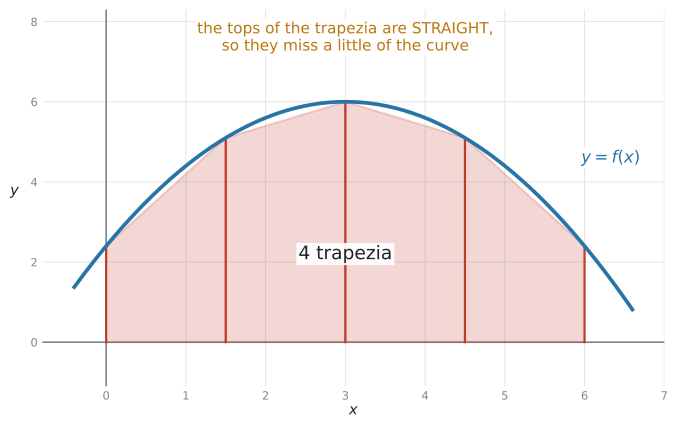
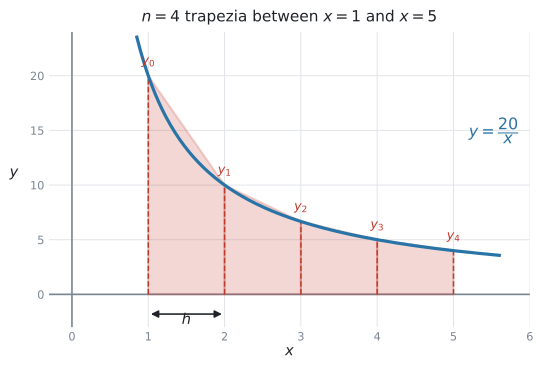
図 1 のように、面積を同じ幅の台形に切り分けて、それを全部足します。
台形の上の辺はまっすぐなので、曲線とのあいだにすき間ができます。だから答えは estimate(見積もり) です。
\[ \text{台形の面積} = \frac{1}{2}(\text{上底} + \text{下底}) \times \text{高さ} \]
公式集にもあります(Area of a trapezoid)。この項目の式は、これを全部足しただけです。
2. The trapezoidal rule(台形公式:端は \(1\) 回、中は \(2\) 回)
面積を台形で estimate するときに使うのが、この公式です。
\[ \int_{a}^{b} y\,dx \approx \frac{1}{2}h\Big(\left(y_{0} + y_{n}\right) + 2\left(y_{1} + y_{2} + \cdots + y_{n-1}\right)\Big) \tag{1}\]
\[ \text{where } \ h = \frac{b - a}{n} \tag{2}\]
この式は、公式集の SL 5.8 の欄にあります。式そのものは覚えなくて構いませんが、下の表の記号の意味は覚えていないと使えません。
| 記号 | 意味 |
|---|---|
| \(n\) | 台形の数(strips の数) |
| \(h\) | \(1\) つの台形の幅 |
| \(y_{0}\)、\(y_{n}\) | 両はしの値(\(1\) 回だけ足す) |
| \(y_{1} \ldots y_{n-1}\) | 中の値(\(2\) 倍して足す) |
条件が1つあります。幅は、全部同じ(intervals of equal width)でなければなりません。
そのうえで、公式のいちばん大事なところがここです。
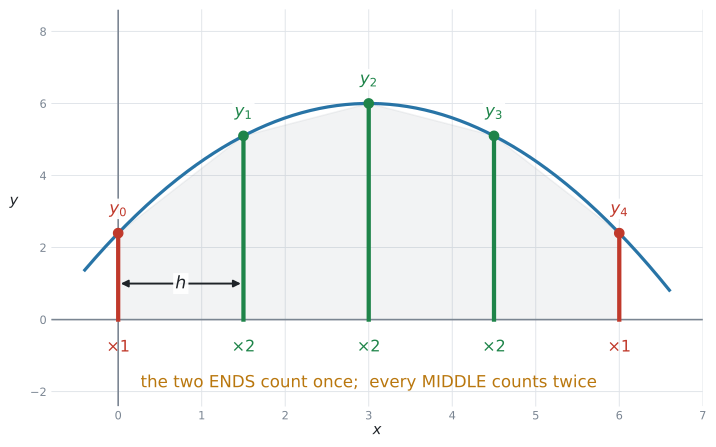
\[ \frac{1}{2}h\Big(\underbrace{\left(y_{0} + y_{n}\right)}_{\text{端:}1\text{回}} + \underbrace{2\left(y_{1} + \cdots + y_{n-1}\right)}_{\text{中:}2\text{回}}\Big) \]
なぜ中だけ \(2\) 倍なのか。 図 2 の \(y_{1}\) を見てください。この線は、左の台形の右辺であり、右の台形の左辺でもあります。\(2\) つの台形が共有しているので、\(2\) 回数えます。
いっぽう \(y_{0}\) と \(y_{4}\) は、いちばん外側なので \(1\) つの台形にしか属しません。
- \(h\) を求める(となり合う \(x\) の差。または \(\dfrac{b-a}{n}\))
- 両はしを足す
- 中を全部足して、\(2\) 倍する
- 合計に \(\dfrac{1}{2}h\) を掛ける
この \(4\) 行を、そのまま答案に書いてください。 途中で計算を間違えても、行があれば点が残ります。
3. The number of strips(\(n\) は台形の数)
\(n\) を「値の個数」とまちがえるのが、この項目で一番多い間違いです。
| 数 | |
|---|---|
| 台形(strips)の数 | \(n\) |
| \(y\) の値の数 | \(n + 1\) |
\(y_{0}, y_{1}, y_{2}, y_{3}, y_{4}\) という \(5\) つの値があるなら、台形は \(4\) つ。つまり \(n = 4\) です。
\(h = \dfrac{b-a}{n}\) の \(n\) を間違えると、\(h\) が変わって、答えが全部ずれます。
表を見たら、まず「点は何個か」→「台形はその \(1\) つ少ない」と数えてください。
\(0\) から \(8\) まで \(2\) おきに \(0, 2, 4, 6, 8\) なら、点は \(5\) 個、台形は \(4\) つ、\(h = 2\) です。
となり合う \(x\) の差を見るだけです。\(0, 5, 10, 15\) なら \(h = 5\)。
\(\dfrac{b-a}{n}\) を使うのは、「\(n = 4\) で見積もりなさい」のように \(n\) が指定されたときです。
4. Over-estimate or under-estimate(過大評価か、過小評価か)
台形公式の答えは見積もりなので、本当の面積とは少しずれます。答えが本当の面積より大きいか小さいかは、曲線の曲がり方で決まります。
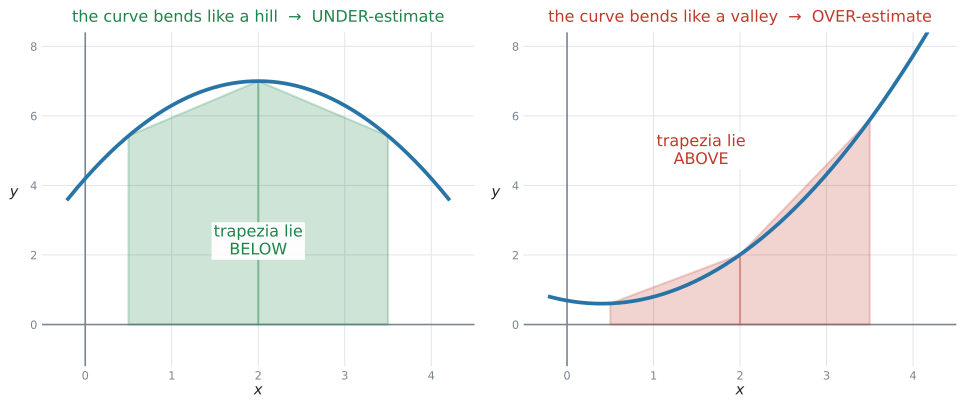
図 3 の左は上に凸の曲線(under-estimate)、右は下に凸の曲線(over-estimate)です。
| 曲線の形 | 台形は | 答えは |
|---|---|---|
| 上に凸(上にふくらむ形) | 曲線より下 | under-estimate(小さすぎる) |
| 下に凸(下にくぼむ形) | 曲線より上 | over-estimate(大きすぎる) |
これは、SL 1.6 の丸めによる upper bound / lower bound とは計算方法が違います。ここでは、台形の直線部分が曲線より上か下かで判断します。
Is this an over-estimate or an under-estimate? Give a reason. は、よく出る設問です。
試験ではこう書く
It is an over-estimate, because the curve bends upwards, so each straight top lies above the curve.
「グラフを見たから」では理由になりません。 台形の上の辺が曲線の上か下か、を書いてください。
全部の台形を考える必要はありません。曲線を1本と、そこに引いた弦(まっすぐな線)を1本かいてみてください。
弦が曲線の上にあれば過大、下にあれば過小です。
例題 1 Use the trapezoidal rule with \(n = 4\) to estimate the area enclosed by the curve \(y = x^{2}\), the \(x\)-axis, and the lines \(x = 0\) and \(x = 4\).
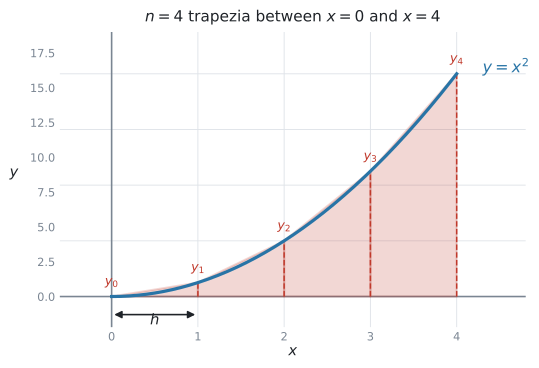
(a) Find the value of \(h\).
(b) Find the estimate.
(c) The exact area is \(21.3\) (3 s.f.). State whether the estimate is an over-estimate or an under-estimate, and give a reason.
日本語訳
\(n = 4\) の台形公式を使って、曲線 \(y = x^{2}\)、\(x\) 軸、直線 \(x = 0\)、\(x = 4\) で囲まれた面積を見積もりなさい。
(a) \(h\) の値を求めなさい。
(b) 見積もりの値を求めなさい。
(c) 正確な面積は \(21.3\)(有効数字 \(3\) 桁)です。この見積もりが過大評価か過小評価かを述べ、理由を書きなさい。
(a)
\[ h = \frac{b - a}{n} = \frac{4 - 0}{4} = 1 \]
(b) \(x = 0, 1, 2, 3, 4\) での \(y\) を出します。\(5\) つです。
| \(x\) | \(0\) | \(1\) | \(2\) | \(3\) | \(4\) |
|---|---|---|---|---|---|
| \(y = x^{2}\) | \(0\) | \(1\) | \(4\) | \(9\) | \(16\) |
\[ A \approx \frac{1}{2}(1)\Big[(0 + 16) + 2(1 + 4 + 9)\Big] \]
\[ = \frac{1}{2}\Big[16 + 2(14)\Big] = \frac{1}{2}\left[16 + 28\right] = \frac{44}{2} = 22 \]
(c) \(22 > 21.3\) なので過大評価です。理由は曲線の形。
試験ではこう書く
It is an over-estimate, because \(y = x^{2}\) bends upwards, so the straight top of each trapezium lies above the curve.
\(y\) の値を並べた表(または \(y_{0} = 0\)、\(y_{1} = 1\)、… と書いた行)が、最初の点です。
いきなり \(22\) と書くと、途中点がもらえません。
(a) \(h = \dfrac{4 - 0}{4} = 1\)
(b) \(y\)-values: \(0,\ 1,\ 4,\ 9,\ 16\)
\(A \approx \dfrac{1}{2}(1)\left[(0 + 16) + 2(1 + 4 + 9)\right] = \dfrac{1}{2}(44) = 22\)
(c) Over-estimate, because the curve bends upwards, so each straight top lies above the curve.
例題 2 Use the trapezoidal rule with \(n = 4\) to estimate \(\displaystyle\int_{1}^{5} \frac{20}{x}\,dx\), giving your answer correct to three significant figures.
日本語訳
\(n = 4\) の台形公式を使って \(\displaystyle\int_{1}^{5} \dfrac{20}{x}\,dx\) を見積もり、答えを有効数字 \(3\) 桁で書きなさい。
\(\dfrac{20}{x}\) は \(20x^{-1}\)、つまり \(n = -1\) です。SL 5.5 の公式では積分できません(\(n \neq -1\) という条件がありました)。式はあるのに積分できない、という2つ目の場合です。
\[ h = \frac{5 - 1}{4} = 1 \]
\(x = 1, 2, 3, 4, 5\) で値を出します。電卓を使ってかまいません。(GDCの使い方)
| \(x\) | \(1\) | \(2\) | \(3\) | \(4\) | \(5\) |
|---|---|---|---|---|---|
| \(y = \dfrac{20}{x}\) | \(20\) | \(10\) | \(6.667\) | \(5\) | \(4\) |
\[ A \approx \frac{1}{2}(1)\Big[(20 + 4) + 2(10 + 6.667 + 5)\Big] \]
\[ = \frac{1}{2}\Big[24 + 2(21.667)\Big] = \frac{1}{2}(67.333) = 33.7 \quad (3 \text{ s.f.}) \]
表には \(6.667\) と書きましたが、計算には \(\dfrac{20}{3}\) をそのまま使います。
\(6.67\) で計算すると、答えが \(33.7\) からずれることがあります。電卓の中の値を使って、最後に丸めてください。
\(x\) が大きくなるほど急に平らになる曲線で、下に凸(下にくぼむ形)です。
だから、この見積もりは過大評価です。実際の値は \(32.2\)(\(3\) 桁)で、\(33.7\) より小さくなっています。
\(h = 1\); \(y\)-values: \(20,\ 10,\ \dfrac{20}{3},\ 5,\ 4\)
\(A \approx \dfrac{1}{2}(1)\left[(20 + 4) + 2\left(10 + \dfrac{20}{3} + 5\right)\right] = 33.7\) (3 s.f.)
5. Data in a table(関数がなくても使える)
この公式のいちばんの値打ちは、式で表せない形(湖など)の面積も見積もれることです。
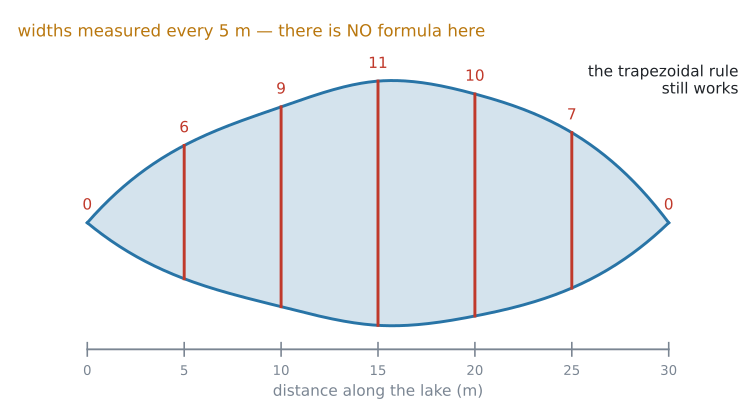
図 6 は、湖の幅を \(5\) m おきに測ったものです。湖の形を表す式は、ありません。 それでも、台形公式なら面積が見積もれます。
\[ A \approx \frac{1}{2}(5)\Big[(0 + 0) + 2(6 + 9 + 11 + 10 + 7)\Big] = 2.5 \times 86 = 215 \ \text{m}^{2} \]
関数に代入する必要はありません。表に並んでいる数を、順番に公式へ入れるだけです。
いちばん左といちばん右が \(y_{0}\) と \(y_{n}\)、あいだが全部「中」です。
例題 3 The width of a lake is measured every \(5\) metres along its length. The results are shown in the table.
| Distance (m) | \(0\) | \(5\) | \(10\) | \(15\) | \(20\) | \(25\) | \(30\) |
|---|---|---|---|---|---|---|---|
| Width (m) | \(0\) | \(6\) | \(9\) | \(11\) | \(10\) | \(7\) | \(0\) |
(a) Write down the value of \(h\) and the number of trapezia.
(b) Use the trapezoidal rule to estimate the area of the lake.
日本語訳
ある湖の幅を、長さ方向に \(5\) m おきに測りました。結果は表のとおりです。
(a) \(h\) の値と、台形の数を書きなさい。
(b) 台形公式を使って、湖の面積を見積もりなさい。
(a) となり合う距離の差が \(5\) なので \(h = 5\)。
値は \(7\) 個、だから台形は \(6\) つ。
\[ h = 5, \qquad n = 6 \]
(b) 両はしは \(0\) と \(0\)、中は \(6, 9, 11, 10, 7\)。
\[ A \approx \frac{1}{2}(5)\Big[(0 + 0) + 2(6 + 9 + 11 + 10 + 7)\Big] \]
\[ = 2.5\Big[0 + 2(43)\Big] = 2.5 \times 86 = 215 \ \text{m}^{2} \]
\((0 + 0)\) の行を省くと、式を正しく使ったことが伝わりません。
湖や川の問題では、両はしが \(0\) になるのがふつうです。\(0\) だからこそ、書いておくと安心です。
\(n\) は台形の数。\(7\) 個の点のあいだには、すき間が \(6\) つあります。
もし \(n = 7\) としてしまうと、\(h\) の計算まで狂います(この問題では \(h\) は表から読めるので気づきにくく、そのぶん危険です)。
(a) \(h = 5\), \(n = 6\)
(b) \(A \approx \dfrac{1}{2}(5)\left[(0 + 0) + 2(6 + 9 + 11 + 10 + 7)\right] = 2.5(86) = 215\ \text{m}^{2}\)
例題 4 The speed of a car, in metres per second, is recorded every \(2\) seconds.
| Time (s) | \(0\) | \(2\) | \(4\) | \(6\) | \(8\) | \(10\) |
|---|---|---|---|---|---|---|
| Speed (m s⁻¹) | \(0\) | \(5\) | \(12\) | \(18\) | \(21\) | \(22\) |
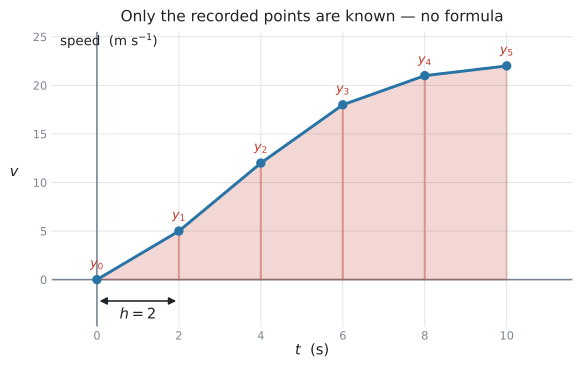
(a) Use the trapezoidal rule to estimate the area under the speed–time graph.
(b) Interpret your answer in the context of the question.
日本語訳
ある車の速さ(m/秒)を、\(2\) 秒おきに記録しました。
(a) 台形公式を使って、速さと時間のグラフの下の面積を見積もりなさい。
(b) 答えを、問題の文脈で解釈しなさい。
(a) 値は \(6\) 個なので台形は \(5\) つ、\(h = 2\)。
\[ A \approx \frac{1}{2}(2)\Big[(0 + 22) + 2(5 + 12 + 18 + 21)\Big] \]
\[ = 1 \times \Big[22 + 2(56)\Big] = 22 + 112 = 134 \]
(b) 速さのグラフの面積は、距離です。単位は \(\dfrac{\text{m}}{\text{秒}} \times \text{秒} = \text{m}\)。
試験ではこう書く
The car travels approximately \(134\) metres in the first \(10\) seconds.
approximately を入れてください
台形公式で出した値は、あくまで見積もりです。
\(134\) metres と言い切らず、approximately や about を付けると、意味が正確になります。
速さと時間のグラフの下の面積(進んだ距離)を見積もるのは、この項目の代表的な使い道です。物理の kinematics(運動学)ともつながっています。
(ただし SL 5.7 で見たとおり、運動そのものを扱う設問は SL では出ません。 ここでやっているのは「グラフの下の面積を求める」ことだけです。)
(a) \(h = 2\), \(n = 5\)
\(A \approx \dfrac{1}{2}(2)\left[(0 + 22) + 2(5 + 12 + 18 + 21)\right] = 134\)
(b) The car travels approximately \(134\) metres in the first \(10\) seconds.
6. Improving the estimate(\(n\) を増やすと近づく)
台形の数 \(n\) を増やすと、見積もりがどう変わるかを見てみます。
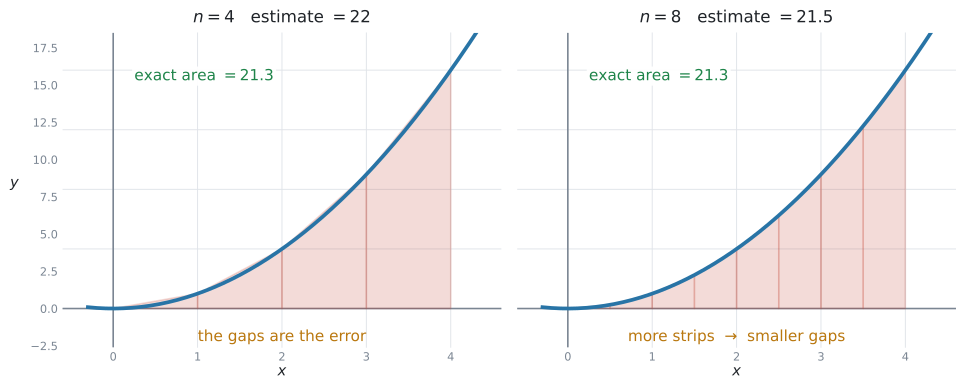
図 8 は、\(y = x^{2}\) の \(0\) から \(4\) までの面積です。
| \(n\) | 見積もり | 本当の値 |
|---|---|---|
| \(4\) | \(22\) | \(21.3\) |
| \(8\) | \(21.5\) | \(21.3\) |
台形が細くなるほど、すき間が小さくなります。 ただし手計算の量は増えます。
もっと精度のよい方法として Simpson’s rule(シンプソンの公式)もありますが、AI SL の試験には出ません。
例題 5 The area enclosed by \(y = x^{2}\), the \(x\)-axis, \(x = 0\) and \(x = 4\) is estimated using the trapezoidal rule.
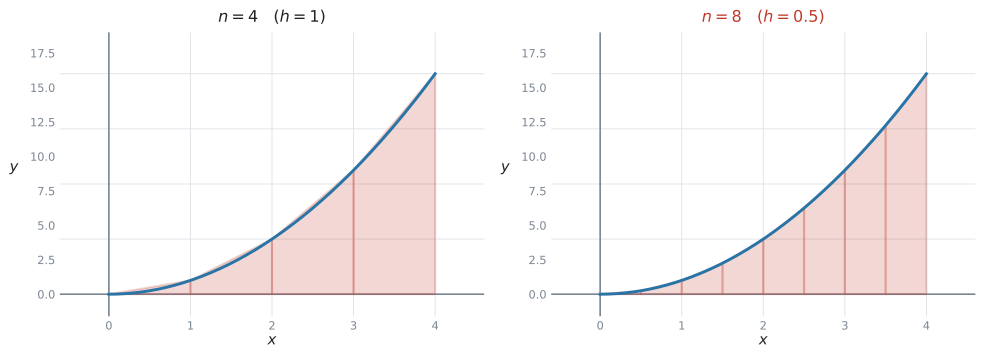
(a) Use \(n = 8\) to find a new estimate.
(b) The estimate with \(n = 4\) was \(22\), and the exact area is \(\dfrac{64}{3}\). Comment on the effect of increasing \(n\).
日本語訳
\(y = x^{2}\)、\(x\) 軸、\(x = 0\)、\(x = 4\) で囲まれた面積を、台形公式で見積もります。
(a) \(n = 8\) を使って、新しい見積もりを求めなさい。
(b) \(n = 4\) のときの見積もりは \(22\)、正確な面積は \(\dfrac{64}{3}\) です。\(n\) を増やすことの効果についてコメントしなさい。
(a)
\[ h = \frac{4 - 0}{8} = 0.5 \]
\(x = 0,\ 0.5,\ 1,\ 1.5,\ 2,\ 2.5,\ 3,\ 3.5,\ 4\) の \(9\) 個の値です。
| \(x\) | \(0\) | \(0.5\) | \(1\) | \(1.5\) | \(2\) | \(2.5\) | \(3\) | \(3.5\) | \(4\) |
|---|---|---|---|---|---|---|---|---|---|
| \(y\) | \(0\) | \(0.25\) | \(1\) | \(2.25\) | \(4\) | \(6.25\) | \(9\) | \(12.25\) | \(16\) |
中の値の和は \(0.25 + 1 + 2.25 + 4 + 6.25 + 9 + 12.25 = 35\)。
\[ A \approx \frac{1}{2}(0.5)\Big[(0 + 16) + 2(35)\Big] = 0.25\left[16 + 70\right] = 0.25(86) = 21.5 \]
(b)
試験ではこう書く
Increasing \(n\) makes the estimate more accurate.
With \(n = 4\) the estimate was \(22\); with \(n = 8\) it is \(21.5\), which is closer to the exact value \(21.3\).
The trapezia are narrower, so less area is missed.
\(n = 8\) なら、値は \(9\) 個。両はしをのぞくと 中は \(7\) つです。
\(1\) つ数え落とすだけで答えが変わるので、\(y_{1}\) から \(y_{7}\) まで、指で追って数えてください。
(a) \(h = 0.5\)
\(A \approx \dfrac{1}{2}(0.5)\left[(0 + 16) + 2(0.25 + 1 + 2.25 + 4 + 6.25 + 9 + 12.25)\right]\)
\(= 0.25(86) = 21.5\)
(b) A larger \(n\) gives a more accurate estimate: \(21.5\) is closer to \(21.3\) than \(22\) is, because the trapezia are narrower.
Why it works
台形 \(1\) つぶんの面積から始めます。
いちばん左の台形は、上底 \(y_{0}\)、下底 \(y_{1}\)、高さ \(h\)(横に倒れているので「高さ」が横幅です)。
\[ \frac{1}{2}(y_{0} + y_{1})h \]
次の台形は
\[ \frac{1}{2}(y_{1} + y_{2})h \]
… と続きます。\(n = 4\) なら、全部足して
\[ A \approx \frac{1}{2}h(y_{0} + y_{1}) + \frac{1}{2}h(y_{1} + y_{2}) + \frac{1}{2}h(y_{2} + y_{3}) + \frac{1}{2}h(y_{3} + y_{4}) \]
\(\dfrac{1}{2}h\) でくくります。
\[ A \approx \frac{1}{2}h\Big(y_{0} + y_{1} + y_{1} + y_{2} + y_{2} + y_{3} + y_{3} + y_{4}\Big) \]
同じ文字が何回出てくるかを数えてください。
- \(y_{0}\) … \(1\) 回
- \(y_{1}\)、\(y_{2}\)、\(y_{3}\) … \(2\) 回ずつ
- \(y_{4}\) … \(1\) 回
\[ A \approx \frac{1}{2}h\Big((y_{0} + y_{4}) + 2(y_{1} + y_{2} + y_{3})\Big) \]
これが公式集の式です。 中の値が \(2\) 倍されているのは、となり合う \(2\) つの台形で共有されているからです。
\(h\) をどんどん小さくしていくと、この和は本当の面積に近づきます。それが SL 5.5 で見た definite integral(定積分)です。
台形公式は、定積分の「途中で止めた版」だと思ってください。
Common errors
この項目で一番多い失点です。
値が \(7\) 個なら台形は \(6\) つ。\(n = 6\) です。
\(h\) はとなり合う \(x\) の差、または \(\dfrac{b-a}{n}\)。
\(n\) を間違えると \(h\) も狂うので、答えが全部ずれます。
\(2\) 倍するのは中だけです。\(y_{0}\) と \(y_{n}\) は \(1\) 回。
\(( \ )\) の位置を、公式集を見ながら確かめてください。
\(h\) だけ掛けて終わってしまうと、答えがちょうど \(2\) 倍になります。
答えが妙に大きいときは、まずここを疑ってください。
\(n = 8\) なら中は \(7\) つ、\(n = 6\) なら中は \(5\) つ。
指で \(1\) つずつ追って、個数を確かめてください。
\(\dfrac{20}{3}\) を \(6.67\) にしてから足すと、答えがずれます。
電卓の中の値で計算し、最後に丸めます。
台形公式は、幅がすべて同じ(intervals of equal width)ときに使う公式です。
\(x\) が \(0, 5, 10, 20\) のように不ぞろいなら、この公式はそのままでは使えません(試験では、必ずそろっています)。
Give a reason があったら、台形の上の辺が曲線の上か下かを書きます。
「グラフを見たら」では点になりません。
estimate なのに言い切ってしまう
文脈の問題では、approximately / about を付けてください。
台形公式が返すのは、いつでも見積もりです。
湖なら m²、距離なら m、水の量なら L。
面積の単位は、縦の単位 × 横の単位です(SL 5.5 と同じ)。
表しかない問題では、関数はありません。 表の数をそのまま公式に入れます。
「式が分からないから解けない」と思ってしまうのが、いちばんもったいない誤りです。
Using your GDC (TI-Nspire CX II)
台形公式そのものは手で計算します。電卓は、値を出すところと確かめるところで使います。
1. Making a table of values(\(y\) の値を表で一気に出す)
関数が与えられているときは、Graphs ページで表を出すのが速いです。
- \(f1(x) = \dfrac{20}{x}\)
ctrl + T
ctrl + T で、グラフの横に表が出ます。きざみ幅は次で変えられます。
menu → Table → Edit Table SettingsTable Step を \(h\) の値(この例なら \(1\))にすれば、必要な \(y\) が縦に並びます。
\(x = 1, 2, 3, 4, 5\) の行を見て、\(y\) を答案の表に書き写すだけです。
\(1\) つずつ代入するより、ずっと速くて確実です。
2. Calculating in one line(計算は \(1\) 行で)
Calculator ページで、公式をそのまま打ちます。
\(0.5 \times 1 \times \left(\left(20 + 4\right) + 2 \times \left(10 + \dfrac{20}{3} + 5\right)\right)\)
\(\dfrac{20}{3}\) を小数にせず、そのまま入れるのがポイントです。途中で丸めないですみます。
3. Checking the answer(答えを確かめる)
関数が分かっているときは、SL 5.5 の定積分で本当の値が出せます。
menu → Calculus → Integral\(\displaystyle\int_{1}^{5}\frac{20}{x}\,dx = 32.2\)(\(3\) 桁)。台形公式の \(33.7\) より小さいので、過大評価だったと確かめられます。
Use the trapezoidal rule と指定されているのに定積分の値(\(32.2\))を書くと、指示に従っていないことになります。
定積分は、検算用です。答えは \(33.7\) です。
4. Rounding(丸めについて)
途中の値は、電卓の中に残したまま使います。
ans前の計算結果は ans で呼び出せます。表示された \(6.67\) を打ち直さないでください。
Exercises
1 Use the trapezoidal rule with \(n = 4\) to estimate the area enclosed by the curve \(y = x^{2} + 1\), the \(x\)-axis, and the lines \(x = 0\) and \(x = 4\).
日本語訳
\(n = 4\) の台形公式を使って、曲線 \(y = x^{2} + 1\)、\(x\) 軸、直線 \(x = 0\)、\(x = 4\) で囲まれた面積を見積もりなさい。
\(h = \dfrac{4 - 0}{4} = 1\)
\(y\)-values: \(1,\ 2,\ 5,\ 10,\ 17\)
\(A \approx \dfrac{1}{2}(1)\left[(1 + 17) + 2(2 + 5 + 10)\right] = \dfrac{1}{2}(52) = 26\)
例題 1と同じ形。\(+1\) が付いただけです。
両はしは \(1\) と \(17\)。\(0\) ではないので、うっかり \((0 + 17)\) としないように。
\(18 + 34 = 52\)、\(\div 2\) で \(26\)。
検算。 本当の値は \(\dfrac{64}{3} + 4 = 25.3\)。\(26\) は少し大きく、過大評価です ✓(\(y = x^2+1\) は下に凸)
2 Use the trapezoidal rule with \(n = 4\) to estimate \(\displaystyle\int_{1}^{5} x^{3}\,dx\).
日本語訳
\(n = 4\) の台形公式を使って \(\displaystyle\int_{1}^{5} x^{3}\,dx\) を見積もりなさい。
\(h = \dfrac{5 - 1}{4} = 1\)
\(y\)-values: \(1,\ 8,\ 27,\ 64,\ 125\)
\(A \approx \dfrac{1}{2}(1)\left[(1 + 125) + 2(8 + 27 + 64)\right] = \dfrac{1}{2}(324) = 162\)
\(a = 1\) から始まるので、\(h = \dfrac{5-1}{4} = 1\)。\(\dfrac{5}{4}\) ではありません。
\(126 + 2(99) = 126 + 198 = 324\)。
検算。 定積分の本当の値は \(156\)。\(162\) は大きめで、過大評価です ✓
3 The height of a hill above a straight road is measured every \(10\) metres.
| Distance (m) | \(0\) | \(10\) | \(20\) | \(30\) | \(40\) | \(50\) | \(60\) |
|---|---|---|---|---|---|---|---|
| Height (m) | \(0\) | \(4\) | \(7\) | \(9\) | \(8\) | \(5\) | \(0\) |
Use the trapezoidal rule to estimate the area of the cross-section of the hill.
日本語訳
まっすぐな道路より上にある丘の高さを、\(10\) m おきに測りました。
台形公式を使って、丘の断面積を見積もりなさい。
\(h = 10\), \(n = 6\)
\(A \approx \dfrac{1}{2}(10)\left[(0 + 0) + 2(4 + 7 + 9 + 8 + 5)\right] = 5(66) = 330\ \text{m}^{2}\)
値は \(7\) 個、台形は \(6\) つ。
中の和は \(4 + 7 + 9 + 8 + 5 = 33\)。\(2\) 倍して \(66\)。\(\dfrac{1}{2} \times 10 = 5\) を掛けて \(330\)。
単位は m² です。高さ(m)× 距離(m)だからです。
4 The trapezoidal rule with \(n = 2\) is used to estimate the area enclosed by \(y = x^{2}\), the \(x\)-axis, \(x = 0\) and \(x = 2\).
(a) Find the estimate.
(b) The exact area is \(\dfrac{8}{3}\). State whether the estimate is an over-estimate or an under-estimate, and give a reason.
日本語訳
\(n = 2\) の台形公式を使って、\(y = x^{2}\)、\(x\) 軸、\(x = 0\)、\(x = 2\) で囲まれた面積を見積もります。
(a) 見積もりの値を求めなさい。
(b) 正確な面積は \(\dfrac{8}{3}\) です。この見積もりが過大評価か過小評価かを述べ、理由を書きなさい。
(a) \(h = 1\); \(y\)-values: \(0,\ 1,\ 4\)
\(A \approx \dfrac{1}{2}(1)\left[(0 + 4) + 2(1)\right] = \dfrac{1}{2}(6) = 3\)
(b) Over-estimate, because the curve bends upwards, so each straight top lies above the curve. (\(3 > \dfrac{8}{3} = 2.67\))
台形が \(2\) つだけなので、中の値は \(y_{1} = 1\) の\(1\) つだけです。\(2(1) = 2\)。
台形が少ないぶん、誤差が大きくなります。\(3\) に対して本当は \(2.67\)。
(b) の理由は「曲線が下に凸だから、弦が上に来る」。この一文を丸ごと覚えてください。
5 Water flows into a tank. The rate of flow, in litres per minute, is measured every \(3\) minutes.
| Time (min) | \(0\) | \(3\) | \(6\) | \(9\) | \(12\) |
|---|---|---|---|---|---|
| Rate (L min⁻¹) | \(20\) | \(17\) | \(13\) | \(8\) | \(2\) |
(a) Use the trapezoidal rule to estimate the total volume of water that flows in during the \(12\) minutes.
(b) Interpret your answer in the context of the question.
日本語訳
水がタンクに流れこみます。流量(\(1\) 分あたりのリットル数)を \(3\) 分おきに測りました。
(a) 台形公式を使って、\(12\) 分間に流れこんだ水の合計の量を見積もりなさい。
(b) 答えを、問題の文脈で解釈しなさい。
(a) \(h = 3\), \(n = 4\)
\(V \approx \dfrac{1}{2}(3)\left[(20 + 2) + 2(17 + 13 + 8)\right] = 1.5(98) = 147\)
(b) Approximately \(147\) litres of water flow into the tank during the \(12\) minutes.
変化率のグラフの面積は、合計です(SL 5.5)。単位は \(\dfrac{\text{L}}{\text{分}} \times \text{分} = \text{L}\)。
中の和は \(17 + 13 + 8 = 38\)、\(2\) 倍で \(76\)。端は \(20 + 2 = 22\)。合計 \(98\)。\(\times 1.5\) で \(147\)。
(b) に approximately と litres の両方を入れてください。
6 Use the trapezoidal rule with \(n = 4\) to estimate \(\displaystyle\int_{0}^{2} 2^{x}\,dx\), giving your answer correct to three significant figures.
日本語訳
\(n = 4\) の台形公式を使って \(\displaystyle\int_{0}^{2} 2^{x}\,dx\) を見積もり、答えを有効数字 \(3\) 桁で書きなさい。
\(h = \dfrac{2 - 0}{4} = 0.5\)
\(y\)-values: \(1,\ 1.414,\ 2,\ 2.828,\ 4\)
\(A \approx \dfrac{1}{2}(0.5)\left[(1 + 4) + 2(1.414 + 2 + 2.828)\right] = 0.25(17.49) = 4.37\) (3 s.f.)
\(2^{0.5} = \sqrt{2} = 1.41421\ldots\)、\(2^{1.5} = 2.82842\ldots\)。電卓で出してください。
表示された \(1.414\) を打ち直さないこと。電卓の表を使って、そのまま計算します。
\(5 + 2(6.24264) = 17.48528\)、\(\times 0.25\) で \(4.37132\ldots \to 4.37\)。
検算。 本当の値は \(4.33\)。過大評価です ✓(\(2^x\) は下に凸)
7 The table shows values of a function \(f\).
| \(x\) | \(2\) | \(5\) | \(8\) | \(11\) | \(14\) |
|---|---|---|---|---|---|
| \(f(x)\) | \(6\) | \(9\) | \(11\) | \(10\) | \(4\) |
(a) Write down the value of \(h\) and the number of trapezia.
(b) Use the trapezoidal rule to estimate \(\displaystyle\int_{2}^{14} f(x)\,dx\).
日本語訳
表は関数 \(f\) の値を示しています。
(a) \(h\) の値と、台形の数を書きなさい。
(b) 台形公式を使って \(\displaystyle\int_{2}^{14} f(x)\,dx\) を見積もりなさい。
(a) \(h = 3\), \(n = 4\)
(b) \(\displaystyle\int_{2}^{14} f(x)\,dx \approx \dfrac{1}{2}(3)\left[(6 + 4) + 2(9 + 11 + 10)\right] = 1.5(70) = 105\)
\(h\) は表から読めます。\(5 - 2 = 3\)、\(8 - 5 = 3\) … 等間隔 ✓
\(\dfrac{b-a}{n} = \dfrac{14-2}{4} = 3\) でも同じです。どちらでも確かめられます。
両はしは \(6\) と \(4\)。 \(0\) ではないので注意。中の和は \(9 + 11 + 10 = 30\)、\(2\) 倍で \(60\)。\(10 + 60 = 70\)。
8 The speed of a runner, in metres per second, is recorded every \(5\) seconds.
| Time (s) | \(0\) | \(5\) | \(10\) | \(15\) | \(20\) | \(25\) | \(30\) |
|---|---|---|---|---|---|---|---|
| Speed (m s⁻¹) | \(0\) | \(8\) | \(14\) | \(18\) | \(20\) | \(19\) | \(15\) |
(a) Estimate the distance run in the \(30\) seconds.
(b) Explain why your answer is only an estimate.
日本語訳
ランナーの速さ(m/秒)を、\(5\) 秒おきに記録しました。
(a) \(30\) 秒間に走った距離を見積もりなさい。
(b) 答えが見積もりにすぎない理由を説明しなさい。
(a) \(h = 5\), \(n = 6\)
\(d \approx \dfrac{1}{2}(5)\left[(0 + 15) + 2(8 + 14 + 18 + 20 + 19)\right] = 2.5(173) = 432.5\ \text{m}\)
(b) The trapezoidal rule replaces the curve by straight lines between the measured points, so the area found is not exactly the area under the graph. We do not know what the speed was between the readings.
最後の値は \(15\) で、\(0\) ではありません。 端は \(0 + 15 = 15\) です。
中の和は \(8+14+18+20+19 = 79\)、\(2\) 倍で \(158\)。\(15 + 158 = 173\)。\(\times 2.5\) で \(432.5\) m。
(b) の理由は \(2\) つ書けます ── ①台形の上の辺はまっすぐで曲線ではない、②測った点のあいだの速さが分からない。どちらか \(1\) つで十分です。
9 The area enclosed by \(y = x^{3}\), the \(x\)-axis, \(x = 0\) and \(x = 4\) is estimated using the trapezoidal rule.
(a) Find the estimate when \(n = 2\).
(b) Find the estimate when \(n = 4\).
(c) The exact area is \(64\). Comment on your two answers.
日本語訳
\(y = x^{3}\)、\(x\) 軸、\(x = 0\)、\(x = 4\) で囲まれた面積を、台形公式で見積もります。
(a) \(n = 2\) のときの見積もりを求めなさい。
(b) \(n = 4\) のときの見積もりを求めなさい。
(c) 正確な面積は \(64\) です。\(2\) つの答えについてコメントしなさい。
(a) \(h = 2\); \(y\)-values: \(0,\ 8,\ 64\)
\(A \approx \dfrac{1}{2}(2)\left[(0 + 64) + 2(8)\right] = 80\)
(b) \(h = 1\); \(y\)-values: \(0,\ 1,\ 8,\ 27,\ 64\)
\(A \approx \dfrac{1}{2}(1)\left[(0 + 64) + 2(1 + 8 + 27)\right] = \dfrac{1}{2}(136) = 68\)
(c) Both are over-estimates, because the curve bends upwards. The estimate with \(n = 4\) (\(68\)) is much closer to \(64\) than the one with \(n = 2\) (\(80\)), because narrower trapezia miss less area.
\(n = 2\) では中の値が \(y_{1} = 8\) の\(1\) つだけ。\(64 + 16 = 80\)。
\(n = 4\) では中が \(3\) つ。\(1 + 8 + 27 = 36\)、\(2\) 倍で \(72\)。\(64 + 72 = 136\)、\(\div 2\) で \(68\)。
誤差は \(16\) から \(4\) へ。 幅を半分にすると、誤差はおよそ \(\dfrac{1}{4}\) になります。
(c) には「どちらも過大」「\(n\) が大きいほうが近い」の両方を書いてください。
10 The width of a lake is measured every \(20\) metres.
| Distance (m) | \(0\) | \(20\) | \(40\) | \(60\) | \(80\) | \(100\) | \(120\) |
|---|---|---|---|---|---|---|---|
| Width (m) | \(0\) | \(25\) | \(40\) | \(46\) | \(42\) | \(30\) | \(0\) |
(a) Estimate the area of the lake.
(b) State one reason why the trapezoidal rule is useful here.
日本語訳
ある湖の幅を \(20\) m おきに測りました。
(a) 湖の面積を見積もりなさい。
(b) ここで台形公式が役に立つ理由を \(1\) つ述べなさい。
(a) \(h = 20\), \(n = 6\)
\(A \approx \dfrac{1}{2}(20)\left[(0 + 0) + 2(25 + 40 + 46 + 42 + 30)\right] = 10(366) = 3660\ \text{m}^{2}\)
(b) There is no function that describes the shape of the lake, so the area cannot be found by integration. The trapezoidal rule needs only the measured widths.
中の和は \(25 + 40 + 46 + 42 + 30 = 183\)、\(2\) 倍で \(366\)。\(\dfrac{1}{2} \times 20 = 10\) を掛けて \(3660\ \text{m}^{2}\)。
(b) は、「湖のように、式で表せない形の面積」を台形公式で見積もる、という考え方をそのまま問う設問です。
「式がないから積分できない。でも測った値ならある。」 ── この一文が答えです。
11 In SL 5.5 the exact value of \(\displaystyle\int_{1}^{3}\left(x^{2}+1\right)dx\) was found to be \(\dfrac{32}{3}\).
(a) Use the trapezoidal rule with \(n = 4\) to estimate this integral.
(b) Find the difference between your estimate and the exact value.
(c) State whether the estimate is an over-estimate or an under-estimate, and give a reason.
日本語訳
SL 5.5 で、\(\displaystyle\int_{1}^{3}\left(x^{2}+1\right)dx\) の正確な値は \(\dfrac{32}{3}\) と分かりました。
(a) \(n = 4\) の台形公式を使って、この積分を見積もりなさい。
(b) 見積もりと正確な値の差を求めなさい。
(c) 見積もりが過大評価か過小評価かを述べ、理由を書きなさい。
(a) \(h = \dfrac{3 - 1}{4} = 0.5\)
\(y\)-values at \(x = 1,\ 1.5,\ 2,\ 2.5,\ 3\): \(2,\ 3.25,\ 5,\ 7.25,\ 10\)
\(A \approx \dfrac{1}{2}(0.5)\left[(2 + 10) + 2(3.25 + 5 + 7.25)\right] = 0.25(43) = 10.75\)
(b) \(10.75 - \dfrac{32}{3} = 10.75 - 10.667 = 0.0833\) (3 s.f.)
(c) Over-estimate, because \(y = x^{2}+1\) bends upwards, so each straight top lies above the curve.
SL 5.5 の例題と同じ積分です。あちらは電卓で \(\dfrac{32}{3} = 10.7\) と出しました。
今度は式を使わずに、\(5\) つの値だけで \(10.75\)。差はわずか \(0.083\) です。
台形公式は、かなりよい近似だと分かります。\(h = 0.5\) と細かいからです。
\(h = \dfrac{3-1}{4} = 0.5\) です。\(a = 1\) から始まることに注意してください。
\(y\) の値は \(1^2+1 = 2\)、\(1.5^2+1 = 3.25\)、\(2^2+1 = 5\)、\(2.5^2+1 = 7.25\)、\(3^2+1 = 10\)。