HL 3.16 — The vector product(ベクトル積)
- vector product、cross product(ベクトル積)の定義を言える。
- 成分から \(\mathbf{v}\times\mathbf{w}\) を計算できる。
- \(\mathbf{v}\times\mathbf{w} = -\,\mathbf{w}\times\mathbf{v}\) など、性質を使える。
- \(\mathbf{v}\times\mathbf{w} = \mathbf{0}\) が parallel(平行)と同値であることを使える。
- \(\lvert\mathbf{v}\times\mathbf{w}\rvert\) で parallelogram(平行四辺形)の面積を求められる。
- その半分で、三角形の面積を求められる。
- scalar product(内積。結果はスカラー)と vector product(ベクトル積。結果はベクトル)を取りちがえない。
The idea
1. The vector product(ベクトル積)
\(2\) つのベクトルから新しいベクトルを作る計算を、vector product(ベクトル積)といいます。cross product とも呼びます。\(\theta\) を \(\mathbf{v}\) と \(\mathbf{w}\) の angle between(なす角)、\(\mathbf{n}\) を右ねじの向きの単位 normal vector(法線ベクトル)として、次の式で定義します。
\[ \mathbf{v}\times\mathbf{w} = \lvert\mathbf{v}\rvert\lvert\mathbf{w}\rvert\sin\theta\ \mathbf{n} \tag{1}\]
内積とちがって、答えはベクトルです(HL 3.13)。大きさが \(\lvert\mathbf{v}\rvert\lvert\mathbf{w}\rvert\sin\theta\)、向きが \(\mathbf{n}\) です。
\(\mathbf{n}\) は両方に perpendicular(垂直)な unit vector(単位ベクトル)です。ですから \(\mathbf{v}\times\mathbf{w}\) は、\(\mathbf{v}\) にも \(\mathbf{w}\) にも垂直です。
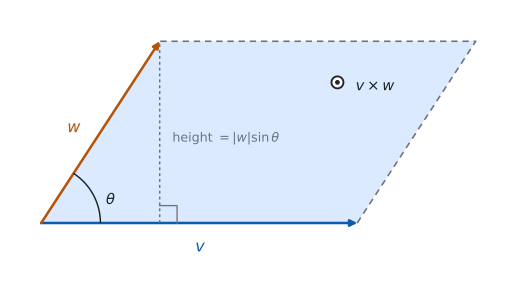
図の ⊙ は、\(\mathbf{v}\times\mathbf{w}\) が紙面から手前(自分のほう)へ向かうことを表します。
2. The right-hand screw rule(右ねじの規則)
両方に垂直な向きは、表と裏の \(2\) つあります。どちらを取るかを決めるのが、右ねじの規則です。
右手の指を \(\mathbf{v}\) から \(\mathbf{w}\) へ回すように曲げると、親指の向きが \(\mathbf{v}\times\mathbf{w}\) です。
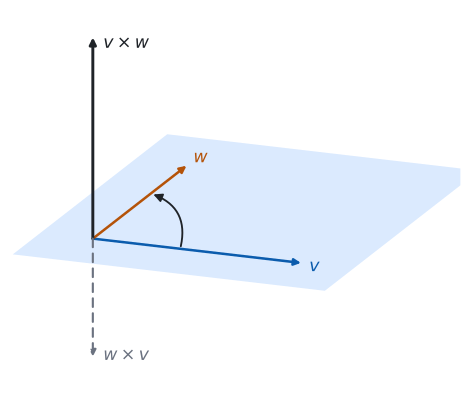
\(\mathbf{v}\) から \(\mathbf{w}\) へ回すのと、\(\mathbf{w}\) から \(\mathbf{v}\) へ回すのでは、ねじの進む向きが逆です。
\[ \mathbf{w}\times\mathbf{v} = -\,\mathbf{v}\times\mathbf{w} \]
内積では順番を変えても同じでした。ベクトル積はちがいます(第 4 節)。
3. Components(成分で出す)
公式集の 3.16 の欄にあります。
\[ \mathbf{v}\times\mathbf{w} = \begin{pmatrix} v_{2}w_{3}-v_{3}w_{2} \\ v_{3}w_{1}-v_{1}w_{3} \\ v_{1}w_{2}-v_{2}w_{1} \end{pmatrix} \tag{2}\]
\[ \lvert\mathbf{v}\times\mathbf{w}\rvert = \lvert\mathbf{v}\rvert\lvert\mathbf{w}\rvert\sin\theta \tag{3}\]
添字の並びに、きまりがあります。 第 \(1\) 成分は \(2,3\)、第 \(2\) 成分は \(3,1\)、第 \(3\) 成分は \(1,2\) です。\(1 \to 2 \to 3 \to 1\) と輪になっていると覚えてください。
検算はいつも同じです。 出てきたベクトルと \(\mathbf{v}\)、\(\mathbf{w}\) の内積が、どちらも \(0\) になるかを見ます。
例題 1 Let \(\mathbf{v} = \begin{pmatrix} 1 \\ 2 \\ 3 \end{pmatrix}\) and \(\mathbf{w} = \begin{pmatrix} 4 \\ 5 \\ 6 \end{pmatrix}\). Find \(\mathbf{v}\times\mathbf{w}\).
日本語訳
\(\mathbf{v} = \begin{pmatrix} 1 \\ 2 \\ 3 \end{pmatrix}\)、\(\mathbf{w} = \begin{pmatrix} 4 \\ 5 \\ 6 \end{pmatrix}\) とします。\(\mathbf{v}\times\mathbf{w}\) を求めなさい。
式 2 にそのまま入れます。
\[ \mathbf{v}\times\mathbf{w} = \begin{pmatrix} (2)(6)-(3)(5) \\ (3)(4)-(1)(6) \\ (1)(5)-(2)(4) \end{pmatrix} = \begin{pmatrix} 12-15 \\ 12-6 \\ 5-8 \end{pmatrix} = \begin{pmatrix} -3 \\ 6 \\ -3 \end{pmatrix} \]
検算。 \(\mathbf{v}\) との内積を見ます。 \((1)(-3)+(2)(6)+(3)(-3) = -3+12-9 = 0\) ✓
検算(\(\mathbf{w}\) のほう)。 \((4)(-3)+(5)(6)+(6)(-3) = -12+30-18 = 0\) ✓ 両方に垂直です。
\[\mathbf{v}\times\mathbf{w} = \begin{pmatrix} (2)(6)-(3)(5) \\ (3)(4)-(1)(6) \\ (1)(5)-(2)(4) \end{pmatrix} = \begin{pmatrix} -3 \\ 6 \\ -3 \end{pmatrix}\]
4. Properties(性質)
vector product には、次の性質があります。
\[ \mathbf{v}\times\mathbf{w} = -\mathbf{w}\times\mathbf{v}, \qquad \mathbf{u}\times(\mathbf{v}+\mathbf{w}) = \mathbf{u}\times\mathbf{v}+\mathbf{u}\times\mathbf{w} \]
\[ (k\mathbf{v})\times\mathbf{w} = k(\mathbf{v}\times\mathbf{w}), \qquad \mathbf{v}\times\mathbf{v} = \mathbf{0} \]
\(1\) つ目をanticommutative(反交換法則)といいます。\(4\) つ目は、\(\theta = 0\) で \(\sin\theta = 0\) になるからです。
\(\mathbf{v}\times\mathbf{v} = \mathbf{0}\) の \(\mathbf{0}\) は、太字の zero vector(零ベクトル)です。数の \(0\) ではありません。
5. Parallel vectors(平行なベクトル)
\(\mathbf{v}\)、\(\mathbf{w}\) が \(\mathbf{0}\) でないとき、\(\mathbf{v}\times\mathbf{w} = \mathbf{0}\) であることと、\(\mathbf{v}\) と \(\mathbf{w}\) が平行であることは同じです。
平行なら \(\theta = 0\) か \(\theta = \pi\) で、どちらも \(\sin\theta = 0\) です。
内積とちょうど逆の役目です(HL 3.13)。
| scalar product(内積) | vector product(ベクトル積) | |
|---|---|---|
| 答え | スカラー | ベクトル |
| 計算に入る三角比 | \(\cos\theta\) | \(\sin\theta\) |
| \(0\)(\(\mathbf{0}\))になるとき | 垂直 | 平行 |
最後に、英語でまとめておきます。(\(\mathbf{v}\)、\(\mathbf{w}\) は \(\mathbf{0}\) でないとします。)
- If the scalar product is \(0\), the vectors are perpendicular.
- If the vector product is \(\mathbf{0}\), the vectors are parallel.
例題 2 Use the vector product to show that \(\mathbf{a} = \begin{pmatrix} 2 \\ -1 \\ 3 \end{pmatrix}\) and \(\mathbf{b} = \begin{pmatrix} -4 \\ 2 \\ -6 \end{pmatrix}\) are parallel.
日本語訳
ベクトル積を使って、\(\mathbf{a}\) と \(\mathbf{b}\) が平行であることを示しなさい。
第 5 節 を使います。
\[ \mathbf{a}\times\mathbf{b} = \begin{pmatrix} (-1)(-6)-(3)(2) \\ (3)(-4)-(2)(-6) \\ (2)(2)-(-1)(-4) \end{pmatrix} = \begin{pmatrix} 6-6 \\ -12+12 \\ 4-4 \end{pmatrix} = \begin{pmatrix} 0 \\ 0 \\ 0 \end{pmatrix} \]
どちらも零ベクトルではないので、平行です。
検算。 スカラー倍でも見えます。 \(\mathbf{b} = -2\mathbf{a}\) ✓ たしかに平行です。
検算(面積として)。 平行な \(2\) 辺では平行四辺形がつぶれ、面積が \(0\) です ✓ \(\lvert\mathbf{a}\times\mathbf{b}\rvert = 0\) と合います。
\[\mathbf{a}\times\mathbf{b} = \begin{pmatrix} (-1)(-6)-(3)(2) \\ (3)(-4)-(2)(-6) \\ (2)(2)-(-1)(-4) \end{pmatrix} = \begin{pmatrix} 0 \\ 0 \\ 0 \end{pmatrix}\]
Both vectors are non-zero, so \(\mathbf{a}\times\mathbf{b} = \mathbf{0}\) shows that they are parallel.
6. The area of a parallelogram(平行四辺形の面積)
\(\lvert\mathbf{v}\times\mathbf{w}\rvert\) は、平行四辺形の面積を表します。三角形の面積も、その半分として求められます。
公式集の 3.16 の欄に、こうあります。
\[ A = \lvert\mathbf{v}\times\mathbf{w}\rvert \tag{4}\]
\(\mathbf{v}\) と \(\mathbf{w}\) は、平行四辺形のとなり合う \(2\) 辺です。
底辺が \(\lvert\mathbf{v}\rvert\)、高さが \(\lvert\mathbf{w}\rvert\sin\theta\) なので、面積は \(\lvert\mathbf{v}\rvert\lvert\mathbf{w}\rvert\sin\theta\) です(図 1)。これが 式 3 と同じ式です。
例題 3 Find the area of the parallelogram with adjacent sides \(\begin{pmatrix} 1 \\ 0 \\ 1 \end{pmatrix}\) and \(\begin{pmatrix} 0 \\ 2 \\ 1 \end{pmatrix}\).
日本語訳
となり合う \(2\) 辺が \(\begin{pmatrix} 1 \\ 0 \\ 1 \end{pmatrix}\)、\(\begin{pmatrix} 0 \\ 2 \\ 1 \end{pmatrix}\) である平行四辺形の面積を求めなさい。
まずベクトル積です(式 2)。
\[ \begin{pmatrix} 1 \\ 0 \\ 1 \end{pmatrix}\times\begin{pmatrix} 0 \\ 2 \\ 1 \end{pmatrix} = \begin{pmatrix} (0)(1)-(1)(2) \\ (1)(0)-(1)(1) \\ (1)(2)-(0)(0) \end{pmatrix} = \begin{pmatrix} -2 \\ -1 \\ 2 \end{pmatrix} \]
面積は、その大きさです(式 4)。
\[ A = \sqrt{(-2)^{2}+(-1)^{2}+2^{2}} = \sqrt{9} = 3 \]
検算。 両方との内積を見ます。 \(-2+0+2 = 0\) ✓、\(0-2+2 = 0\) ✓
検算(\(\sin\theta\) から)。 \(\lvert\mathbf{v}\rvert = \sqrt{2}\)、\(\lvert\mathbf{w}\rvert = \sqrt{5}\)、内積が \(1\) なので \(\cos\theta = \dfrac{1}{\sqrt{10}}\)、\(\sin\theta = \dfrac{3}{\sqrt{10}}\)。積は \(\sqrt{2}\sqrt{5}\cdot\dfrac{3}{\sqrt{10}} = 3\) ✓
\[\begin{pmatrix} 1 \\ 0 \\ 1 \end{pmatrix}\times\begin{pmatrix} 0 \\ 2 \\ 1 \end{pmatrix} = \begin{pmatrix} -2 \\ -1 \\ 2 \end{pmatrix}\]
\[A = \left\lvert \begin{pmatrix} -2 \\ -1 \\ 2 \end{pmatrix} \right\rvert = \sqrt{4+1+4} = 3\]
7. The area of a triangle(三角形の面積)
三角形 \(ABC\) の面積は、平行四辺形のちょうど半分です。
\[ \text{Area of } \triangle ABC = \frac{1}{2}\left\lvert \overrightarrow{AB}\times\overrightarrow{AC} \right\rvert \tag{5}\]
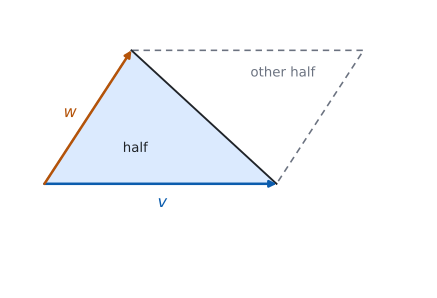
\(2\) 本とも、同じ頂点から出します。 \(\overrightarrow{AB}\) と \(\overrightarrow{BC}\) を混ぜると、ちがう平行四辺形になってしまいます。
例題 4 The points \(A\), \(B\) and \(C\) have coordinates \((1,\ 0,\ 0)\), \((2,\ 1,\ 1)\) and \((0,\ 2,\ 1)\). Find the area of triangle \(ABC\).
日本語訳
\(A(1,\ 0,\ 0)\)、\(B(2,\ 1,\ 1)\)、\(C(0,\ 2,\ 1)\) とします。三角形 \(ABC\) の面積を求めなさい。
\(A\) から出る \(2\) 本を作ります(第 7 節)。
\[ \overrightarrow{AB} = \begin{pmatrix} 1 \\ 1 \\ 1 \end{pmatrix}, \qquad \overrightarrow{AC} = \begin{pmatrix} -1 \\ 2 \\ 1 \end{pmatrix} \]
\[ \overrightarrow{AB}\times\overrightarrow{AC} = \begin{pmatrix} (1)(1)-(1)(2) \\ (1)(-1)-(1)(1) \\ (1)(2)-(1)(-1) \end{pmatrix} = \begin{pmatrix} -1 \\ -2 \\ 3 \end{pmatrix} \]
式 5 から
\[ \text{Area} = \frac{1}{2}\sqrt{1+4+9} = \frac{\sqrt{14}}{2} \]
検算。 両方との内積を見ます。 \(-1-2+3 = 0\) ✓、\(1-4+3 = 0\) ✓
検算(\(B\) から出しても同じか)。 \(\overrightarrow{BA} = \begin{pmatrix} -1 \\ -1 \\ -1 \end{pmatrix}\)、\(\overrightarrow{BC} = \begin{pmatrix} -2 \\ 1 \\ 0 \end{pmatrix}\) のベクトル積は \(\begin{pmatrix} 1 \\ 2 \\ -3 \end{pmatrix}\) で、大きさは同じ \(\sqrt{14}\) ✓ どの頂点から出しても面積は同じです。
\[\overrightarrow{AB} = \begin{pmatrix} 1 \\ 1 \\ 1 \end{pmatrix}, \qquad \overrightarrow{AC} = \begin{pmatrix} -1 \\ 2 \\ 1 \end{pmatrix}\]
\[\overrightarrow{AB}\times\overrightarrow{AC} = \begin{pmatrix} -1 \\ -2 \\ 3 \end{pmatrix}\]
\[\text{Area} = \frac{1}{2}\left\lvert \begin{pmatrix} -1 \\ -2 \\ 3 \end{pmatrix} \right\rvert = \frac{\sqrt{14}}{2}\]
試験ではこう書く
Both vectors must start at the same vertex, so take \(\overrightarrow{AB} = \begin{pmatrix} 1 \\ 1 \\ 1 \end{pmatrix}\) and \(\overrightarrow{AC} = \begin{pmatrix} -1 \\ 2 \\ 1 \end{pmatrix}\), each found by subtracting the position vector of \(A\).
The vector product is then \(\overrightarrow{AB}\times\overrightarrow{AC} = \begin{pmatrix} (1)(1)-(1)(2) \\ (1)(-1)-(1)(1) \\ (1)(2)-(1)(-1) \end{pmatrix} = \begin{pmatrix} -1 \\ -2 \\ 3 \end{pmatrix}\).
As a check, this vector has scalar product zero with both \(\overrightarrow{AB}\) and \(\overrightarrow{AC}\), as it must.
The magnitude of the vector product is the area of the parallelogram with these two vectors as adjacent sides, and the triangle is half of that parallelogram.
Hence the area of triangle \(ABC\) is \(\dfrac{1}{2}\sqrt{(-1)^{2}+(-2)^{2}+3^{2}} = \dfrac{\sqrt{14}}{2}\).
Why it works
なぜ、大きさが平行四辺形の面積になるのか
平行四辺形の面積は「底辺 \(\times\) 高さ」です。
底辺を \(\lvert\mathbf{v}\rvert\) とすると、高さは \(\mathbf{w}\) の垂直方向の成分です。\(\mathbf{w}\) と底辺のなす角が \(\theta\) なので、高さは \(\lvert\mathbf{w}\rvert\sin\theta\) です。
\[ A = \lvert\mathbf{v}\rvert \times \lvert\mathbf{w}\rvert\sin\theta = \lvert\mathbf{v}\times\mathbf{w}\rvert \]
内積が \(\cos\)、ベクトル積が \(\sin\) です。内積は「影の長さ」、ベクトル積は「広がった面積」を測っています。
なぜ、成分の式があの形なのか
式 2 のベクトルが、\(\mathbf{v}\) と \(\mathbf{w}\) の両方に垂直であることは、内積を計算すれば分かります。
\[ \mathbf{v}\cdot(\mathbf{v}\times\mathbf{w}) = v_{1}(v_{2}w_{3}-v_{3}w_{2})+v_{2}(v_{3}w_{1}-v_{1}w_{3})+v_{3}(v_{1}w_{2}-v_{2}w_{1}) \]
展開すると、\(6\) 個の項が符号ちがいで打ち消し合って \(0\) になります。\(\mathbf{w}\) についても同じです。
これが、いちばん手早い検算です。\(2\) 回とも \(0\) にならなければ、どこかで計算をまちがえています。
なぜ、順番を変えると符号が変わるのか
式 2 の各成分で、\(\mathbf{v}\) と \(\mathbf{w}\) を入れかえてみてください。
\[ w_{2}v_{3}-w_{3}v_{2} = -(v_{2}w_{3}-v_{3}w_{2}) \]
引き算の順番が逆になるので、符号が変わります。\(3\) 成分とも同じです。
定義のほうから見れば、右ねじを回す向きが逆になる、ということです(第 2 節)。
なぜ、\(\mathbf{v}\times\mathbf{v} = \mathbf{0}\) なのか
\(\mathbf{v}\) と \(\mathbf{v}\) のなす角は \(0\) です。\(\sin 0 = 0\) なので、大きさが \(0\) になります。
面積で考えると、\(2\) 辺が重なった平行四辺形はつぶれていて、面積が \(0\) です。
\(\mathbf{v}\times\mathbf{w} = -\,\mathbf{w}\times\mathbf{v}\) に \(\mathbf{w} = \mathbf{v}\) を入れても、\(\mathbf{v}\times\mathbf{v} = -\,\mathbf{v}\times\mathbf{v}\) から同じ結論になります。
Common errors
\(\mathbf{v}\times\mathbf{w} = -\,\mathbf{w}\times\mathbf{v}\) です(第 4 節)。
向きが逆になります。大きさは同じなので、面積を聞かれているときだけは、どちらでも答えが変わりません。
第 \(2\) 成分は \(v_{3}w_{1}-v_{1}w_{3}\) です(式 2)。\(v_{1}w_{3}-v_{3}w_{1}\) ではありません。
\(1 \to 2 \to 3 \to 1\) の輪で覚え、出したら内積 \(0\) の検算をしてください。
平行はベクトル積が \(\mathbf{0}\)、垂直は内積が \(0\) です(第 5 節)。
逆に覚えると、いつも反対の答えが出ます。 \(\sin\) と \(\cos\) のどちらが \(0\) になるかで思い出してください。
\(\lvert\overrightarrow{AB}\times\overrightarrow{AC}\rvert\) は平行四辺形の面積です(図 3)。
三角形はその半分です。答えがちょうど \(2\) 倍になっているときは、まずここを疑ってください。
\(\overrightarrow{AB}\) と \(\overrightarrow{BC}\) を組にしてはいけません(第 7 節)。
同じ頂点から出すのがきまりです。\(A\) からなら \(\overrightarrow{AB}\) と \(\overrightarrow{AC}\)、\(B\) からなら \(\overrightarrow{BA}\) と \(\overrightarrow{BC}\) です。
Exercises
1 Let \(\mathbf{v} = \begin{pmatrix} 1 \\ -1 \\ 2 \end{pmatrix}\) and \(\mathbf{w} = \begin{pmatrix} 3 \\ 0 \\ 1 \end{pmatrix}\). Find \(\mathbf{v}\times\mathbf{w}\).
日本語訳
\(\mathbf{v} = \begin{pmatrix} 1 \\ -1 \\ 2 \end{pmatrix}\)、\(\mathbf{w} = \begin{pmatrix} 3 \\ 0 \\ 1 \end{pmatrix}\) とします。\(\mathbf{v}\times\mathbf{w}\) を求めなさい。
\[\mathbf{v}\times\mathbf{w} = \begin{pmatrix} (-1)(1)-(2)(0) \\ (2)(3)-(1)(1) \\ (1)(0)-(-1)(3) \end{pmatrix} = \begin{pmatrix} -1 \\ 5 \\ 3 \end{pmatrix}\]
式 2 に入れるだけです。符号をていねいに。
検算。 \(\mathbf{v}\) との内積は \(-1-5+6 = 0\) ✓
検算(\(\mathbf{w}\) のほう)。 \(-3+0+3 = 0\) ✓ 両方に垂直です。
2 Find \(\mathbf{u}\times\mathbf{u}\) for \(\mathbf{u} = \begin{pmatrix} 2 \\ 3 \\ -1 \end{pmatrix}\), and explain the result geometrically.
日本語訳
\(\mathbf{u} = \begin{pmatrix} 2 \\ 3 \\ -1 \end{pmatrix}\) について \(\mathbf{u}\times\mathbf{u}\) を求め、その結果を図形の言葉で説明しなさい。
\[\mathbf{u}\times\mathbf{u} = \begin{pmatrix} (3)(-1)-(-1)(3) \\ (-1)(2)-(2)(-1) \\ (2)(3)-(3)(2) \end{pmatrix} = \begin{pmatrix} 0 \\ 0 \\ 0 \end{pmatrix}\]
The angle between \(\mathbf{u}\) and itself is \(0\), so the parallelogram collapses and its area is \(0\).
3 Given that \(\mathbf{v}\times\mathbf{w} = \begin{pmatrix} 2 \\ -5 \\ 1 \end{pmatrix}\), write down \(\mathbf{w}\times\mathbf{v}\).
日本語訳
\(\mathbf{v}\times\mathbf{w} = \begin{pmatrix} 2 \\ -5 \\ 1 \end{pmatrix}\) であるとき、\(\mathbf{w}\times\mathbf{v}\) を書きなさい。
\[\mathbf{w}\times\mathbf{v} = -\,\mathbf{v}\times\mathbf{w} = \begin{pmatrix} -2 \\ 5 \\ -1 \end{pmatrix}\]
計算はいりません。 反交換法則をそのまま使います(第 4 節)。
\(3\) 成分すべての符号を変えます。大きさは変わりません。
検算(大きさ)。 どちらも \(\sqrt{4+25+1} = \sqrt{30}\) ✓
検算(向き)。 右ねじを逆に回した向きです ✓ 面積を聞かれているなら、答えは同じになります。
4 Use the vector product to determine whether \(\begin{pmatrix} 3 \\ -6 \\ 9 \end{pmatrix}\) and \(\begin{pmatrix} -1 \\ 2 \\ -3 \end{pmatrix}\) are parallel.
日本語訳
ベクトル積を使って、\(2\) つのベクトルが平行かどうかを調べなさい。
\[\begin{pmatrix} 3 \\ -6 \\ 9 \end{pmatrix}\times\begin{pmatrix} -1 \\ 2 \\ -3 \end{pmatrix} = \begin{pmatrix} (-6)(-3)-(9)(2) \\ (9)(-1)-(3)(-3) \\ (3)(2)-(-6)(-1) \end{pmatrix} = \begin{pmatrix} 0 \\ 0 \\ 0 \end{pmatrix}\]
Both vectors are non-zero, so they are parallel.
第 5 節 の判定です。\(3\) 成分とも \(0\) になることを示します。
「both non-zero」と書き添えると確実です。零ベクトルのときは、この同値が使えません。
検算。 \(\begin{pmatrix} 3 \\ -6 \\ 9 \end{pmatrix} = -3\begin{pmatrix} -1 \\ 2 \\ -3 \end{pmatrix}\) ✓ スカラー倍です。
検算(面積)。 つぶれた平行四辺形なので、面積は \(0\) ✓
5 Find the area of the parallelogram with adjacent sides \(\begin{pmatrix} 2 \\ 0 \\ 0 \end{pmatrix}\) and \(\begin{pmatrix} 0 \\ 3 \\ 0 \end{pmatrix}\).
日本語訳
となり合う \(2\) 辺が \(\begin{pmatrix} 2 \\ 0 \\ 0 \end{pmatrix}\)、\(\begin{pmatrix} 0 \\ 3 \\ 0 \end{pmatrix}\) である平行四辺形の面積を求めなさい。
\[\begin{pmatrix} 2 \\ 0 \\ 0 \end{pmatrix}\times\begin{pmatrix} 0 \\ 3 \\ 0 \end{pmatrix} = \begin{pmatrix} 0 \\ 0 \\ 6 \end{pmatrix}, \qquad A = 6\]
\(2\) 辺が垂直なので、これは長方形です。\(2 \times 3 = 6\) と、すぐ分かります。
ベクトル積の第 \(3\) 成分だけが残り、その値がちょうど面積です。\(z\) 軸の向きを向いているのは、平面が \(xy\) 平面だからです。
検算。 \(\theta = \dfrac{\pi}{2}\)、\(\sin\theta = 1\) なので \(2 \times 3 \times 1 = 6\) ✓
検算(内積)。 \(\begin{pmatrix} 0 \\ 0 \\ 6 \end{pmatrix}\) は両方と内積 \(0\) ✓
6 Find the area of the triangle with vertices \((0,\ 0,\ 0)\), \((1,\ 2,\ 0)\) and \((3,\ 1,\ 0)\).
日本語訳
\(3\) 頂点が \((0,\ 0,\ 0)\)、\((1,\ 2,\ 0)\)、\((3,\ 1,\ 0)\) である三角形の面積を求めなさい。
\[\begin{pmatrix} 1 \\ 2 \\ 0 \end{pmatrix}\times\begin{pmatrix} 3 \\ 1 \\ 0 \end{pmatrix} = \begin{pmatrix} 0 \\ 0 \\ -5 \end{pmatrix}\]
\[\text{Area} = \frac{1}{2}\lvert -5 \rvert = \frac{5}{2}\]
原点が頂点なので、\(2\) 本はそのまま位置ベクトルです。\(\dfrac{1}{2}\) を忘れないこと(式 5)。
第 \(3\) 成分が負でも、大きさを取るので問題ありません。頂点の順番を変えると符号が変わるだけです。
検算(順番を変える)。 \(\begin{pmatrix} 3 \\ 1 \\ 0 \end{pmatrix}\times\begin{pmatrix} 1 \\ 2 \\ 0 \end{pmatrix} = \begin{pmatrix} 0 \\ 0 \\ 5 \end{pmatrix}\) で、面積は同じ ✓
検算(\(2\) 次元の公式)。 \(\dfrac{1}{2}\lvert (1)(1)-(2)(3) \rvert = \dfrac{5}{2}\) ✓
7 Find a vector that is perpendicular to both \(\begin{pmatrix} 1 \\ 1 \\ 0 \end{pmatrix}\) and \(\begin{pmatrix} 0 \\ 1 \\ 1 \end{pmatrix}\).
日本語訳
\(\begin{pmatrix} 1 \\ 1 \\ 0 \end{pmatrix}\) と \(\begin{pmatrix} 0 \\ 1 \\ 1 \end{pmatrix}\) の両方に垂直なベクトルを \(1\) つ求めなさい。
\[\begin{pmatrix} 1 \\ 1 \\ 0 \end{pmatrix}\times\begin{pmatrix} 0 \\ 1 \\ 1 \end{pmatrix} = \begin{pmatrix} (1)(1)-(0)(1) \\ (0)(0)-(1)(1) \\ (1)(1)-(1)(0) \end{pmatrix} = \begin{pmatrix} 1 \\ -1 \\ 1 \end{pmatrix}\]
「両方に垂直」と言われたら、ベクトル積です(第 1 節)。これが、この単元でいちばん使う場面です。
答えは \(1\) つではありません。 スカラー倍はどれも垂直なので、\(\begin{pmatrix} -1 \\ 1 \\ -1 \end{pmatrix}\) でも正解です。
検算。 \(1-1+0 = 0\) ✓、\(0-1+1 = 0\) ✓
検算(大きさ)。 \(\sqrt{3}\) です。単位ベクトルがほしければ \(\sqrt{3}\) で割ります ✓
8 Show that \(\lvert\mathbf{v}\times\mathbf{w}\rvert^{2}+(\mathbf{v}\cdot\mathbf{w})^{2} = \lvert\mathbf{v}\rvert^{2}\lvert\mathbf{w}\rvert^{2}\) for any vectors \(\mathbf{v}\) and \(\mathbf{w}\).
日本語訳
任意のベクトル \(\mathbf{v}\)、\(\mathbf{w}\) について、上の等式を示しなさい。
\[\lvert\mathbf{v}\times\mathbf{w}\rvert = \lvert\mathbf{v}\rvert\lvert\mathbf{w}\rvert\sin\theta, \qquad \mathbf{v}\cdot\mathbf{w} = \lvert\mathbf{v}\rvert\lvert\mathbf{w}\rvert\cos\theta\]
\[\lvert\mathbf{v}\times\mathbf{w}\rvert^{2}+(\mathbf{v}\cdot\mathbf{w})^{2} = \lvert\mathbf{v}\rvert^{2}\lvert\mathbf{w}\rvert^{2}\left(\sin^{2}\theta+\cos^{2}\theta\right) = \lvert\mathbf{v}\rvert^{2}\lvert\mathbf{w}\rvert^{2}\]
\(\sin^{2}\theta+\cos^{2}\theta = 1\) を使うだけです(HL 3.9)。
\(2\) つの積は、同じ \(2\) つの大きさに \(\sin\) と \(\cos\) を掛けたものです。だから \(2\) 乗して足すと、\(\sin\) と \(\cos\) が消えます。
検算(具体例)。 \(\mathbf{v} = \begin{pmatrix} 1 \\ 2 \\ 2 \end{pmatrix}\)、\(\mathbf{w} = \begin{pmatrix} 2 \\ -1 \\ 0 \end{pmatrix}\) なら、左辺は \(45\) ✓
検算(右辺)。 \(\lvert\mathbf{v}\rvert^{2} = 9\)、\(\lvert\mathbf{w}\rvert^{2} = 5\) で \(45\) ✓ 合いました。
試験ではこう書く
Let \(\theta\) be the angle between \(\mathbf{v}\) and \(\mathbf{w}\).
By the definitions of the two products, \(\lvert\mathbf{v}\times\mathbf{w}\rvert = \lvert\mathbf{v}\rvert\lvert\mathbf{w}\rvert\sin\theta\) and \(\mathbf{v}\cdot\mathbf{w} = \lvert\mathbf{v}\rvert\lvert\mathbf{w}\rvert\cos\theta\).
Note that \(\theta\) lies between \(0\) and \(\pi\), so \(\sin\theta\) is not negative and the first expression is indeed a magnitude.
Squaring each and adding gives
\[\lvert\mathbf{v}\times\mathbf{w}\rvert^{2}+(\mathbf{v}\cdot\mathbf{w})^{2} = \lvert\mathbf{v}\rvert^{2}\lvert\mathbf{w}\rvert^{2}\sin^{2}\theta +\lvert\mathbf{v}\rvert^{2}\lvert\mathbf{w}\rvert^{2}\cos^{2}\theta\]
Taking out the common factor \(\lvert\mathbf{v}\rvert^{2}\lvert\mathbf{w}\rvert^{2}\) leaves \(\sin^{2}\theta+\cos^{2}\theta\), which is \(1\) by the Pythagorean identity.
Hence the sum equals \(\lvert\mathbf{v}\rvert^{2}\lvert\mathbf{w}\rvert^{2}\) for any two vectors.
9 Explain why the scalar product detects perpendicular vectors while the vector product detects parallel vectors.
日本語訳
内積が垂直を、ベクトル積が平行を見分けるのはなぜかを説明しなさい。
The scalar product carries a factor \(\cos\theta\), which is zero when \(\theta = \dfrac{\pi}{2}\), that is, when the vectors are perpendicular.
The vector product carries a factor \(\sin\theta\), which is zero when \(\theta = 0\) or \(\theta = \pi\), that is, when the vectors are parallel.
For non-zero vectors the other factors cannot vanish, so in each case the product is zero exactly when that angle occurs.
\(\cos\) と \(\sin\) の、\(0\) になる角がちがうというだけです(第 5 節)。
面積と影で考えることもできます。垂直なら影が \(0\)、平行なら面積が \(0\) です。
検算(垂直の例)。 \(\begin{pmatrix} 1 \\ 0 \\ 0 \end{pmatrix}\) と \(\begin{pmatrix} 0 \\ 1 \\ 0 \end{pmatrix}\) は内積 \(0\)、ベクトル積は \(\begin{pmatrix} 0 \\ 0 \\ 1 \end{pmatrix} \neq \mathbf{0}\) ✓
検算(平行の例)。 \(\begin{pmatrix} 1 \\ 0 \\ 0 \end{pmatrix}\) と \(\begin{pmatrix} 2 \\ 0 \\ 0 \end{pmatrix}\) は内積 \(2 \neq 0\)、ベクトル積は \(\mathbf{0}\) ✓
試験ではこう書く
Both products are built from the same two magnitudes but with different trigonometric factors.
The scalar product is \(\mathbf{v}\cdot\mathbf{w} = \lvert\mathbf{v}\rvert\lvert\mathbf{w}\rvert\cos\theta\) and the vector product has magnitude \(\lvert\mathbf{v}\times\mathbf{w}\rvert = \lvert\mathbf{v}\rvert\lvert\mathbf{w}\rvert\sin\theta\), where \(\theta\) is the angle between the vectors, with \(0 \leq \theta \leq \pi\).
If both vectors are non-zero then \(\lvert\mathbf{v}\rvert\lvert\mathbf{w}\rvert\) is positive, so each product vanishes exactly when its trigonometric factor does.
On the interval \(0 \leq \theta \leq \pi\), \(\cos\theta = 0\) only at \(\theta = \dfrac{\pi}{2}\), which is the perpendicular case, while \(\sin\theta = 0\) only at \(\theta = 0\) and \(\theta = \pi\), which are the two parallel cases.
Geometrically, the scalar product measures how much of one vector lies along the other, and that is zero when they are at right angles; the vector product measures the area of the parallelogram they span, and that is zero when they lie along the same line.
10 A student writes: “The area of the triangle with vertices \(A\), \(B\) and \(C\) is \(\lvert\overrightarrow{AB}\times\overrightarrow{BC}\rvert\).” Identify the two errors and give the correct expression.
日本語訳
ある生徒が「三角形 \(ABC\) の面積は \(\lvert\overrightarrow{AB}\times\overrightarrow{BC}\rvert\) だ」と書きました。\(2\) つのまちがいを指摘し、正しい式を書きなさい。
First, the factor \(\dfrac{1}{2}\) is missing: the magnitude of a vector product gives the area of the parallelogram, and the triangle is half of it.
Second, the two vectors must start at the same vertex, so \(\overrightarrow{BC}\) should be replaced by \(\overrightarrow{AC}\).
\[\text{Area} = \frac{1}{2}\left\lvert \overrightarrow{AB}\times\overrightarrow{AC} \right\rvert\]
\(2\) つあります。\(\dfrac{1}{2}\) と、出発点です(第 7 節)。
\(\overrightarrow{AB}\) と \(\overrightarrow{BC}\) は、\(B\) でつながった \(2\) 本です。共通の頂点から出ていません。
検算(面白いことに)。 \(\overrightarrow{BC} = \overrightarrow{AC}-\overrightarrow{AB}\) なので、\(\overrightarrow{AB}\times\overrightarrow{BC} = \overrightarrow{AB}\times\overrightarrow{AC}\) ✓ 大きさは偶然合います。
検算(\(\dfrac{1}{2}\) のほう)。 こちらは合いません ✓ 生徒の答えは、いつも正しい面積の \(2\) 倍です。
試験ではこう書く
The first error is the missing factor of \(\dfrac{1}{2}\).
The magnitude of a vector product is the area of the parallelogram with those two vectors as adjacent sides, and a triangle is exactly half of that parallelogram, so the student’s expression is twice the required area.
The second error is using two vectors that do not start at the same point.
\(\overrightarrow{AB}\) runs from \(A\) to \(B\) and \(\overrightarrow{BC}\) runs from \(B\) to \(C\), so they are placed head to tail rather than spanning a parallelogram from one vertex.
The vectors should both be taken from the same vertex, for example \(\overrightarrow{AB}\) and \(\overrightarrow{AC}\).
The correct expression is \(\dfrac{1}{2}\left\lvert \overrightarrow{AB}\times\overrightarrow{AC} \right\rvert\).
Here the second error happens not to change the value, since \(\overrightarrow{AB}\times\overrightarrow{BC} = \overrightarrow{AB}\times(\overrightarrow{AC}-\overrightarrow{AB}) = \overrightarrow{AB}\times\overrightarrow{AC}\), but the reasoning behind it is wrong and the missing factor of \(\dfrac{1}{2}\) does change the answer.