HL 5.12 — Continuity, differentiability and first principles(連続性・微分可能性と第一原理)
- limit(極限)が convergence(収束)するか divergence(発散)するかを、ことばで説明できる。
- continuous(連続)・ differentiable(微分可能)の意味を、グラフで言える。
- from first principles(第一原理)で、polynomial(多項式)の derivative(導関数)を求められる。
- \(\displaystyle\lim_{h \to 0}\) を、答えが出るまで書き続けられる。
- higher derivative(高次導関数)を求め、\(\dfrac{\mathrm{d}^{n}y}{\mathrm{d}x^{n}}\) と \(f^{(n)}(x)\) の記号を使える。
- 規則を見つけて、帰納法で示せる(HL 1.15)。
The idea
1. Limits(極限)
limit(極限)の考え方(収束と発散)を扱います。
\(x\) をある値に近づけたとき、\(f(x)\) が\(1\) つの値に近づくなら convergence(収束)、近づかないなら divergence(発散)です(SL 5.1)。
\(x = a\) での値と、\(x \to a\) での極限は別ものです。穴があいていても、極限はあります。
infinite geometric series(無限等比級数)で見た「近づくけれど、たどり着かない」と同じ考え方です(SL 1.8)。
2. Continuity(連続性)
ペンを離さずにかけるなら、そこで連続です。切れ目や穴があれば、連続ではありません。
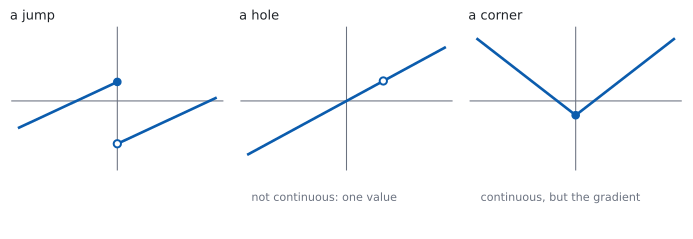
ことばで説明できれば十分です。\(\varepsilon\)–\(\delta\) のような形式的な定義は要りません。
3. Differentiability(微分可能性)
tangent(接線)が \(1\) 本に決まるなら、そこで微分可能です。
図 1 の右のようにcorner(角)があると、左から来た傾きと右から来た傾きがちがいます。接線が決まらないので、微分できません。
Differentiable implies continuous(微分可能なら連続)です。逆は成り立ちません。角のある \(y = \lvert x \rvert\) が、その例です。
4. The derivative from first principles(第一原理による微分)
公式集の 5.12 の欄にあります。
\[ y = f(x) \ \Rightarrow \ \frac{\mathrm{d}y}{\mathrm{d}x} = f'(x) = \lim_{h \to 0}\left(\frac{f(x+h)-f(x)}{h}\right) \tag{1}\]
分数の中身は、\(2\) 点を結ぶ直線(割線)の傾きです(SL 5.1)。
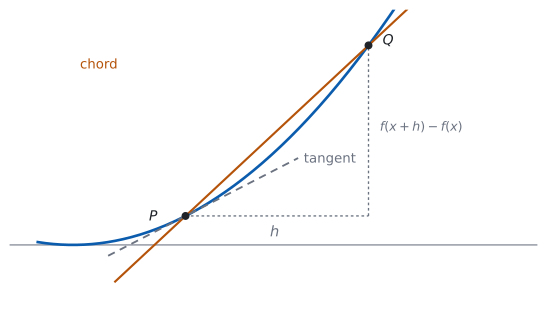
\(h = 0\) を代入してはいけません。 分母が \(0\) になります。先に約分して、\(h\) を消してから近づけます(Why it works)。
例題 1 Find \(f'(x)\) from first principles for \(f(x) = x^{2}\).
日本語訳
第一原理(導関数の定義)を使って、\(f(x) = x^{2}\) の \(f'(x)\) を求めなさい。
式 1 に入れます。
\[ f(x+h) = (x+h)^{2} = x^{2}+2xh+h^{2} \]
\[ f(x+h)-f(x) = 2xh+h^{2} = h(2x+h) \]
\[ \frac{f(x+h)-f(x)}{h} = 2x+h \qquad (h \neq 0) \]
\[ f'(x) = \lim_{h \to 0}\,(2x+h) = 2x \]
検算。 べき乗の公式と合うかを見ます。\(\dfrac{\mathrm{d}}{\mathrm{d}x}x^{2} = 2x\) ✓(SL 5.3)
検算(\(x = 1\) で)。 \(h = 0.1\) のとき割線の傾きは \(2.1\)、\(h = 0.01\) なら \(2.01\) ✓ \(2\) に近づいています。
\[f'(x) = \lim_{h \to 0}\frac{(x+h)^{2}-x^{2}}{h} = \lim_{h \to 0}\frac{2xh+h^{2}}{h}\]
\[= \lim_{h \to 0}\,(2x+h) = 2x\]
5. Using it on polynomials(多項式でやってみる)
first principles(式 1 の導関数の定義)を使って微分するのは、多項式だけです。
手順は、いつも同じ \(4\) つです。
- \(f(x+h)\) を展開する。
- \(f(x)\) を引く。定数項と、\(h\) のない項が消えます。
- 分子のすべての項に \(h\) があるので、\(h\) で割る。
- \(h \to 0\) とする。\(h\) の残った項が消えます。
答えは、SL 5.3 のべき乗の公式と一致します。
例題 2 Find \(f'(x)\) from first principles for \(f(x) = 3x^{2}-2x+1\).
日本語訳
第一原理(導関数の定義)を使って、\(f(x) = 3x^{2}-2x+1\) の \(f'(x)\) を求めなさい。
\[ f(x+h) = 3(x+h)^{2}-2(x+h)+1 = 3x^{2}+6xh+3h^{2}-2x-2h+1 \]
\(f(x)\) を引くと、\(h\) のない項がすべて消えます。
\[ f(x+h)-f(x) = 6xh+3h^{2}-2h = h(6x+3h-2) \]
\[ f'(x) = \lim_{h \to 0}\,(6x+3h-2) = 6x-2 \]
検算。 項ごとに微分したものと合うかを見ます。\(6x-2+0\) ✓
検算(定数項)。 \(+1\) はどこにも残りませんでした ✓ 定数の微分は \(0\) です。
\[f(x+h)-f(x) = 6xh+3h^{2}-2h\]
\[f'(x) = \lim_{h \to 0}\frac{h(6x+3h-2)}{h} = \lim_{h \to 0}\,(6x+3h-2) = 6x-2\]
例題 3 Find \(f'(x)\) from first principles for \(f(x) = x^{3}\).
日本語訳
第一原理(導関数の定義)を使って、\(f(x) = x^{3}\) の \(f'(x)\) を求めなさい。
展開がやまです。
\[ (x+h)^{3} = x^{3}+3x^{2}h+3xh^{2}+h^{3} \]
\[ f(x+h)-f(x) = 3x^{2}h+3xh^{2}+h^{3} = h\left(3x^{2}+3xh+h^{2}\right) \]
\[ f'(x) = \lim_{h \to 0}\left(3x^{2}+3xh+h^{2}\right) = 3x^{2} \]
検算。 \(h\) の付いた項だけが消えました ✓ 残ったのは \(3x^{2}\) です。
検算(公式と)。 \(\dfrac{\mathrm{d}}{\mathrm{d}x}x^{3} = 3x^{2}\) ✓ 一致します。
\[f'(x) = \lim_{h \to 0}\frac{(x+h)^{3}-x^{3}}{h} = \lim_{h \to 0}\frac{3x^{2}h+3xh^{2}+h^{3}}{h}\]
\[= \lim_{h \to 0}\left(3x^{2}+3xh+h^{2}\right) = 3x^{2}\]
6. Higher derivatives(高次導関数)
\(f'(x)\) をもう一度微分したものが \(f''(x)\) です。\(n\) 回微分したものは、次の記号で書きます。
\[ \frac{\mathrm{d}^{n}y}{\mathrm{d}x^{n}} = f^{(n)}(x) \tag{2}\]
\(f^{(n)}\) のかっこは、指数ではありません。 \(f^{3}(x)\) は \(\left(f(x)\right)^{3}\) の意味で使われることがあるので、\(f^{(3)}(x)\) とかっこを付けて区別します。
\(n\) 次の多項式は、\(n+1\) 回微分すると \(0\) になります。
7. Finding a pattern, then proving it(規則を見つけて示す)
\(n\) 回微分した形を聞かれたら、まず \(1\) 回、\(2\) 回、\(3\) 回と書き出して規則を見つけます。
見つけた形は、帰納法で示します。
「\(n = k\) で成り立つとして、もう \(1\) 回微分する」のが帰納段階です(HL 1.15)。
例題 4 Let \(y = e^{2x}\).
(a) Find \(\dfrac{\mathrm{d}y}{\mathrm{d}x}\), \(\dfrac{\mathrm{d}^{2}y}{\mathrm{d}x^{2}}\) and \(\dfrac{\mathrm{d}^{3}y}{\mathrm{d}x^{3}}\).
(b) Write down a conjecture for \(\dfrac{\mathrm{d}^{n}y}{\mathrm{d}x^{n}}\) and prove it by induction.
日本語訳
\(y = e^{2x}\) とします。
(a) \(\dfrac{\mathrm{d}y}{\mathrm{d}x}\)、\(\dfrac{\mathrm{d}^{2}y}{\mathrm{d}x^{2}}\)、\(\dfrac{\mathrm{d}^{3}y}{\mathrm{d}x^{3}}\) を求めなさい。
(b) \(\dfrac{\mathrm{d}^{n}y}{\mathrm{d}x^{n}}\) を予想し、帰納法で証明しなさい。
(a) 連鎖律で、\(1\) 回ごとに \(2\) がかかります(SL 5.6)。
\[ \frac{\mathrm{d}y}{\mathrm{d}x} = 2e^{2x}, \qquad \frac{\mathrm{d}^{2}y}{\mathrm{d}x^{2}} = 4e^{2x}, \qquad \frac{\mathrm{d}^{3}y}{\mathrm{d}x^{3}} = 8e^{2x} \]
(b) \(2\)、\(4\)、\(8\) なので、予想は
\[ \frac{\mathrm{d}^{n}y}{\mathrm{d}x^{n}} = 2^{n}e^{2x} \]
です。\(n = 1\) で \(2e^{2x}\) ✓ 成り立ちます。
\(n = k\) で成り立つとします。もう \(1\) 回微分すると
\[ \frac{\mathrm{d}^{k+1}y}{\mathrm{d}x^{k+1}} = \frac{\mathrm{d}}{\mathrm{d}x}\left(2^{k}e^{2x}\right) = 2^{k}\cdot 2e^{2x} = 2^{k+1}e^{2x} \]
なので、\(n = k+1\) でも成り立ちます。
検算。 \(n = 3\) を式に入れます。 \(2^{3}e^{2x} = 8e^{2x}\) ✓ (a) と合います。
検算(\(n = 0\))。 \(2^{0}e^{2x} = e^{2x}\) ✓ 微分する前の式にもどります。
(a) \(\dfrac{\mathrm{d}y}{\mathrm{d}x} = 2e^{2x}\), \(\ \dfrac{\mathrm{d}^{2}y}{\mathrm{d}x^{2}} = 4e^{2x}\), \(\ \dfrac{\mathrm{d}^{3}y}{\mathrm{d}x^{3}} = 8e^{2x}\)
(b) Conjecture: \(\dfrac{\mathrm{d}^{n}y}{\mathrm{d}x^{n}} = 2^{n}e^{2x}\) for all \(n \in \mathbb{Z}^{+}\).
True for \(n = 1\). Assume true for \(n = k\). Then
\[\frac{\mathrm{d}^{k+1}y}{\mathrm{d}x^{k+1}} = \frac{\mathrm{d}}{\mathrm{d}x}\left(2^{k}e^{2x}\right) = 2^{k+1}e^{2x}\]
so it is true for \(n = k+1\), and the result follows by induction.
試験ではこう書く
Differentiating repeatedly with the chain rule brings down a factor of \(2\) each time:
\[\frac{\mathrm{d}y}{\mathrm{d}x} = 2e^{2x}, \qquad \frac{\mathrm{d}^{2}y}{\mathrm{d}x^{2}} = 4e^{2x}, \qquad \frac{\mathrm{d}^{3}y}{\mathrm{d}x^{3}} = 8e^{2x}\]
The factors \(2\), \(4\), \(8\) are powers of \(2\), which suggests the conjecture \(\dfrac{\mathrm{d}^{n}y}{\mathrm{d}x^{n}} = 2^{n}e^{2x}\) for every positive integer \(n\).
Base case: for \(n = 1\) the formula gives \(2^{1}e^{2x} = 2e^{2x}\), which agrees with the first derivative found above, so the statement holds for \(n = 1\).
Inductive step: assume the statement holds for some positive integer \(n = k\), so that \(\dfrac{\mathrm{d}^{k}y}{\mathrm{d}x^{k}} = 2^{k}e^{2x}\).
Differentiating both sides once more,
\[\frac{\mathrm{d}^{k+1}y}{\mathrm{d}x^{k+1}} = \frac{\mathrm{d}}{\mathrm{d}x}\left(2^{k}e^{2x}\right) = 2^{k}\left(2e^{2x}\right) = 2^{k+1}e^{2x}\]
which is the statement for \(n = k+1\).
Since the statement is true for \(n = 1\), and its truth for \(n = k\) implies its truth for \(n = k+1\), it is true for all positive integers \(n\) by the principle of mathematical induction.
TI-Nspire CX II には limit( があります。limit((f(x+h)-f(x))/h, h, 0) の形で入れられます。
高次導関数は、微分のテンプレート(menu → 4: Calculus → 1: Derivative)に階数を入れるか、d(d(f(x),x),x) のように重ねます。
答案には、式を書いてください。 式 1 の形から始め、展開・約分・極限の \(3\) 行を見せます。limit(...) と書いても点になりません。
Paper 1 では使えません。 このページの例題と演習は、すべて手で解けるようにしてあります。
Why it works
なぜ、先に約分するのか
\(h = 0\) をそのまま入れると \(\dfrac{0}{0}\) になります。これは値が決まらない形です(次の項目 AHL 5.13 で扱います)。
ところが \(h \neq 0\) のあいだは、分子と分母を \(h\) で割ってかまいません。割ったあとの式は、\(h = 0\) の近くでちゃんと値をもちます。
極限が見ているのは「\(h\) が \(0\) に近いときの値」であって、「\(h = 0\) のときの値」ではありません。ですから、約分してから近づけてよいのです。
なぜ、\(f(x+h)-f(x)\) の各項に \(h\) が残るのか
多項式なら、\(f(x+h)\) を展開した式は \(f(x)\) の項をそのまま含みます。
\[ (x+h)^{2} = x^{2}+2xh+h^{2}, \qquad (x+h)^{3} = x^{3}+3x^{2}h+3xh^{2}+h^{3} \]
\(h\) を含まない項だけが \(f(x)\) と同じで、引くと消えます。残るのは、すべて \(h\) をもつ項です。だからかならず \(h\) で割れます。
binomial theorem(二項定理)で見れば、\((x+h)^{n}\) の \(h^{0}\) の項が \(x^{n}\) です(SL 1.9)。
なぜ、角では微分できないのか
\(y = \lvert x \rvert\) を \(x = 0\) で考えます。式 1 の中身は
\[ \frac{\lvert 0+h \rvert-0}{h} = \frac{\lvert h \rvert}{h} \]
です。\(h > 0\) なら \(1\)、\(h < 0\) なら \(-1\) です。
右から近づけた値と、左から近づけた値がちがいます。 極限が \(1\) つに決まらないので、微分できません。
グラフでは「接線が \(1\) 本に決まらない」ことにあたります。
なぜ、微分可能なら連続なのか
\(f'(a)\) が存在するとします。\(h\) が小さいとき
\[ f(a+h)-f(a) = h \cdot \frac{f(a+h)-f(a)}{h} \]
です。右辺は「\(0\) に近づくもの」かける「\(f'(a)\) に近づくもの」なので、\(0\) に近づきます。
つまり \(f(a+h) \to f(a)\) で、これが連続だということです。
逆は成り立ちません。 連続でも角があれば微分できません。
Common errors
\(\dfrac{0}{0}\) になり、そこで止まってしまいます(Why it works)。
分子を因数分解して \(h\) を約分してから、\(h \to 0\) とします。
最後の行までは、毎行 \(\displaystyle\lim_{h \to 0}\) を書きます(式 1)。
\(h\) を消したあとで初めて外せます。途中で落とすと、点を引かれます。
\(2xh\) の項が要ります。\((x+h)^{3}\) なら \(3x^{2}h+3xh^{2}\) も要ります(Why it works)。
この項が、答えそのものです。落とすと導関数が \(0\) になってしまいます。
\(y = \lvert x \rvert\) は \(x = 0\) で連続ですが、微分できません(第 3 節)。
向きはこちらだけです。微分可能 \(\Rightarrow\) 連続、ですが逆は成り立ちません。
\(f^{(3)}(x)\) は \(3\) 回微分、\(\left(f(x)\right)^{3}\) は \(3\) 乗です(第 6 節)。
かっこがあるかどうかで見分けます。
\(3\) 回ぶん書き出して形を見つけるのは予想です(第 7 節)。
prove と言われたら、帰納法の \(3\) 段(基底・仮定・\(k+1\))まで書いてください。
Exercises
1 Find \(f'(x)\) from first principles for \(f(x) = 5x-2\).
日本語訳
第一原理(導関数の定義)を使って、\(f(x) = 5x-2\) の \(f'(x)\) を求めなさい。
\[f(x+h)-f(x) = \left(5x+5h-2\right)-\left(5x-2\right) = 5h\]
\[f'(x) = \lim_{h \to 0}\frac{5h}{h} = \lim_{h \to 0} 5 = 5\]
\(1\) 次式なので、約分したあとに \(h\) が残りません。極限を取る前から \(5\) です。
検算。 直線の傾きは、どこでも \(5\) ✓ 導関数が定数になるのは、そのためです。
検算(\(-2\))。 引き算で消えました ✓ 上下にずらしても傾きは変わりません。
2 Find \(f'(x)\) from first principles for \(f(x) = x^{2}+3x\).
日本語訳
第一原理(導関数の定義)を使って、\(f(x) = x^{2}+3x\) の \(f'(x)\) を求めなさい。
\[f(x+h)-f(x) = 2xh+h^{2}+3h = h\left(2x+h+3\right)\]
\[f'(x) = \lim_{h \to 0}\left(2x+h+3\right) = 2x+3\]
\(x^{2}\) の部分と \(3x\) の部分を、別々に処理しても同じです。どちらにも \(h\) が残ります。
検算。 項ごとに微分すると \(2x+3\) ✓
検算(\(x = 0\))。 \(f'(0) = 3\) で、原点での傾きは \(3\) ✓ グラフの形と合います。
3 Find \(f'(x)\) from first principles for \(f(x) = 2x^{2}-5\).
日本語訳
第一原理(導関数の定義)を使って、\(f(x) = 2x^{2}-5\) の \(f'(x)\) を求めなさい。
\[f(x+h)-f(x) = 4xh+2h^{2} = h\left(4x+2h\right)\]
\[f'(x) = \lim_{h \to 0}\left(4x+2h\right) = 4x\]
\(2\) を先に外に出してから展開すると、計算が減ります。\(2\left[(x+h)^{2}-x^{2}\right] = 2h(2x+h)\) です。
検算。 \(-5\) は消えました ✓ 定数項は導関数に出てきません。
検算(公式)。 \(2 \times 2x = 4x\) ✓
4 Find \(f'(x)\) from first principles for \(f(x) = x^{3}-x\).
日本語訳
第一原理(導関数の定義)を使って、\(f(x) = x^{3}-x\) の \(f'(x)\) を求めなさい。
\[f(x+h)-f(x) = 3x^{2}h+3xh^{2}+h^{3}-h = h\left(3x^{2}+3xh+h^{2}-1\right)\]
\[f'(x) = \lim_{h \to 0}\left(3x^{2}+3xh+h^{2}-1\right) = 3x^{2}-1\]
\((x+h)^{3}\) の展開を落とさないこと(Why it works)。\(-x\) からは \(-h\) が出ます。
検算。 項ごとに微分すると \(3x^{2}-1\) ✓
検算(\(f'(x) = 0\))。 \(x = \pm\dfrac{1}{\sqrt{3}}\) で傾きが \(0\) ✓ \(3\) 次のグラフに山と谷があることと合います。
5 Explain why \(f(x) = \lvert x \rvert\) is not differentiable at \(x = 0\).
日本語訳
\(f(x) = \lvert x \rvert\) が \(x = 0\) で微分可能でない理由を説明しなさい。
\[\frac{f(0+h)-f(0)}{h} = \frac{\lvert h \rvert}{h}\]
This equals \(1\) when \(h > 0\) and \(-1\) when \(h < 0\).
The two one-sided limits are different, so the limit as \(h \to 0\) does not exist and \(f\) is not differentiable at \(0\).
左右で値がちがうので、極限が \(1\) つに決まりません(Why it works)。
グラフでは、\(x = 0\) に角があります(図 1)。接線が \(1\) 本に決まりません。
検算(連続性)。 \(x \to 0\) で \(\lvert x \rvert \to 0 = f(0)\) ✓ 連続ではあります。
検算(ほかの点)。 \(x > 0\) では \(f(x) = x\) なので \(f'(x) = 1\) ✓ \(0\) 以外では微分できます。
6 Let \(y = x^{5}\). Find \(\dfrac{\mathrm{d}^{3}y}{\mathrm{d}x^{3}}\).
日本語訳
\(y = x^{5}\) とします。\(\dfrac{\mathrm{d}^{3}y}{\mathrm{d}x^{3}}\) を求めなさい。
\[\frac{\mathrm{d}y}{\mathrm{d}x} = 5x^{4}, \qquad \frac{\mathrm{d}^{2}y}{\mathrm{d}x^{2}} = 20x^{3}, \qquad \frac{\mathrm{d}^{3}y}{\mathrm{d}x^{3}} = 60x^{2}\]
\(1\) 回ずつ、ていねいに書きます(第 6 節)。指数が \(1\) ずつ下がります。
検算(係数)。 \(5 \times 4 \times 3 = 60\) ✓
検算(次数)。 \(5\) 次を \(3\) 回微分したので \(2\) 次 ✓ あと \(3\) 回で \(0\) になります。
7 Find \(\displaystyle\lim_{x \to 2}\frac{x^{2}-4}{x-2}\).
日本語訳
\(\displaystyle\lim_{x \to 2}\frac{x^{2}-4}{x-2}\) を求めなさい。
\[\frac{x^{2}-4}{x-2} = \frac{(x-2)(x+2)}{x-2} = x+2 \qquad (x \neq 2)\]
\[\lim_{x \to 2}\frac{x^{2}-4}{x-2} = \lim_{x \to 2}\,(x+2) = 4\]
そのまま入れると \(\dfrac{0}{0}\) です。因数分解して約分します(Why it works)。
グラフで言えば、\(y = x+2\) の \(x = 2\) に穴があいた形です(図 1)。
検算(近づける)。 \(x = 2.01\) なら \(4.01\)、\(x = 1.99\) なら \(3.99\) ✓ どちらからも \(4\) に近づきます。
検算(別の見方)。 これは \(f(x) = x^{2}\) の \(x = 2\) での導関数でもあります ✓ \(f'(2) = 4\) です。
8 Show from first principles that, for constants \(a\), \(b\) and \(c\), the function \(f(x) = ax^{2}+bx+c\) has \(f'(x) = 2ax+b\).
日本語訳
第一原理(導関数の定義)を使って、定数 \(a\)、\(b\)、\(c\) について \(f(x) = ax^{2}+bx+c\) の導関数が \(f'(x) = 2ax+b\) であることを示しなさい。
\[f(x+h) = a\left(x^{2}+2xh+h^{2}\right)+b(x+h)+c\]
\[f(x+h)-f(x) = 2axh+ah^{2}+bh = h\left(2ax+ah+b\right)\]
\[f'(x) = \lim_{h \to 0}\left(2ax+ah+b\right) = 2ax+b\]
文字のままでも、手順は同じです(第 5 節)。\(c\) は引き算で消えます。
\(a\)、\(b\)、\(c\) は定数なので、極限を取るときに動きません。動くのは \(h\) だけです。
検算(例題 \(2\))。 \(a = 3\)、\(b = -2\)、\(c = 1\) を入れると \(6x-2\) ✓
検算(\(a = 0\))。 \(1\) 次式になり、\(f'(x) = b\) ✓ 演習 \(1\) と合います。
試験ではこう書く
By the definition of the derivative,
\[f'(x) = \lim_{h \to 0}\frac{f(x+h)-f(x)}{h}\]
Expanding the numerator, with \(a\), \(b\) and \(c\) constants,
\[f(x+h) = a(x+h)^{2}+b(x+h)+c = ax^{2}+2axh+ah^{2}+bx+bh+c\]
Subtracting \(f(x) = ax^{2}+bx+c\) removes every term that does not contain \(h\), leaving
\[f(x+h)-f(x) = 2axh+ah^{2}+bh = h\left(2ax+ah+b\right)\]
Every term of the numerator has a factor \(h\), so for \(h \neq 0\) the quotient simplifies to \(2ax+ah+b\).
This cancellation is legitimate because the limit only concerns values of \(h\) close to \(0\), not \(h = 0\) itself.
Finally, as \(h \to 0\) the only term involving \(h\) vanishes, giving
\[f'(x) = \lim_{h \to 0}\left(2ax+ah+b\right) = 2ax+b\]
9 Explain what \(\displaystyle\lim_{h \to 0}\) means in the definition of the derivative, and why the value \(h = 0\) cannot simply be substituted at the start.
日本語訳
導関数の定義における \(\displaystyle\lim_{h \to 0}\) の意味を説明し、はじめから \(h = 0\) を代入できない理由を述べなさい。
The limit describes the value the quotient approaches as \(h\) gets close to \(0\), for values of \(h\) that are not themselves \(0\).
Substituting \(h = 0\) at the start gives \(\dfrac{0}{0}\), which has no value, because the denominator of the quotient is \(h\).
For \(h \neq 0\) the factor \(h\) may be cancelled, and the resulting expression does have a value as \(h \to 0\).
「近づく」と「等しい」はちがいます(第 1 節)。極限は、\(h = 0\) のときの値を聞いていません。
割線は \(2\) 点を結ぶ直線なので、\(h = 0\) だと点が \(1\) つになってしまい、直線が決まりません(図 2)。
検算(数で)。 \(f(x) = x^{2}\)、\(x = 1\) で \(h = 0.001\) なら \(2.001\) ✓ \(2\) に近づきます。
検算(約分後)。 \(2x+h\) には \(h = 0\) を入れてよい ✓ 分母が消えているからです。
試験ではこう書く
The notation \(\displaystyle\lim_{h \to 0}\) asks what value the expression approaches as \(h\) is made arbitrarily close to \(0\), taking only values with \(h \neq 0\).
It is a statement about the behaviour of the expression near \(h = 0\), not about its value at \(h = 0\).
The quotient in the definition has denominator \(h\), so substituting \(h = 0\) directly gives \(\dfrac{f(x)-f(x)}{0} = \dfrac{0}{0}\), which is not a number: division by zero is undefined, and the numerator being zero as well means no single value is forced.
Geometrically, the quotient is the gradient of the chord joining the points at \(x\) and \(x+h\).
If \(h = 0\) the two points coincide, and a single point does not determine a line.
The way through is to keep \(h \neq 0\) while simplifying.
For a polynomial every term of the numerator contains a factor \(h\), so the \(h\) in the denominator cancels.
The simplified expression is defined at \(h = 0\), and its value there is the limit.
10 A student writes: “\(f'(x) = \dfrac{f(x+0)-f(x)}{0} = \dfrac{0}{0}\), so the derivative cannot be found.” Identify the error and explain the correct procedure.
日本語訳
ある生徒が「\(f'(x) = \dfrac{f(x+0)-f(x)}{0} = \dfrac{0}{0}\) だから、導関数は求められない」と書きました。まちがいを指摘し、正しい手順を説明しなさい。
The student has substituted \(h = 0\) instead of taking a limit. The definition uses \(\displaystyle\lim_{h \to 0}\), which considers values of \(h\) close to \(0\) but not equal to it.
The correct procedure is to expand \(f(x+h)\), subtract \(f(x)\), cancel the common factor \(h\) while \(h \neq 0\), and only then let \(h \to 0\).
\(\lim\) を落としてしまったのが原因です(第 4 節)。
「\(\dfrac{0}{0}\) だから求められない」は言いすぎです。約分すれば値が出ます。
検算(\(f(x) = x^{2}\) で)。 約分して \(2x+h\)、\(h \to 0\) で \(2x\) ✓ ちゃんと求まります。
検算(順番)。 約分を先、極限を後 ✓ 逆にすると止まります。
試験ではこう書く
The error is to replace the limit by a substitution.
The definition of the derivative is
\[f'(x) = \lim_{h \to 0}\frac{f(x+h)-f(x)}{h}\]
and the symbol \(\displaystyle\lim_{h \to 0}\) is not an instruction to put \(h = 0\).
It asks for the value approached as \(h\) becomes small, with \(h\) never actually equal to \(0\).
Setting \(h = 0\) does produce \(\dfrac{0}{0}\), but this only shows that the quotient is undefined at that one value; it says nothing about the limit.
An expression can fail to have a value at a point and still approach a definite value near it.
The correct procedure has four steps: expand \(f(x+h)\); subtract \(f(x)\), which removes all terms without a factor \(h\); divide numerator and denominator by \(h\), which is allowed because \(h \neq 0\); and finally take \(h \to 0\) in the simplified expression, where the substitution is now legitimate.
For \(f(x) = x^{2}\) this gives \(2x+h\) after cancelling, and hence \(f'(x) = 2x\).