HL 3.11 — Relationships between trigonometric functions and symmetry(三角関数の関係式とグラフの対称性)
- \(\sin(\pi-\theta)\)、\(\cos(\pi-\theta)\)、\(\tan(\pi-\theta)\) を書ける。
- これらを単位円からも compound angle identities(加法定理)からも導ける。
- \(\sin(-\theta)\)、\(\cos(-\theta)\)、\(\tan(-\theta)\) を、odd function(奇関数)・ even function(偶関数)の言葉で言える。
- \(\pi\) や \(\dfrac{\pi}{2}\) をずらしたときの関係を使える。
- 同じことを、グラフの対称性として説明できる。
- \(1\) つの三角比の値から、関係する角の値をすべて出せる。
The idea
1. The unit circle behind the relationships(単位円から読む)
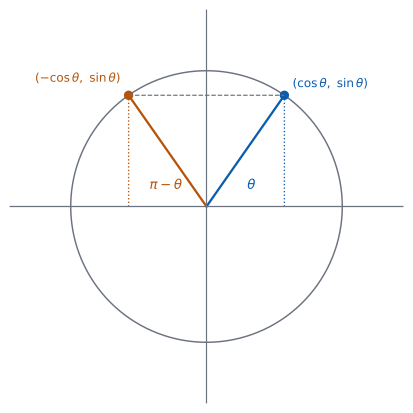
三角関数どうしの関係を、グラフの対称性から読み取ります。
単位円の上で、角 \(\theta\) の点は \((\cos\theta,\ \sin\theta)\) です(SL 3.5)。
図 1 のとおり、\(\pi-\theta\) の点は、\(\theta\) の点を \(y\) 軸について折り返したものです。ですから
\[ (\text{$\pi-\theta$ の点}) = (-\cos\theta,\ \sin\theta) \]
です。\(y\) 座標はそのまま、\(x\) 座標だけ符号が変わります。
覚える式はありません。単位円の図を \(1\) つかけば、その場で読めます。
\(\theta\) の点をかいて、聞かれている角の点がどこに移るかを見てください。
2. The three relationships for \(\pi-\theta\)(\(\pi-\theta\) の \(3\) つの関係)
関係は \(3\) つあります。
\[ \sin(\pi-\theta) = \sin\theta \tag{1}\]
\[ \cos(\pi-\theta) = -\cos\theta \tag{2}\]
\[ \tan(\pi-\theta) = -\tan\theta \tag{3}\]
\(\sin\) だけが符号を変えません。 \(y\) 座標が \(\sin\) だからです(第 1 節)。
\(\tan\) は \(\dfrac{\sin}{\cos}\) なので、分母だけ符号が変わって、全体が負になります。
例題 1 Use the compound angle identities to show that \(\sin(\pi-\theta) = \sin\theta\) and that \(\cos(\pi-\theta) = -\cos\theta\).
日本語訳
加法定理を使って、\(\sin(\pi-\theta) = \sin\theta\) と \(\cos(\pi-\theta) = -\cos\theta\) を示しなさい。
\(\sin(A-B)\) の形に当てはめます(HL 3.10)。\(A = \pi\)、\(B = \theta\) です。
\[ \sin(\pi-\theta) = \sin\pi\cos\theta - \cos\pi\sin\theta \]
\(\sin\pi = 0\)、\(\cos\pi = -1\) を入れます。
\[ = 0 \cdot \cos\theta - (-1)\sin\theta = \sin\theta \]
\(\cos\) も同じです。\(\cos(A-B)\) の右辺は \(+\) です(HL 3.10)。
\[ \cos(\pi-\theta) = \cos\pi\cos\theta + \sin\pi\sin\theta = -\cos\theta + 0 = -\cos\theta \]
検算。 \(\theta = \dfrac{\pi}{3}\) で確かめます。 \(\sin\dfrac{2\pi}{3} = \dfrac{\sqrt{3}}{2} = \sin\dfrac{\pi}{3}\) ✓
検算(\(\cos\) のほう)。 \(\cos\dfrac{2\pi}{3} = -\dfrac{1}{2}\) で、\(-\cos\dfrac{\pi}{3} = -\dfrac{1}{2}\) ✓ 符号が逆になっています。
\[\sin(\pi-\theta) = \sin\pi\cos\theta-\cos\pi\sin\theta = 0\cdot\cos\theta-(-1)\sin\theta = \sin\theta\]
\[\cos(\pi-\theta) = \cos\pi\cos\theta+\sin\pi\sin\theta = (-1)\cos\theta+0\cdot\sin\theta = -\cos\theta\]
3. Negative angles: odd and even(負の角:奇関数と偶関数)
\(-\theta\) の点は、\(\theta\) の点を\(x\) 軸について折り返したものです。ですから
\[ \sin(-\theta) = -\sin\theta, \qquad \cos(-\theta) = \cos\theta, \qquad \tan(-\theta) = -\tan\theta \tag{4}\]
です。これは、\(\sin\) と \(\tan\) が odd function(奇関数)、\(\cos\) が even function(偶関数)だと言っているのと同じです(HL 2.14)。
| 関数 | \(f(-x)\) | 種類 | グラフ |
|---|---|---|---|
| \(\sin\) | \(-\sin x\) | odd | 原点について点対称 |
| \(\cos\) | \(\cos x\) | even | \(y\) 軸について線対称 |
| \(\tan\) | \(-\tan x\) | odd | 原点について点対称 |
4. Shifting by \(\pi\) and by \(\dfrac{\pi}{2}\)(\(\pi\) と \(\dfrac{\pi}{2}\) のずらし)
\(\pi\) を足すと、単位円の点は原点について反対側に移ります。両方の座標の符号が変わるので
\[ \sin(\pi+\theta) = -\sin\theta, \qquad \cos(\pi+\theta) = -\cos\theta, \qquad \tan(\pi+\theta) = \tan\theta \tag{5}\]
です。\(\tan\) だけ、符号が変わりません。 分子と分母の両方が負になるからです。\(\tan\) の周期が \(\pi\) であることが、ここに現れています。
\(\dfrac{\pi}{2}\) をずらすと、\(\sin\) と \(\cos\) が入れかわります。
\[ \sin\left(\frac{\pi}{2}-\theta\right) = \cos\theta, \qquad \cos\left(\frac{\pi}{2}-\theta\right) = \sin\theta \tag{6}\]
\[ \sin\left(\frac{\pi}{2}+\theta\right) = \cos\theta, \qquad \cos\left(\frac{\pi}{2}+\theta\right) = -\sin\theta \tag{7}\]
どの関係式も、具体的な角を \(1\) つ入れれば確かめられます。
\(\cos\left(\dfrac{\pi}{2}+\dfrac{\pi}{6}\right) = \cos\dfrac{2\pi}{3} = -\dfrac{1}{2}\) で、\(-\sin\dfrac{\pi}{6} = -\dfrac{1}{2}\) ✓ 合っています。
符号を \(1\) つ覚えまちがえても、\(20\) 秒で見つかります。
例題 2 Let \(\alpha\) be an angle with \(\sin\alpha = \dfrac{2}{3}\) and \(\dfrac{\pi}{2} < \alpha < \pi\).
(a) Find the exact value of \(\cos\alpha\).
(b) Find the exact value of \(\sin(\pi-\alpha)\).
(c) Find the exact value of \(\cos(\pi+\alpha)\).
日本語訳
\(\sin\alpha = \dfrac{2}{3}\)、\(\dfrac{\pi}{2} < \alpha < \pi\) とします。
(a) \(\cos\alpha\) の正確な値を求めなさい。
(b) \(\sin(\pi-\alpha)\) の正確な値を求めなさい。
(c) \(\cos(\pi+\alpha)\) の正確な値を求めなさい。
(a) \(\cos^{2}\alpha = 1 - \dfrac{4}{9} = \dfrac{5}{9}\) なので \(\cos\alpha = \pm\dfrac{\sqrt{5}}{3}\) です。
\(\alpha\) は第 \(2\) 象限の角なので、\(\cos\) は負です。
\[ \cos\alpha = -\frac{\sqrt{5}}{3} \]
(b) 式 1 から、そのままです。
\[ \sin(\pi-\alpha) = \sin\alpha = \frac{2}{3} \]
(c) 式 5 から
\[ \cos(\pi+\alpha) = -\cos\alpha = \frac{\sqrt{5}}{3} \]
検算。 \(\sin^{2}+\cos^{2} = 1\) で確かめます。 \(\dfrac{4}{9} + \dfrac{5}{9} = 1\) ✓
検算(象限で)。 \(\pi + \alpha\) は \(\pi\) と \(\dfrac{3\pi}{2}\) のあいだ、つまり第 \(3\) 象限…ではありません。\(\alpha\) が \(\dfrac{\pi}{2}\) と \(\pi\) のあいだなので、\(\pi+\alpha\) は \(\dfrac{3\pi}{2}\) と \(2\pi\) のあいだで、第 \(4\) 象限です。第 \(4\) 象限では \(\cos\) が正 ✓ 答えが正であることと合っています。
(a) \(\cos^{2}\alpha = 1-\dfrac{4}{9} = \dfrac{5}{9}\), and \(\alpha\) is in the second quadrant, so
\[\cos\alpha = -\frac{\sqrt{5}}{3}\]
(b) \(\sin(\pi-\alpha) = \sin\alpha = \dfrac{2}{3}\)
(c) \(\cos(\pi+\alpha) = -\cos\alpha = \dfrac{\sqrt{5}}{3}\)
5. The same facts read off the graphs(グラフの対称性として読む)
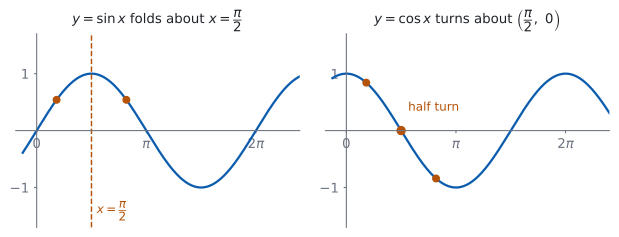
図 2 の左は \(y = \sin x\) です。\(x = \dfrac{\pi}{2}\) について線対称になっています。
\(\dfrac{\pi}{2}\) から左右に同じだけ離れた \(2\) 点、つまり \(\dfrac{\pi}{2}-a\) と \(\dfrac{\pi}{2}+a\) で、高さが同じです。\(\theta = \dfrac{\pi}{2}-a\) と置くと \(\pi-\theta = \dfrac{\pi}{2}+a\) なので、これは 式 1 そのものです。
右は \(y = \cos x\) です。点 \(\left(\dfrac{\pi}{2},\ 0\right)\) について点対称です。半回転すると重なるので、\(\dfrac{\pi}{2}\) から左右に同じだけ離れた \(2\) 点で、値の符号が逆になります。これが 式 2 です。
例題 3 Explain, using the graph of \(y = \cos x\), why \(\cos(\pi-\theta) = -\cos\theta\).
日本語訳
\(y = \cos x\) のグラフを使って、\(\cos(\pi-\theta) = -\cos\theta\) である理由を説明しなさい。
\(\theta\) と \(\pi-\theta\) は、\(\dfrac{\pi}{2}\) から左右に同じだけ離れています。 \(2\) つの平均が
\[ \frac{\theta + (\pi-\theta)}{2} = \frac{\pi}{2} \]
だからです。
図 2 の右のとおり、\(y = \cos x\) は点 \(\left(\dfrac{\pi}{2},\ 0\right)\) について点対称です。
試験ではこう書く
The two inputs \(\theta\) and \(\pi-\theta\) have mean \(\dfrac{\theta+(\pi-\theta)}{2} = \dfrac{\pi}{2}\), so they are the same distance to the left and to the right of \(x = \dfrac{\pi}{2}\).
The graph of \(y = \cos x\) has rotational symmetry of order two about the point \(\left(\dfrac{\pi}{2},\ 0\right)\): a half turn about that point maps the curve onto itself.
A half turn about a point on the \(x\)-axis sends the point \(\left(\dfrac{\pi}{2}-a,\ y\right)\) to the point \(\left(\dfrac{\pi}{2}+a,\ -y\right)\), so the two heights are negatives of each other.
Writing \(\theta = \dfrac{\pi}{2}-a\), the partner input is \(\dfrac{\pi}{2}+a = \pi-\theta\), and the two heights give \(\cos(\pi-\theta) = -\cos\theta\).
(\(\theta\) と \(\pi-\theta\) は \(\dfrac{\pi}{2}\) から等しく離れていて、\(\cos\) のグラフはそこで点対称なので、高さの符号が逆になる、という意味です。)
検算。 \(\theta = \dfrac{\pi}{3}\) で見ます。 \(\dfrac{\pi}{3}\) と \(\dfrac{2\pi}{3}\) は、\(\dfrac{\pi}{2}\) から \(\dfrac{\pi}{6}\) ずつ離れています ✓
検算(値で)。 \(\cos\dfrac{\pi}{3} = \dfrac{1}{2}\)、\(\cos\dfrac{2\pi}{3} = -\dfrac{1}{2}\) ✓ 符号だけが逆です。
The inputs \(\theta\) and \(\pi-\theta\) are equally spaced either side of \(x = \dfrac{\pi}{2}\), since their mean is \(\dfrac{\pi}{2}\).
The graph of \(y = \cos x\) has a half-turn symmetry about \(\left(\dfrac{\pi}{2},\ 0\right)\), so two inputs equally spaced either side of \(\dfrac{\pi}{2}\) give heights that are negatives of each other.
\[\cos(\pi-\theta) = -\cos\theta\]
6. Using the relationships(使い方)
よく出るのは、\(1\) つの値から、関係する角の値を書く問題です。
\(\sin\dfrac{\pi}{5} = p\) とします。すると
\(\sin\dfrac{4\pi}{5} = \sin\left(\pi-\dfrac{\pi}{5}\right) = p\)(式 1)
\(\sin\dfrac{6\pi}{5} = \sin\left(\pi+\dfrac{\pi}{5}\right) = -p\)(式 5)
\(\cos\dfrac{3\pi}{10} = \cos\left(\dfrac{\pi}{2}-\dfrac{\pi}{5}\right) = p\)(式 6)
です。まず、与えられた角との関係を式で書くのが手順です。
角を \(\pi-\theta\)、\(\pi+\theta\)、\(\dfrac{\pi}{2}\pm\theta\) のどれかの形に直します。
例題 4 Let \(\sin\dfrac{\pi}{5} = p\). Write each of the following in terms of \(p\).
(a) \(\sin\dfrac{4\pi}{5}\)
(b) \(\sin\dfrac{6\pi}{5}\)
(c) \(\cos\dfrac{3\pi}{10}\)
日本語訳
\(\sin\dfrac{\pi}{5} = p\) とします。次のそれぞれを \(p\) で表しなさい。
まず、\(\dfrac{\pi}{5}\) との関係を式で書きます(第 6 節)。
(a) \(\dfrac{4\pi}{5} = \pi - \dfrac{\pi}{5}\) です。
\[ \sin\frac{4\pi}{5} = \sin\left(\pi-\frac{\pi}{5}\right) = \sin\frac{\pi}{5} = p \]
(b) \(\dfrac{6\pi}{5} = \pi + \dfrac{\pi}{5}\) です。
\[ \sin\frac{6\pi}{5} = -\sin\frac{\pi}{5} = -p \]
(c) \(\dfrac{3\pi}{10} = \dfrac{5\pi - 2\pi}{10} = \dfrac{\pi}{2} - \dfrac{\pi}{5}\) です。
\[ \cos\frac{3\pi}{10} = \cos\left(\frac{\pi}{2}-\frac{\pi}{5}\right) = \sin\frac{\pi}{5} = p \]
検算。 象限で符号を見ます。 \(\dfrac{4\pi}{5}\) は第 \(2\) 象限なので \(\sin\) は正 ✓ \(\dfrac{6\pi}{5}\) は第 \(3\) 象限なので \(\sin\) は負 ✓
検算((c) の角)。 \(\dfrac{3\pi}{10}\) は \(\dfrac{\pi}{2}\) より小さいので第 \(1\) 象限、\(\cos\) は正 ✓ \(p\) は正なので、合っています。
(a) \(\dfrac{4\pi}{5} = \pi-\dfrac{\pi}{5}\), so \(\sin\dfrac{4\pi}{5} = \sin\dfrac{\pi}{5} = p\).
(b) \(\dfrac{6\pi}{5} = \pi+\dfrac{\pi}{5}\), so \(\sin\dfrac{6\pi}{5} = -\sin\dfrac{\pi}{5} = -p\).
(c) \(\dfrac{3\pi}{10} = \dfrac{\pi}{2}-\dfrac{\pi}{5}\), so \(\cos\dfrac{3\pi}{10} = \sin\dfrac{\pi}{5} = p\).
TI-Nspire CX II で \(\sin(\pi - 0.7)\) と \(\sin(0.7)\) を計算すると、どちらも同じ値になります。関係式を覚えまちがえていないかの確かめに使えます。
RAD になっているかを、必ず見てください。度のままだと \(\pi\) が \(3.14^{\circ}\) として扱われます。
ただし、in terms of $p$ と書かれた問題では、電卓は答えになりません。 \(p\) を使った式で答える必要があります。
Paper 1 では使えません。 このページの例題と演習は、すべて手で解けるようにしてあります。
Why it works
単位円から読む
角 \(\theta\) の点を \(P\) とします。\(P = (\cos\theta,\ \sin\theta)\) です。
\(\pi - \theta\) の点は、\(P\) を \(y\) 軸について折り返した点です。正の \(x\) 軸から測って \(\pi-\theta\) の向きは、\(\pi\) の向き(負の \(x\) 軸)から \(\theta\) だけ戻った向きだからです。
折り返しは \(x\) 座標の符号だけを変えるので、その点は \((-\cos\theta,\ \sin\theta)\) です。座標がそのまま \(\cos\) と \(\sin\) の値なので、式 1 と 式 2 が読めます。
\(\tan\) は \(\dfrac{y}{x}\) なので
\[ \tan(\pi-\theta) = \frac{\sin\theta}{-\cos\theta} = -\tan\theta \]
です。\(3\) つとも、\(1\) つの図から出ます。
\(\pi\) を足すと、なぜ \(\tan\) だけ符号が変わらないのか
\(\pi\) を足すと、点は原点について反対側に移り、両方の座標の符号が変わります。
\[ \tan(\pi+\theta) = \frac{-\sin\theta}{-\cos\theta} = \frac{\sin\theta}{\cos\theta} = \tan\theta \]
負が \(2\) つで消えます。 ですから \(\tan\) の周期は \(\pi\) で、\(\sin\) や \(\cos\) の \(2\pi\) の半分です。
\(\dfrac{\pi}{2}\) のずらしで、なぜ入れかわるのか
直角三角形で考えると分かりやすいです。\(2\) つの acute angle(鋭角)は足して \(\dfrac{\pi}{2}\) になります。
角 \(\theta\) から見た対辺は、角 \(\dfrac{\pi}{2}-\theta\) から見れば隣辺です。ですから
\[ \sin\theta = \frac{\text{対辺}}{\text{斜辺}} = \cos\left(\frac{\pi}{2}-\theta\right) \]
です。\(\cos\) の co は complementary(余角)から来ています。 「\(\cos\) は余角の \(\sin\)」という意味です。
グラフの対称性との対応
式 1 で \(\theta = \dfrac{\pi}{2}-a\) と置くと
\[ \pi - \theta = \pi - \frac{\pi}{2} + a = \frac{\pi}{2}+a \]
なので、式は
\[ \sin\left(\frac{\pi}{2}+a\right) = \sin\left(\frac{\pi}{2}-a\right) \]
になります。これは「\(x = \dfrac{\pi}{2}\) から左右に同じだけ離れた \(2\) 点で、値が等しい」という意味で、線対称そのものです。
式 2 で同じ置きかえをすると
\[ \cos\left(\frac{\pi}{2}+a\right) = -\cos\left(\frac{\pi}{2}-a\right) \]
で、値の符号が逆になります。これは点 \(\left(\dfrac{\pi}{2},\ 0\right)\) についての点対称です(HL 2.14)。
Common errors
\(\cos\) はかっこの中を分けられません(HL 3.10)。
加法定理を使うか、単位円をかいてください。 \(\cos\pi - \cos\theta = -1-\cos\theta\) は、まったく別の式です。
\(\cos^{2}\alpha = \dfrac{5}{9}\) から \(\cos\alpha\) を出すときは、\(\alpha\) がどの象限にあるかを見ます(例題 2)。
\(\dfrac{\pi}{2} < \alpha < \pi\) なら \(\cos\) は負です。\(\pm\) のまま答えないでください。
\(\tan(\pi+\theta) = \tan\theta\) です(式 5)。\(\tan\) だけ、符号が変わりません。
分子と分母の両方が負になるからです(Why it works)。
\(\dfrac{\pi}{2}-\theta\) では \(\sin\) と \(\cos\) が入れかわります(式 6)。\(\pi-\theta\) では入れかわりません。
引く数が \(\dfrac{\pi}{2}\) か \(\pi\) かを、先に見てください。
in terms of $p$ と書かれた問題では、\(p\) を使った式が答えです(第 6 節)。
小数を書いても点になりません。まず \(\pi-\theta\) などの形に直してください。
Exercises
1 Write \(\sin(\pi-\theta)\), \(\cos(\pi-\theta)\) and \(\tan(\pi-\theta)\) in terms of \(\sin\theta\), \(\cos\theta\) and \(\tan\theta\).
日本語訳
\(\sin(\pi-\theta)\)、\(\cos(\pi-\theta)\)、\(\tan(\pi-\theta)\) を、\(\sin\theta\)、\(\cos\theta\)、\(\tan\theta\) で表しなさい。
\[\sin(\pi-\theta) = \sin\theta, \qquad \cos(\pi-\theta) = -\cos\theta, \qquad \tan(\pi-\theta) = -\tan\theta\]
\(\sin\) だけ符号がそのままです(第 2 節)。単位円で、高さが変わらないことから読めます。
検算。 \(\theta = \dfrac{\pi}{4}\) で試します。\(\sin\dfrac{3\pi}{4} = \dfrac{\sqrt{2}}{2} = \sin\dfrac{\pi}{4}\) ✓
検算(\(\tan\) で)。 \(\tan\dfrac{3\pi}{4} = -1\)、\(-\tan\dfrac{\pi}{4} = -1\) ✓
2 Let \(\beta\) be an angle with \(\cos\beta = -\dfrac{1}{4}\) and \(\dfrac{\pi}{2} < \beta < \pi\). Find the exact value of (a) \(\cos(\pi-\beta)\), (b) \(\cos(-\beta)\), (c) \(\cos(\pi+\beta)\).
日本語訳
\(\cos\beta = -\dfrac{1}{4}\)、\(\dfrac{\pi}{2} < \beta < \pi\) とします。(a) \(\cos(\pi-\beta)\)、(b) \(\cos(-\beta)\)、(c) \(\cos(\pi+\beta)\) の正確な値を求めなさい。
(a) \(\cos(\pi-\beta) = -\cos\beta = \dfrac{1}{4}\)
(b) \(\cos(-\beta) = \cos\beta = -\dfrac{1}{4}\)
(c) \(\cos(\pi+\beta) = -\cos\beta = \dfrac{1}{4}\)
(b) は \(\cos\) が偶関数であることを使います(式 4)。符号は変わりません。
- と (c) は、どちらも \(-\cos\beta\) になります。\(\cos\) では、\(\pi-\beta\) と \(\pi+\beta\) が同じ値です。
検算。 \(\cos\) は偶関数なので、\(\cos(\pi-\beta)\) と \(\cos(\beta-\pi)\) も同じです。\(\beta-\pi = -(\pi-\beta)\) ✓
検算(象限で)。 \(\pi-\beta\) は \(0\) と \(\dfrac{\pi}{2}\) のあいだ、つまり第 \(1\) 象限です。\(\cos\) は正 ✓ 答えが \(\dfrac{1}{4} > 0\) と合っています。
3 Let \(\sin\dfrac{\pi}{7} = q\). Write each of the following in terms of \(q\): (a) \(\sin\dfrac{6\pi}{7}\), (b) \(\sin\dfrac{8\pi}{7}\), (c) \(\cos\dfrac{5\pi}{14}\).
日本語訳
\(\sin\dfrac{\pi}{7} = q\) とします。次のそれぞれを \(q\) で表しなさい。(a) \(\sin\dfrac{6\pi}{7}\)、(b) \(\sin\dfrac{8\pi}{7}\)、(c) \(\cos\dfrac{5\pi}{14}\)。
(a) \(\dfrac{6\pi}{7} = \pi-\dfrac{\pi}{7}\), so \(\sin\dfrac{6\pi}{7} = q\).
(b) \(\dfrac{8\pi}{7} = \pi+\dfrac{\pi}{7}\), so \(\sin\dfrac{8\pi}{7} = -q\).
(c) \(\dfrac{5\pi}{14} = \dfrac{7\pi-2\pi}{14} = \dfrac{\pi}{2}-\dfrac{\pi}{7}\), so \(\cos\dfrac{5\pi}{14} = \sin\dfrac{\pi}{7} = q\).
(c) は分母を \(14\) にそろえると見つかります。\(\dfrac{\pi}{2} = \dfrac{7\pi}{14}\)、\(\dfrac{\pi}{7} = \dfrac{2\pi}{14}\) です(例題 4)。
検算。 (a) は第 \(2\) 象限なので \(\sin\) は正 ✓ (b) は第 \(3\) 象限なので負 ✓
検算(和で)。 \(\dfrac{5\pi}{14}+\dfrac{\pi}{7} = \dfrac{5\pi+2\pi}{14} = \dfrac{\pi}{2}\) ✓ 余角の組になっています。
4 Use the compound angle identity to show that \(\cos(\pi+\theta) = -\cos\theta\).
日本語訳
加法定理を使って、\(\cos(\pi+\theta) = -\cos\theta\) を示しなさい。
\[\cos(\pi+\theta) = \cos\pi\cos\theta-\sin\pi\sin\theta = (-1)\cos\theta-0\cdot\sin\theta = -\cos\theta\]
\(\cos(A+B)\) の右辺は \(-\) です(HL 3.10)。\(A = \pi\)、\(B = \theta\) とします。
\(\sin\pi = 0\) なので、\(2\) 項目はいつも消えます。
検算。 \(\theta = 0\) では、左辺 \(\cos\pi = -1\)、右辺 \(-\cos 0 = -1\) ✓
検算(\(\theta = \dfrac{\pi}{3}\) で)。 左辺は \(\cos\dfrac{4\pi}{3} = -\dfrac{1}{2}\)、右辺は \(-\dfrac{1}{2}\) ✓
5 Simplify \(\sin(\pi-\theta)\cos(-\theta) + \cos(\pi-\theta)\sin(-\theta)\).
日本語訳
\(\sin(\pi-\theta)\cos(-\theta) + \cos(\pi-\theta)\sin(-\theta)\) を簡単にしなさい。
\[\sin(\pi-\theta) = \sin\theta, \quad \cos(-\theta) = \cos\theta, \quad \cos(\pi-\theta) = -\cos\theta, \quad \sin(-\theta) = -\sin\theta\]
\[\sin\theta\cos\theta + (-\cos\theta)(-\sin\theta) = 2\sin\theta\cos\theta = \sin 2\theta\]
\(4\) つの部分を、それぞれ書きかえてからかけ算します。\(2\) 項目は負 \(\times\) 負で正になります。
最後は \(2\) 倍角の形です(HL 3.10)。
検算。 \(\theta = \dfrac{\pi}{4}\) で試します。\(\sin\dfrac{3\pi}{4}\cos\dfrac{\pi}{4} + \cos\dfrac{3\pi}{4}\sin\dfrac{\pi}{4} = \dfrac{1}{2}+\dfrac{1}{2} = 1\) で、\(\sin\dfrac{\pi}{2} = 1\) ✓
検算(\(\theta = \dfrac{\pi}{6}\) で)。 \(\sin\dfrac{\pi}{3} = \dfrac{\sqrt{3}}{2}\) で、\(2\sin\dfrac{\pi}{6}\cos\dfrac{\pi}{6} = 2 \times \dfrac{1}{2} \times \dfrac{\sqrt{3}}{2} = \dfrac{\sqrt{3}}{2}\) ✓
6 Show that \(\tan(\pi-\theta) = -\tan\theta\), using \(\tan\theta = \dfrac{\sin\theta}{\cos\theta}\).
日本語訳
\(\tan\theta = \dfrac{\sin\theta}{\cos\theta}\) を使って、\(\tan(\pi-\theta) = -\tan\theta\) を示しなさい。
\[\tan(\pi-\theta) = \frac{\sin(\pi-\theta)}{\cos(\pi-\theta)} = \frac{\sin\theta}{-\cos\theta} = -\frac{\sin\theta}{\cos\theta} = -\tan\theta\]
分子はそのまま、分母だけ符号が変わります。 ですから、全体が負になります(Why it works)。
\(\cos\theta \neq 0\) が要ります。\(\tan\) が定義されている角で考えています。
検算。 \(\theta = \dfrac{\pi}{3}\) では、\(\tan\dfrac{2\pi}{3} = -\sqrt{3}\)、\(-\tan\dfrac{\pi}{3} = -\sqrt{3}\) ✓
検算(\(\theta = \dfrac{\pi}{6}\) で)。 \(\tan\dfrac{5\pi}{6} = -\dfrac{1}{\sqrt{3}}\) ✓
7 Solve \(\sin(\pi-\theta) = \cos\theta\) for \(0 \leq \theta \leq 2\pi\).
日本語訳
\(0 \leq \theta \leq 2\pi\) の範囲で \(\sin(\pi-\theta) = \cos\theta\) を解きなさい。
\[\sin(\pi-\theta) = \sin\theta, \quad \text{so the equation is} \quad \sin\theta = \cos\theta\]
Dividing by \(\cos\theta\) (which is not zero at any solution, since \(\sin\theta\) and \(\cos\theta\) cannot both be zero):
\[\tan\theta = 1, \qquad \theta = \frac{\pi}{4}, \quad \frac{5\pi}{4}\]
左辺を先に書きかえます(式 1)。\(\sin\theta = \cos\theta\) になれば、知っている形です。
\(\cos\theta\) で割るときは、\(\cos\theta = 0\) が解でないことを書き添えます。\(\cos\theta = 0\) なら \(\sin\theta = \pm 1 \neq 0\) なので、等式が成り立ちません。
検算。 \(\theta = \dfrac{\pi}{4}\) では、\(\sin\dfrac{3\pi}{4} = \dfrac{\sqrt{2}}{2}\)、\(\cos\dfrac{\pi}{4} = \dfrac{\sqrt{2}}{2}\) ✓
検算(\(\theta = \dfrac{5\pi}{4}\) で)。 \(\sin\left(\pi-\dfrac{5\pi}{4}\right) = \sin\left(-\dfrac{\pi}{4}\right) = -\dfrac{\sqrt{2}}{2}\)、\(\cos\dfrac{5\pi}{4} = -\dfrac{\sqrt{2}}{2}\) ✓
8 The graph of \(y = \sin x\) is symmetric about the line \(x = \dfrac{\pi}{2}\). Explain how this symmetry gives \(\sin(\pi-\theta) = \sin\theta\).
日本語訳
\(y = \sin x\) のグラフは、直線 \(x = \dfrac{\pi}{2}\) について対称です。この対称性から \(\sin(\pi-\theta) = \sin\theta\) が得られる理由を説明しなさい。
The inputs \(\theta\) and \(\pi-\theta\) have mean \(\dfrac{\pi}{2}\), so they are the same distance either side of the line \(x = \dfrac{\pi}{2}\).
Reflecting in a vertical line does not change heights, so the two inputs give the same value of \(\sin\).
\[\sin(\pi-\theta) = \sin\theta\]
\(2\) つの角の平均が \(\dfrac{\pi}{2}\) であることを、はじめに書きます(例題 3)。
線対称では、\(x\) 座標だけが動いて高さは変わりません。 ここが \(\cos\) の場合(点対称)とのちがいです。
検算。 \(\theta = \dfrac{\pi}{6}\) では、\(\dfrac{\pi}{6}\) と \(\dfrac{5\pi}{6}\) が \(\dfrac{\pi}{2}\) から \(\dfrac{\pi}{3}\) ずつ離れています ✓
検算(値で)。 \(\sin\dfrac{\pi}{6} = \sin\dfrac{5\pi}{6} = \dfrac{1}{2}\) ✓
試験ではこう書く
Take any \(\theta\) and consider the two inputs \(\theta\) and \(\pi-\theta\).
Their mean is \(\dfrac{\theta+(\pi-\theta)}{2} = \dfrac{\pi}{2}\), so writing \(\theta = \dfrac{\pi}{2}-a\) gives \(\pi-\theta = \dfrac{\pi}{2}+a\): the two inputs lie the same distance \(a\) to the left and to the right of the line \(x = \dfrac{\pi}{2}\).
The graph of \(y = \sin x\) is symmetric about that line, which means that reflecting the curve in it maps the curve onto itself.
A reflection in a vertical line changes the \(x\)-coordinate of a point but leaves its \(y\)-coordinate unchanged, so the two points of the curve at \(x = \dfrac{\pi}{2}-a\) and \(x = \dfrac{\pi}{2}+a\) have the same height.
That height is \(\sin\theta\) for the first and \(\sin(\pi-\theta)\) for the second, so \(\sin(\pi-\theta) = \sin\theta\).
9 Show that \(\sin\left(\dfrac{\pi}{2}+\theta\right) = \cos\theta\), and state what this says about the graphs of \(y = \sin x\) and \(y = \cos x\).
日本語訳
\(\sin\left(\dfrac{\pi}{2}+\theta\right) = \cos\theta\) を示し、これが \(y = \sin x\) と \(y = \cos x\) のグラフについて何を言っているかを述べなさい。
\[\sin\left(\frac{\pi}{2}+\theta\right) = \sin\frac{\pi}{2}\cos\theta+\cos\frac{\pi}{2}\sin\theta = 1\cdot\cos\theta+0\cdot\sin\theta = \cos\theta\]
So the value of \(\sin\) at \(\dfrac{\pi}{2}+\theta\) equals the value of \(\cos\) at \(\theta\): the graph of \(y = \sin x\) translated \(\dfrac{\pi}{2}\) to the left is the graph of \(y = \cos x\).
平行移動として読むところが、後半のポイントです。\(y = \sin\left(x+\dfrac{\pi}{2}\right)\) は、\(y = \sin x\) を左に \(\dfrac{\pi}{2}\) ずらしたグラフです(SL 2.11)。
検算。 \(\theta = 0\) では、\(\sin\dfrac{\pi}{2} = 1\)、\(\cos 0 = 1\) ✓
検算(\(\theta = \dfrac{\pi}{2}\) で)。 \(\sin\pi = 0\)、\(\cos\dfrac{\pi}{2} = 0\) ✓
試験ではこう書く
Apply the compound angle identity for \(\sin(A+B)\) with \(A = \dfrac{\pi}{2}\) and \(B = \theta\):
\[\sin\left(\frac{\pi}{2}+\theta\right) = \sin\frac{\pi}{2}\cos\theta+\cos\frac{\pi}{2}\sin\theta\]
Since \(\sin\dfrac{\pi}{2} = 1\) and \(\cos\dfrac{\pi}{2} = 0\), this reduces to \(\cos\theta\), which proves the identity.
Read as a statement about graphs, it says that the height of \(y = \sin x\) at \(x = \dfrac{\pi}{2}+\theta\) is the same as the height of \(y = \cos x\) at \(x = \theta\), for every \(\theta\).
Equivalently, the curve \(y = \sin\left(x+\dfrac{\pi}{2}\right)\) is the curve \(y = \cos x\), so translating the graph of \(y = \sin x\) by \(\dfrac{\pi}{2}\) in the negative \(x\)-direction gives exactly the graph of \(y = \cos x\).
The two curves have the same shape and differ only by a horizontal shift of a quarter of a period.
10 A student writes \(\cos(\pi-\theta) = \cos\pi - \cos\theta = -1-\cos\theta\). Explain the error, and give the correct value when \(\theta = \dfrac{\pi}{3}\).
日本語訳
ある生徒が \(\cos(\pi-\theta) = \cos\pi - \cos\theta = -1-\cos\theta\) と書きました。まちがいを説明し、\(\theta = \dfrac{\pi}{3}\) のときの正しい値を書きなさい。
Cosine is a function, not a quantity being multiplied out, so \(\cos(A-B)\) cannot be split as \(\cos A-\cos B\). The correct identity is
\[\cos(\pi-\theta) = \cos\pi\cos\theta+\sin\pi\sin\theta = -\cos\theta\]
At \(\theta = \dfrac{\pi}{3}\) the correct value is \(-\cos\dfrac{\pi}{3} = -\dfrac{1}{2}\), while the student’s formula gives \(-1-\dfrac{1}{2} = -\dfrac{3}{2}\), which is impossible since \(\lvert\cos x\rvert \leq 1\).
答えが \(-\dfrac{3}{2}\) になった時点で、まちがいと分かります。 \(\cos\) の値は \(-1\) 以上 \(1\) 以下です。
大きさを見るのは、いちばん早い見つけ方です。
検算。 \(\cos\dfrac{2\pi}{3} = -\dfrac{1}{2}\) ✓ 正しい式と合います。
検算(\(\theta = 0\) で)。 生徒の式なら \(-1-1 = -2\) ですが、\(\cos\pi = -1\) です ✓ ここでも合いません。
試験ではこう書く
The step \(\cos(\pi-\theta) = \cos\pi-\cos\theta\) treats \(\cos\) as if it distributed over a subtraction, but \(\cos\) is a function applied to the single angle \(\pi-\theta\), and \(\cos(A-B)\) is not \(\cos A - \cos B\) in general.
The correct tool is the compound angle identity \(\cos(A-B) = \cos A\cos B+\sin A\sin B\), which with \(A = \pi\) and \(B = \theta\) gives \(\cos(\pi-\theta) = (-1)\cos\theta+0\cdot\sin\theta = -\cos\theta\).
At \(\theta = \dfrac{\pi}{3}\) the correct value is therefore \(-\cos\dfrac{\pi}{3} = -\dfrac{1}{2}\), and indeed \(\cos\dfrac{2\pi}{3} = -\dfrac{1}{2}\).
The student’s formula gives \(-1-\dfrac{1}{2} = -\dfrac{3}{2}\), which lies outside the interval \([-1,\ 1]\) and so cannot be the cosine of any angle; that alone shows the step is wrong.