HL 5.16 — Integration by substitution and by parts(置換積分と部分積分)
- SL の置換積分に、HL で何が加わるかを言える。
- 問題文で与えられた置換を使って、積分を求められる。
- 置換したあとに残った \(x\) を、\(u\) で書き直せる。
- integration by parts(部分積分)の公式を使える。
- \(u\) を選ぶ基準を言える。
- 部分積分をくり返す問題を解ける。
The idea
1. What HL adds(SL からのつながり)
SL 5.10 では、\(\displaystyle\int k\,g'(x)\,f(g(x))\,\mathrm{d}x\) の形の積分を、inspection(見て気づく方法)と integration by substitution(置換積分)で求めました。定積分で上端・下端を \(u\) の値に変える方法も、SL 5.11 で学びました。
HL で新しく加わるのは、次の \(2\) つです。
2. When a substitution is given(置換が与えられるとき)
\(\displaystyle\int k\,g'(x)\,f(g(x))\,\mathrm{d}x\) の形でない積分では、試験の問題文に置きかえ方が書いてあります。「use the substitution \(u = \ldots\)」です。
与えられたら、素直にそれを使います。手順は SL と同じ \(4\) つです。
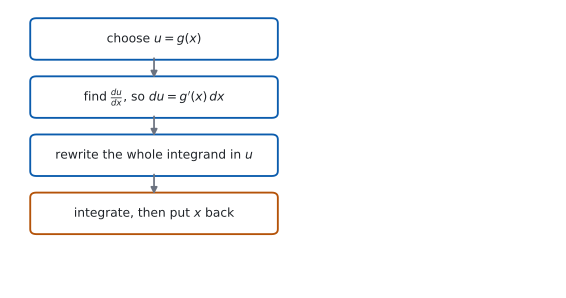
\(\mathrm{d}x\) も置きかえるのがポイントです。\(u = g(x)\) なら
\[ \mathrm{d}u = g'(x)\,\mathrm{d}x \tag{1}\]
と書きます。
SL とちがうのは、\(x\) が残りやすいことです。そのときは、\(u\) の式を \(x\) について解いて(たとえば \(x = u-1\))、残った \(x\) も \(u\) で書きます。\(x\) が \(1\) つでも残っていたら、まだ終わっていません。
例題 1 Use the substitution \(u = x+1\) to find \(\displaystyle\int x\sqrt{x+1}\,\mathrm{d}x\).
日本語訳
置換 \(u = x+1\) を使って \(\displaystyle\int x\sqrt{x+1}\,\mathrm{d}x\) を求めなさい。
\(u = x+1\) なら \(\mathrm{d}u = \mathrm{d}x\) です。\(x\) も \(u\) で書きます。 \(x = u-1\) です。
\[ \int x\sqrt{x+1}\,\mathrm{d}x = \int (u-1)\sqrt{u}\,\mathrm{d}u = \int\left(u^{\frac{3}{2}}-u^{\frac{1}{2}}\right)\mathrm{d}u \]
\[ = \frac{2}{5}u^{\frac{5}{2}}-\frac{2}{3}u^{\frac{3}{2}}+C = \frac{2}{5}(x+1)^{\frac{5}{2}}-\frac{2}{3}(x+1)^{\frac{3}{2}}+C \]
検算。 微分してもどします。 \((x+1)^{\frac{3}{2}}-(x+1)^{\frac{1}{2}} = (x+1)^{\frac{1}{2}}\left[(x+1)-1\right] = x\sqrt{x+1}\) ✓
検算(\(x\) が残っていないか)。 置きかえの途中で \(x = u-1\) を使いました ✓ \(u\) だけの式になっています。
Let \(u = x+1\), so \(\mathrm{d}u = \mathrm{d}x\) and \(x = u-1\).
\[\int x\sqrt{x+1}\,\mathrm{d}x = \int\left(u^{\frac{3}{2}}-u^{\frac{1}{2}}\right)\mathrm{d}u = \frac{2}{5}u^{\frac{5}{2}}-\frac{2}{3}u^{\frac{3}{2}}+C\]
\[= \frac{2}{5}(x+1)^{\frac{5}{2}}-\frac{2}{3}(x+1)^{\frac{3}{2}}+C\]
3. Integration by parts(部分積分)
\(x\sin x\) や \(x^{2}e^{x}\) のような積の積分は、置換ではうまくいきません。そこで、product rule(積の微分公式)を逆に使います。これを integration by parts(部分積分)といい、公式集の 5.16 の欄にあります。
\[ \int u\,\frac{\mathrm{d}v}{\mathrm{d}x}\,\mathrm{d}x = uv-\int v\,\frac{\mathrm{d}u}{\mathrm{d}x}\,\mathrm{d}x \qquad \text{or} \qquad \int u\,\mathrm{d}v = uv-\int v\,\mathrm{d}u \tag{2}\]
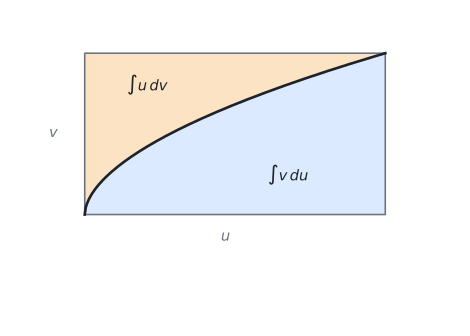
もとは積の微分公式です(Why it works)。マイナスの符号を落とさないでください。
4. Choosing \(u\)(\(u\) の選び方)
\(u\) の選び方には、LIATE ルールという目安があります。
| 種類 | 例 | |
|---|---|---|
| L | Logarithmic(対数関数) | \(\ln x\) |
| I | Inverse trigonometric(逆三角関数) | \(\arcsin x\)、\(\arctan x\) |
| A | Algebraic(多項式) | \(x\)、\(x^{2}\) |
| T | Trigonometric(三角関数) | \(\sin x\)、\(\cos x\) |
| E | Exponential(指数関数) | \(e^{x}\) |
上にあるものほど、微分すると簡単になります。下にあるものほど、積分しやすいものです(Why it works)。与えられた式の中で、この表で上にあるものを \(u\) にして、それにかけられているものを \(\dfrac{\mathrm{d}v}{\mathrm{d}x}\) とします。
- \(\displaystyle\int x\sin x\,\mathrm{d}x\) … A と T なので、\(u = x\)
- \(\displaystyle\int x^{2}e^{x}\,\mathrm{d}x\) … A と E なので、\(u = x^{2}\)
- \(\displaystyle\int \ln x\,\mathrm{d}x\) … \(\ln x \times 1\) と見ます。L なので、\(u = \ln x\)、\(\dfrac{\mathrm{d}v}{\mathrm{d}x} = 1\)
- \(\displaystyle\int \arcsin x\,\mathrm{d}x\) … I なので、\(u = \arcsin x\)、\(\dfrac{\mathrm{d}v}{\mathrm{d}x} = 1\)
\(\ln x\) や \(\arcsin x\) は、そのままでは積分できません。ですからかならず \(u\) のほうに置きます。
残った \(\dfrac{\mathrm{d}v}{\mathrm{d}x}\) は \(1\) です。\(v = x\) として使います。
例題 2 Find \(\displaystyle\int x\sin x\,\mathrm{d}x\).
日本語訳
\(\displaystyle\int x\sin x\,\mathrm{d}x\) を求めなさい。
\(u = x\)、\(\dfrac{\mathrm{d}v}{\mathrm{d}x} = \sin x\) と選びます(第 4 節)。
\[ u = x, \quad \frac{\mathrm{d}u}{\mathrm{d}x} = 1, \qquad \frac{\mathrm{d}v}{\mathrm{d}x} = \sin x, \quad v = -\cos x \]
式 2 に入れます。
\[ \int x\sin x\,\mathrm{d}x = x(-\cos x)-\int (-\cos x)(1)\,\mathrm{d}x \]
\[ = -x\cos x+\int \cos x\,\mathrm{d}x = -x\cos x+\sin x+C \]
検算。 微分してもどします。 \(-\cos x+x\sin x+\cos x = x\sin x\) ✓
検算(選び方)。 \(u = \sin x\) にすると \(\displaystyle\int \dfrac{x^{2}}{2}\cos x\,\mathrm{d}x\) が残ります ✓ もとより難しくなります。
Let \(u = x\) and \(\dfrac{\mathrm{d}v}{\mathrm{d}x} = \sin x\), so \(\dfrac{\mathrm{d}u}{\mathrm{d}x} = 1\) and \(v = -\cos x\).
\[\int x\sin x\,\mathrm{d}x = -x\cos x+\int \cos x\,\mathrm{d}x = -x\cos x+\sin x+C\]
5. Repeated integration by parts(くり返す部分積分)
\(\int x^{2}e^{x}\,\mathrm{d}x\) や \(\int e^{x}\sin x\,\mathrm{d}x\) のように、\(1\) 回では終わらないものがあります。
\(x^{2}\) のように、\(1\) 回では \(1\) にならないときはくり返します。\(x^{2} \to 2x \to 2\) と \(2\) 回です。
\(e^{x}\sin x\) は、\(2\) 回使うともとの積分がもどってきます。そこで、もとの積分を \(I\) と置いて方程式として解きます(Why it works)。
例題 3 Find \(\displaystyle\int x^{2}e^{x}\,\mathrm{d}x\).
日本語訳
\(\displaystyle\int x^{2}e^{x}\,\mathrm{d}x\) を求めなさい。
\(1\) 回目。 \(u = x^{2}\)、\(\dfrac{\mathrm{d}v}{\mathrm{d}x} = e^{x}\) です。
\[ \int x^{2}e^{x}\,\mathrm{d}x = x^{2}e^{x}-\int 2xe^{x}\,\mathrm{d}x \]
\(2\) 回目。 残った積分に、もう一度使います。\(u = 2x\)、\(\dfrac{\mathrm{d}v}{\mathrm{d}x} = e^{x}\) です。
\[ \int 2xe^{x}\,\mathrm{d}x = 2xe^{x}-\int 2e^{x}\,\mathrm{d}x = 2xe^{x}-2e^{x} \]
合わせます。
\[ \int x^{2}e^{x}\,\mathrm{d}x = x^{2}e^{x}-2xe^{x}+2e^{x}+C = e^{x}\left(x^{2}-2x+2\right)+C \]
検算。 微分してもどします。 \(e^{x}\left(x^{2}-2x+2\right)+e^{x}(2x-2) = e^{x}x^{2}\) ✓
検算(回数)。 \(x^{2} \to 2x \to 2\) で、\(2\) 回で \(x\) が消えました ✓ \(x^{3}\) なら \(3\) 回です。
\[\int x^{2}e^{x}\,\mathrm{d}x = x^{2}e^{x}-\int 2xe^{x}\,\mathrm{d}x\]
\[\int 2xe^{x}\,\mathrm{d}x = 2xe^{x}-2e^{x}\]
\[\int x^{2}e^{x}\,\mathrm{d}x = e^{x}\left(x^{2}-2x+2\right)+C\]
試験ではこう書く
Integration by parts is applied twice, because the polynomial factor \(x^{2}\) needs two differentiations before it disappears.
First application: take \(u = x^{2}\) and \(\dfrac{\mathrm{d}v}{\mathrm{d}x} = e^{x}\), so that \(\dfrac{\mathrm{d}u}{\mathrm{d}x} = 2x\) and \(v = e^{x}\).
Then
\[\int x^{2}e^{x}\,\mathrm{d}x = x^{2}e^{x}-\int 2xe^{x}\,\mathrm{d}x\]
The remaining integral is simpler, since the power of \(x\) has dropped from \(2\) to \(1\).
Second application, on that integral: take \(u = 2x\) and \(\dfrac{\mathrm{d}v}{\mathrm{d}x} = e^{x}\), so \(\dfrac{\mathrm{d}u}{\mathrm{d}x} = 2\) and \(v = e^{x}\).
Then
\[\int 2xe^{x}\,\mathrm{d}x = 2xe^{x}-\int 2e^{x}\,\mathrm{d}x = 2xe^{x}-2e^{x}\]
Combining, and writing the constant only once at the end,
\[\int x^{2}e^{x}\,\mathrm{d}x = x^{2}e^{x}-2xe^{x}+2e^{x}+C = e^{x}\left(x^{2}-2x+2\right)+C\]
Differentiating the answer returns the integrand, which confirms it.
Note that the same choice of \(u\) must be kept at each stage: switching to \(u = e^{x}\) at the second step would undo the first and return to the original integral.
TI-Nspire CX II の積分テンプレートに入れれば、置換も部分積分も自動です。\(+C\) は付きません。
答えの見た目が自分の答えとちがうことがあります。差が定数かどうかを見るか、微分してもどるかを見れば、どちらも正しいと分かります。
答案には、式を書いてください。 置換なら \(u\) と \(\mathrm{d}u\) の行、部分積分なら \(u\) と \(\dfrac{\mathrm{d}v}{\mathrm{d}x}\) を決めた行を見せます。
Paper 1 では使えません。 このページの例題と演習は、すべて手で解けるようにしてあります。
Why it works
なぜ、部分積分が成り立つのか
積の微分公式から出ます(SL 5.6)。
\[ \frac{\mathrm{d}}{\mathrm{d}x}(uv) = u\,\frac{\mathrm{d}v}{\mathrm{d}x}+v\,\frac{\mathrm{d}u}{\mathrm{d}x} \]
両辺を \(x\) で積分します。左辺は \(uv\) です。
\[ uv = \int u\,\frac{\mathrm{d}v}{\mathrm{d}x}\,\mathrm{d}x+\int v\,\frac{\mathrm{d}u}{\mathrm{d}x}\,\mathrm{d}x \]
移項すれば 式 2 です。マイナスは、移項から出ています。
図 2 の面積図でも同じことが見えます。長方形 \(uv\) が、曲線で \(2\) つに分かれています。
なぜ、\(u\) は「微分すると簡単になるほう」なのか
式 2 の右辺には、\(\displaystyle\int v\dfrac{\mathrm{d}u}{\mathrm{d}x}\mathrm{d}x\) が残ります。
この残りが、もとより易しくなっていなければ意味がありません。 \(u\) を微分するので、微分して簡単になるものを \(u\) にします。
\(x\sin x\) で \(u = \sin x\) と選ぶと、残りは \(\displaystyle\int \dfrac{x^{2}}{2}\cos x\,\mathrm{d}x\) となり、もとより難しくなります。選び方が大事なのは、このためです。
なぜ、もとの積分がもどってくることがあるのか
\(e^{x}\sin x\) では、微分しても積分しても形が変わりません。\(2\) 回使うと
\[ I = e^{x}\sin x-e^{x}\cos x-I \]
のように、右辺に \(I\) が現れます。
これは\(I\) についての \(1\) 次方程式です。\(2I = e^{x}\sin x-e^{x}\cos x\) から \(I\) が求まります。
\(+C\) は最後に付けます。 方程式を解いてから書き足してください。
Common errors
\(u\) だけ置きかえて \(\mathrm{d}x\) をそのままにすると、式が合いません(式 1)。
\(\mathrm{d}u = g'(x)\mathrm{d}x\) を、かならず書いてください。
置換したあとの式に \(x\) が残っていたら、まだ終わりではありません(第 2 節)。
\(x = u-1\) のように、\(x\) を \(u\) で表す必要があることもあります。
どちらか一方です(SL 5.11)。
上端・下端を \(u\) の値にしたら、そのまま \(u\) で計算します。\(x\) にもどすなら、上端・下端はもとのままです。
式 2 は \(uv-\displaystyle\int v\,\mathrm{d}u\) です。
プラスにすると、符号が全部ずれます。 移項から出た符号だと覚えておくと落としません(Why it works)。
微分して簡単になるほうを \(u\) にします(Why it works)。
残った積分がもとより難しくなったら、選び方が逆です。やり直してください。
どちらも、そのままでは積分できません(第 4 節)。
かならず \(u\) のほうです。残りの \(\dfrac{\mathrm{d}v}{\mathrm{d}x}\) は \(1\) になります。
Exercises
1 Use the substitution \(u = x-2\) to find \(\displaystyle\int x(x-2)^{5}\,\mathrm{d}x\).
日本語訳
置換 \(u = x-2\) を使って、\(\displaystyle\int x(x-2)^{5}\,\mathrm{d}x\) を求めなさい。
Let \(u = x-2\), so \(\mathrm{d}u = \mathrm{d}x\) and \(x = u+2\).
\[\int x(x-2)^{5}\,\mathrm{d}x = \int (u+2)u^{5}\,\mathrm{d}u = \int\left(u^{6}+2u^{5}\right)\mathrm{d}u = \frac{u^{7}}{7}+\frac{u^{6}}{3}+C\]
\[= \frac{(x-2)^{7}}{7}+\frac{(x-2)^{6}}{3}+C\]
\(x\) が残ります。 \(u = x-2\) を \(x\) について解いて、\(x = u+2\) とします(第 2 節)。かっこを展開してから積分します。
検算。 微分すると \((x-2)^{6}+2(x-2)^{5} = (x-2)^{5}\left[(x-2)+2\right] = x(x-2)^{5}\) ✓
2 Use the substitution \(u = 2x+1\) to find \(\displaystyle\int \frac{x}{\sqrt{2x+1}}\,\mathrm{d}x\).
日本語訳
置換 \(u = 2x+1\) を使って、\(\displaystyle\int \frac{x}{\sqrt{2x+1}}\,\mathrm{d}x\) を求めなさい。
Let \(u = 2x+1\), so \(\mathrm{d}u = 2\,\mathrm{d}x\) and \(x = \dfrac{u-1}{2}\).
\[\int \frac{x}{\sqrt{2x+1}}\,\mathrm{d}x = \int \frac{u-1}{2}\cdot u^{-\frac{1}{2}}\cdot\frac{1}{2}\,\mathrm{d}u = \frac{1}{4}\int\left(u^{\frac{1}{2}}-u^{-\frac{1}{2}}\right)\mathrm{d}u\]
\[= \frac{1}{4}\left(\frac{2}{3}u^{\frac{3}{2}}-2u^{\frac{1}{2}}\right)+C = \frac{1}{6}(2x+1)^{\frac{3}{2}}-\frac{1}{2}(2x+1)^{\frac{1}{2}}+C\]
\(\mathrm{d}x = \dfrac{1}{2}\mathrm{d}u\) と \(x = \dfrac{u-1}{2}\) から、\(\dfrac{1}{2}\) が \(2\) つ出ます。かけて \(\dfrac{1}{4}\) です。
検算。 微分すると \(\dfrac{1}{2}(2x+1)^{\frac{1}{2}}-\dfrac{1}{2}(2x+1)^{-\frac{1}{2}} = \dfrac{1}{2}(2x+1)^{-\frac{1}{2}}\left[(2x+1)-1\right] = \dfrac{x}{\sqrt{2x+1}}\) ✓
3 Use the substitution \(u = e^{x}\) to find \(\displaystyle\int \frac{e^{x}}{1+e^{2x}}\,\mathrm{d}x\).
日本語訳
置換 \(u = e^{x}\) を使って、\(\displaystyle\int \frac{e^{x}}{1+e^{2x}}\,\mathrm{d}x\) を求めなさい。
Let \(u = e^{x}\), so \(\mathrm{d}u = e^{x}\,\mathrm{d}x\) and \(e^{2x} = u^{2}\).
\[\int \frac{e^{x}}{1+e^{2x}}\,\mathrm{d}x = \int \frac{1}{1+u^{2}}\,\mathrm{d}u = \arctan u+C = \arctan\left(e^{x}\right)+C\]
\(e^{2x} = \left(e^{x}\right)^{2} = u^{2}\) と見るのがポイントです。分母が \(1+u^{2}\) になり、HL 5.15 の \(\arctan\) の形になります。
検算。 微分すると \(\dfrac{1}{1+\left(e^{x}\right)^{2}}\times e^{x} = \dfrac{e^{x}}{1+e^{2x}}\) ✓
4 Use the substitution \(u = x+1\) to find \(\displaystyle\int_{0}^{3} \frac{x}{\sqrt{x+1}}\,\mathrm{d}x\).
日本語訳
置換 \(u = x+1\) を使って、\(\displaystyle\int_{0}^{3} \frac{x}{\sqrt{x+1}}\,\mathrm{d}x\) を求めなさい。
Let \(u = x+1\), so \(\mathrm{d}u = \mathrm{d}x\) and \(x = u-1\). When \(x = 0\), \(u = 1\); when \(x = 3\), \(u = 4\).
\[\int_{0}^{3} \frac{x}{\sqrt{x+1}}\,\mathrm{d}x = \int_{1}^{4}\left(u^{\frac{1}{2}}-u^{-\frac{1}{2}}\right)\mathrm{d}u = \left[\frac{2}{3}u^{\frac{3}{2}}-2u^{\frac{1}{2}}\right]_{1}^{4}\]
\[= \left(\frac{16}{3}-4\right)-\left(\frac{2}{3}-2\right) = \frac{8}{3}\]
上端・下端を \(u\) の値に変えたので、\(x\) にもどす必要はありません(SL 5.11)。
検算。 \(x\) にもどして計算します。\(F(x) = \dfrac{2}{3}(x+1)^{\frac{3}{2}}-2(x+1)^{\frac{1}{2}}\) なら \(F(3)-F(0) = \dfrac{4}{3}-\left(-\dfrac{4}{3}\right) = \dfrac{8}{3}\) ✓
5 Find \(\displaystyle\int \ln x\,\mathrm{d}x\).
日本語訳
\(\displaystyle\int \ln x\,\mathrm{d}x\) を求めなさい。
Let \(u = \ln x\) and \(\dfrac{\mathrm{d}v}{\mathrm{d}x} = 1\), so \(\dfrac{\mathrm{d}u}{\mathrm{d}x} = \dfrac{1}{x}\) and \(v = x\).
\[\int \ln x\,\mathrm{d}x = x\ln x-\int x\cdot\frac{1}{x}\,\mathrm{d}x = x\ln x-x+C\]
積に見えなくても、\(1\) をかけたと思えば部分積分が使えます(第 4 節)。
\(\ln x\) は積分できないので、\(u\) のほうです。
検算。 微分すると \(\ln x+x\cdot\dfrac{1}{x}-1 = \ln x\) ✓
検算(\(x = 1\))。 答えは \(-1+C\)、被積分関数は \(0\) ✓ そこで傾きが \(0\) です。
6 Find \(\displaystyle\int x\cos x\,\mathrm{d}x\).
日本語訳
\(\displaystyle\int x\cos x\,\mathrm{d}x\) を求めなさい。
Let \(u = x\) and \(\dfrac{\mathrm{d}v}{\mathrm{d}x} = \cos x\), so \(\dfrac{\mathrm{d}u}{\mathrm{d}x} = 1\) and \(v = \sin x\).
\[\int x\cos x\,\mathrm{d}x = x\sin x-\int \sin x\,\mathrm{d}x = x\sin x+\cos x+C\]
\(-\displaystyle\int \sin x\,\mathrm{d}x = +\cos x\) です。符号が \(2\) 回変わります。
検算。 微分すると \(\sin x+x\cos x-\sin x = x\cos x\) ✓
検算(\(\sin\) のとき)。 \(\displaystyle\int x\sin x\,\mathrm{d}x = -x\cos x+\sin x+C\) ✓ 形は似ていますが符号がちがいます。
7 Find \(\displaystyle\int_{0}^{1} x e^{x}\,\mathrm{d}x\).
日本語訳
\(\displaystyle\int_{0}^{1} x e^{x}\,\mathrm{d}x\) を求めなさい。
Let \(u = x\) and \(\dfrac{\mathrm{d}v}{\mathrm{d}x} = e^{x}\), so \(v = e^{x}\).
\[\int_{0}^{1} x e^{x}\,\mathrm{d}x = \left[xe^{x}\right]_{0}^{1}-\int_{0}^{1} e^{x}\,\mathrm{d}x = e-\left[e^{x}\right]_{0}^{1} = e-(e-1) = 1\]
定積分でも、角かっこを付ければ同じです。\(uv\) の部分にも上端・下端が付きます。
検算(indefinite integral(不定積分)から)。 \(e^{x}(x-1)\) を \(0\) から \(1\) で \(0-(-1) = 1\) ✓
検算(大きさ)。 被積分関数は \(0\) から \(e\) まで増えるので、面積が \(1\) 前後なのは自然 ✓
8 Find \(\displaystyle\int e^{x}\sin x\,\mathrm{d}x\).
日本語訳
\(\displaystyle\int e^{x}\sin x\,\mathrm{d}x\) を求めなさい。
Let \(I = \displaystyle\int e^{x}\sin x\,\mathrm{d}x\). Taking \(u = \sin x\), \(\dfrac{\mathrm{d}v}{\mathrm{d}x} = e^{x}\),
\[I = e^{x}\sin x-\int e^{x}\cos x\,\mathrm{d}x\]
Applying parts again to the new integral, with \(u = \cos x\),
\[\int e^{x}\cos x\,\mathrm{d}x = e^{x}\cos x+\int e^{x}\sin x\,\mathrm{d}x = e^{x}\cos x+I\]
\[I = e^{x}\sin x-e^{x}\cos x-I, \qquad I = \frac{e^{x}\left(\sin x-\cos x\right)}{2}+C\]
もとの積分がもどってきます(Why it works)。そこで \(I\) についての方程式として解きます。
\(2\) 回とも同じ側を \(u\) にするのが大切です。\(1\) 回目に \(\sin\)、\(2\) 回目に \(e^{x}\) を \(u\) にすると、もとにもどるだけで進みません。
検算。 微分すると \(\dfrac{e^{x}(\sin x-\cos x)+e^{x}(\cos x+\sin x)}{2} = e^{x}\sin x\) ✓
検算(\(+C\))。 方程式を解いたあとに付けました ✓ 途中で付けると \(2\) 重になります。
試験ではこう書く
Write \(I = \displaystyle\int e^{x}\sin x\,\mathrm{d}x\).
Neither factor becomes simpler on differentiation, so the aim is to recover \(I\) and solve for it.
Apply integration by parts with \(u = \sin x\) and \(\dfrac{\mathrm{d}v}{\mathrm{d}x} = e^{x}\), so \(\dfrac{\mathrm{d}u}{\mathrm{d}x} = \cos x\) and \(v = e^{x}\):
\[I = e^{x}\sin x-\int e^{x}\cos x\,\mathrm{d}x\]
Apply parts a second time to \(\displaystyle\int e^{x}\cos x\,\mathrm{d}x\), keeping the trigonometric factor as \(u\) so that the process moves forward rather than reversing.
With \(u = \cos x\) and \(v = e^{x}\),
\[\int e^{x}\cos x\,\mathrm{d}x = e^{x}\cos x-\int e^{x}(-\sin x)\,\mathrm{d}x = e^{x}\cos x+I\]
Substituting back,
\[I = e^{x}\sin x-\left(e^{x}\cos x+I\right) = e^{x}\sin x-e^{x}\cos x-I\]
This is a linear equation in \(I\).
Adding \(I\) to both sides gives \(2I = e^{x}\left(\sin x-\cos x\right)\), so
\[I = \frac{e^{x}\left(\sin x-\cos x\right)}{2}+C\]
The constant of integration is added only at this final stage, after the equation has been solved.
9 Explain how to choose \(u\) and \(\dfrac{\mathrm{d}v}{\mathrm{d}x}\) when using integration by parts.
日本語訳
部分積分を使うときの \(u\) と \(\dfrac{\mathrm{d}v}{\mathrm{d}x}\) の選び方を説明しなさい。
The formula replaces one integral by \(uv\) minus another integral involving \(v\) and \(\dfrac{\mathrm{d}u}{\mathrm{d}x}\), so the new integral must be easier than the original.
Choose as \(u\) the factor that becomes simpler when differentiated, such as a power of \(x\), and as \(\dfrac{\mathrm{d}v}{\mathrm{d}x}\) a factor that can be integrated, such as \(e^{x}\) or \(\sin x\).
Functions such as \(\ln x\) and \(\arcsin x\) cannot be integrated directly, so they must be taken as \(u\), with \(\dfrac{\mathrm{d}v}{\mathrm{d}x} = 1\).
残る積分が易しくなるか、が判断の基準です(Why it works)。
\(x^{n}\) は微分すると次数が下がるので \(u\) 向きです。\(e^{x}\)、\(\sin x\)、\(\cos x\) は積分しても形が変わらないので \(\dfrac{\mathrm{d}v}{\mathrm{d}x}\) 向きです。
検算(悪い選び方)。 \(x\sin x\) で \(u = \sin x\) とすると \(\displaystyle\int\dfrac{x^{2}}{2}\cos x\,\mathrm{d}x\) ✓ 次数が上がっています。
検算(\(\ln x\))。 積分できないので \(u\) にするしかありません ✓
試験ではこう書く
The formula \(\displaystyle\int u\frac{\mathrm{d}v}{\mathrm{d}x}\mathrm{d}x = uv-\int v\frac{\mathrm{d}u}{\mathrm{d}x}\mathrm{d}x\) does not evaluate an integral by itself: it trades the original integral for a different one.
The choice of \(u\) is therefore made so that the new integral is easier than the old.
Since \(u\) is differentiated and \(\dfrac{\mathrm{d}v}{\mathrm{d}x}\) is integrated, two conditions guide the choice.
First, \(u\) should become simpler on differentiation.
A power of \(x\) is ideal, because each differentiation lowers the degree by one and after enough steps it disappears.
Second, \(\dfrac{\mathrm{d}v}{\mathrm{d}x}\) must be something that can actually be integrated, such as \(e^{x}\), \(\sin x\) or \(\cos x\), whose integrals are no harder than themselves.
Some functions force the choice.
Neither \(\ln x\) nor \(\arcsin x\) has an elementary antiderivative that is known in advance, so neither can serve as \(\dfrac{\mathrm{d}v}{\mathrm{d}x}\).
They must be taken as \(u\), and the remaining factor is then \(1\), giving \(v = x\).
A practical test is to look at the integral that remains.
If it is simpler than the original, the choice was right; if it is more complicated, swapping the two factors usually fixes it.
10 A student writes \(\displaystyle\int u\,\mathrm{d}v = uv+\int v\,\mathrm{d}u\). Identify the error and show, using \(\displaystyle\int x e^{x}\,\mathrm{d}x\), what goes wrong.
日本語訳
ある生徒が \(\displaystyle\int u\,\mathrm{d}v = uv+\int v\,\mathrm{d}u\) と書きました。まちがいを指摘し、\(\displaystyle\int x e^{x}\,\mathrm{d}x\) を使って何がいけないのかを示しなさい。
The correct formula has a minus sign: \(\displaystyle\int u\,\mathrm{d}v = uv-\int v\,\mathrm{d}u\).
With \(u = x\) and \(\mathrm{d}v = e^{x}\mathrm{d}x\), the student’s version gives \(xe^{x}+e^{x}+C\).
Differentiating this gives \(e^{x}+xe^{x}+e^{x} = xe^{x}+2e^{x}\), which is not the integrand. The correct answer is \(xe^{x}-e^{x}+C\).
符号は移項から出ています(Why it works)。プラスにすると、積の微分公式にもどりません。
検算(正しい答え)。 \(xe^{x}-e^{x}\) を微分すると \(e^{x}+xe^{x}-e^{x} = xe^{x}\) ✓
検算(差)。 \(2\) つの答えの差は \(2e^{x}\) で、定数ではありません ✓ ですから「\(+C\) のちがい」では説明できません。
試験ではこう書く
The formula for integration by parts comes from the product rule,
\[\frac{\mathrm{d}}{\mathrm{d}x}(uv) = u\frac{\mathrm{d}v}{\mathrm{d}x}+v\frac{\mathrm{d}u}{\mathrm{d}x}\]
Integrating both sides gives \(uv = \displaystyle\int u\,\mathrm{d}v+\int v\,\mathrm{d}u\), and rearranging to make \(\displaystyle\int u\,\mathrm{d}v\) the subject moves the second integral across, producing a minus sign:
\[\int u\,\mathrm{d}v = uv-\int v\,\mathrm{d}u\]
The student’s version has a plus sign and is therefore not equivalent to the product rule.
Applying it to \(\displaystyle\int xe^{x}\mathrm{d}x\) with \(u = x\) and \(\mathrm{d}v = e^{x}\mathrm{d}x\), so \(\mathrm{d}u = \mathrm{d}x\) and \(v = e^{x}\), the incorrect formula gives \(xe^{x}+\displaystyle\int e^{x}\mathrm{d}x = xe^{x}+e^{x}+C\).
Differentiating this result gives \(e^{x}+xe^{x}+e^{x} = xe^{x}+2e^{x}\), which is not the integrand \(xe^{x}\).
The correct formula gives \(xe^{x}-\displaystyle\int e^{x}\mathrm{d}x = xe^{x}-e^{x}+C\), whose derivative is \(e^{x}+xe^{x}-e^{x} = xe^{x}\) as required.
The two answers differ by \(2e^{x}\), which is not a constant, so this is a genuine error and not merely a different choice of constant.