SL 3.5 — The unit circle, exact values and the ambiguous case(単位円・正確な値・あいまいな場合)
- unit circle(単位円)の上の点の座標が \((\cos\theta,\ \sin\theta)\) であることを使える。
- \(\theta\) が鋭角でなくても(鈍角でも、負でも、\(2\pi\) より大きくても)、\(\cos\theta\) と \(\sin\theta\) が決まる理由が言える。
- \(\tan\theta = \dfrac{\sin\theta}{\cos\theta}\) の定義と、値をもたない角が言える。
- \(4\) つの quadrant(象限)での符号が言える。
- \(0\)、\(\dfrac{\pi}{6}\)、\(\dfrac{\pi}{4}\)、\(\dfrac{\pi}{3}\)、\(\dfrac{\pi}{2}\) の \(\sin\)・\(\cos\)・\(\tan\) を、正確な値で書ける。
- reference angle(参照角)と象限の符号から、その倍数の角の値を出せる。
- 折り返しから、\(\cos(-\theta)\)、\(\sin(\pi-\theta)\)、\(\tan(\pi+\theta)\) などを \(\theta\) の式で書ける。
- 負の角や \(2\pi\) を超える角を、まず \(0\) 以上 \(2\pi\) 未満に直せる。
- sine rule(正弦定理)で角を求めるとき、\(2\) つの候補(\(B\) と \(\pi - B\))を出せる。
- できる三角形が \(2\) つ・\(1\) つ・\(0\) のどれになるかを、理由をつけて言える。
The idea
1. The unit circle(単位円)
三角比を、どんな角にも広げるための円を見ます。図は、単位円の上で、角 \(\theta\) の位置にある点です。
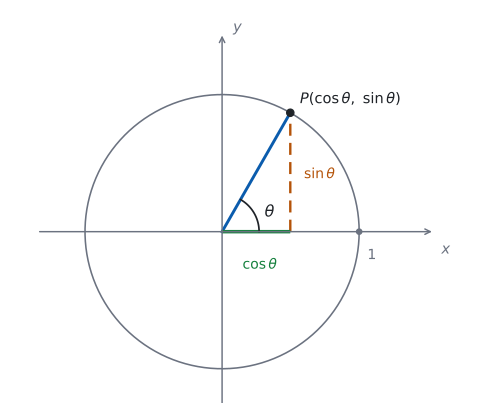
unit circle(単位円)は、原点を中心とする半径 \(1\) の円です。式で書けば \(x^{2}+y^{2}=1\) です。
角は、\(x\) 軸の正の向きから測ります。anticlockwise(反時計回り)が正、clockwise(時計回り)が負です。図 1 を見てください。
bearings(方位角)(SL 3.3)とはちがい、北からでも時計回りでもありません。 ここで混ざりやすいので、気をつけてください。
2. Definitions of \(\cos\theta\), \(\sin\theta\) and \(\tan\theta\)(\(\cos\theta\)・\(\sin\theta\)・\(\tan\theta\) の定義)
単位円の上で、角 \(\theta\) のところにある点を \(P\) とします。このとき
\[ P = (\cos\theta,\ \sin\theta) \tag{1}\]
と定めます。\(x\) 座標が \(\cos\theta\)、\(y\) 座標が \(\sin\theta\) です。
これは、直角三角形での定義(SL 3.2)を広げたものです。\(\theta\) が鋭角なら、\(2\) つは同じ値になります(Why it works)。ちがうのは、\(\theta\) が鋭角でなくても使えるところです。
- \(\theta\) が鈍角でも、点はあります。
- \(\theta\) が負でも、時計回りに測れば点はあります。
- \(\theta\) が \(2\pi\) より大きくても、何周かすればどこかの点に着きます。
点は円の上にあるので、座標は \(-1\) 以上 \(1\) 以下です。つまり
\[ -1 \le \cos\theta \le 1, \qquad -1 \le \sin\theta \le 1 \tag{2}\]
がすべての \(\theta\) で成り立ちます。
軸の上の \(4\) 点は、座標を読むだけです。 図 2 に、その \(4\) 点の \(\cos\) と \(\sin\) を書き入れてあります。
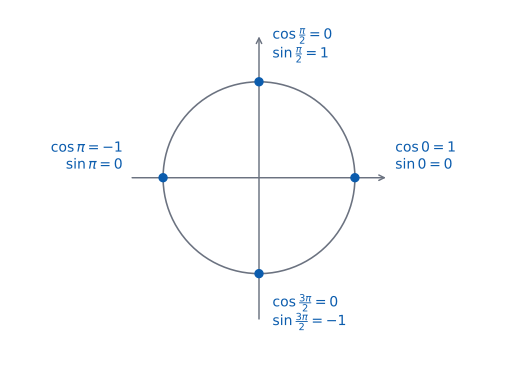
\(\tan\theta\) は、unit circle のなかの直角三角形で、\(\dfrac{\text{opposite}}{\text{adjacent}}\) を使います。
opposite \(= \sin\theta\)、adjacent \(= \cos\theta\) なので、次のようになります。
\[ \tan\theta = \frac{\sin\theta}{\cos\theta} \tag{3}\]
公式集の 3.5 の欄に Identity for tanθ として印刷されています。
\(\tan\theta = \dfrac{\sin\theta}{\cos\theta}\)
分母が \(0\) のときは定まりません。 そこは公式集には書かれていないので、自分で気をつけます。
\(\cos\theta = 0\) になるのは、点が \(y\) 軸の上にあるとき、つまり \(\theta = \dfrac{\pi}{2}\)、\(\theta = \dfrac{3\pi}{2}\)、そしてそれらに \(2\pi\) の整数倍を足した角です。そこでは \(\tan\theta\) は定まりません(英語では undefined)。
3. Quadrants and signs(象限と符号)
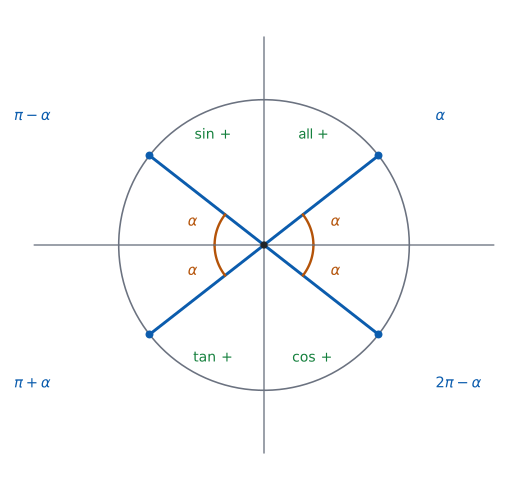
角がどの象限にあるかで、三角比の符号が決まることを見ます。図は、\(4\) つの象限での符号と、\(3\) 通りの折り返しを示しています。
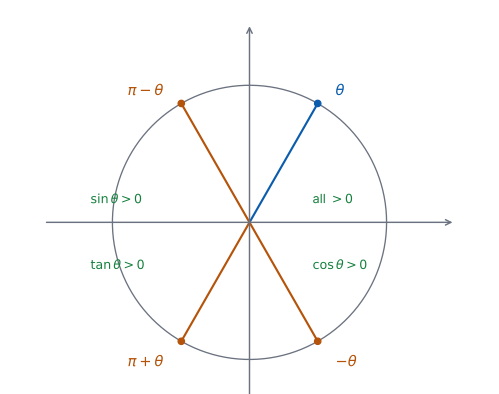
座標平面は \(4\) つの quadrant(象限)に分かれます。符号は、座標の符号を見るだけで決まります。
| 象限 | \(\theta\) の範囲 | \(\cos\theta\) | \(\sin\theta\) | \(\tan\theta\) |
|---|---|---|---|---|
| 第 \(1\) | \(0 < \theta < \dfrac{\pi}{2}\) | \(+\) | \(+\) | \(+\) |
| 第 \(2\) | \(\dfrac{\pi}{2} < \theta < \pi\) | \(-\) | \(+\) | \(-\) |
| 第 \(3\) | \(\pi < \theta < \dfrac{3\pi}{2}\) | \(-\) | \(-\) | \(+\) |
| 第 \(4\) | \(\dfrac{3\pi}{2} < \theta < 2\pi\) | \(+\) | \(-\) | \(-\) |
\(\tan\theta\) の符号は、\(2\) つの符号の割り算です。 第 \(3\) 象限で \(\tan\theta\) が正になるのは、負を負で割るからです。図 3 にまとめてあります。
4. Two special triangles(\(2\) つの特別な三角形)
正確な値のもとになる、\(2\) つの直角三角形を見ます。
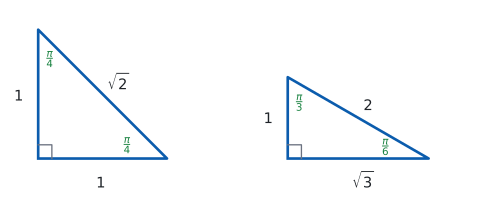
\(0\) と \(\dfrac{\pi}{2}\) の値は、単位円の軸の上の点から直接読みます(第 2 節)。それ以外の値は、\(2\) つの三角形から読み取るだけです。図 4 を見てください。
- 正方形を対角線で半分にすると、\(\dfrac{\pi}{4}\)、\(\dfrac{\pi}{4}\)、\(\dfrac{\pi}{2}\) の直角三角形になります。辺の比は \(1 : 1 : \sqrt{2}\) です。
- 正三角形を高さで半分にすると、\(\dfrac{\pi}{6}\)、\(\dfrac{\pi}{3}\)、\(\dfrac{\pi}{2}\) の直角三角形になります。辺の比は \(1 : \sqrt{3} : 2\) です。
どちらも、ピタゴラスの定理で辺の長さを出せます(Why it works)。
exact values(正確な値)は、この \(2\) つの三角形から読み取ったものです。
表 2 が、覚えておく値です。
| \(\theta\) | \(0\) | \(\dfrac{\pi}{6}\) | \(\dfrac{\pi}{4}\) | \(\dfrac{\pi}{3}\) | \(\dfrac{\pi}{2}\) |
|---|---|---|---|---|---|
| \(\sin\theta\) | \(0\) | \(\dfrac{1}{2}\) | \(\dfrac{\sqrt{2}}{2}\) | \(\dfrac{\sqrt{3}}{2}\) | \(1\) |
| \(\cos\theta\) | \(1\) | \(\dfrac{\sqrt{3}}{2}\) | \(\dfrac{\sqrt{2}}{2}\) | \(\dfrac{1}{2}\) | \(0\) |
| \(\tan\theta\) | \(0\) | \(\dfrac{\sqrt{3}}{3}\) | \(1\) | \(\sqrt{3}\) | なし |
この表は公式集にはありません。 Paper 1 は電卓なしなので、覚える必要があります。
\(\sin\) の行は \(0, \dfrac{1}{2}, \dfrac{\sqrt{2}}{2}, \dfrac{\sqrt{3}}{2}, 1\) と増えていき、\(\cos\) の行はそれを逆に並べたものです。 この見方だと、\(2\) 行を取りちがえにくくなります。
\(\dfrac{\sqrt{3}}{3}\) は \(\dfrac{1}{\sqrt{3}}\) を有理化した形です。答案ではどちらでもかまいませんが、分母に \(\sqrt{\ }\) を残さない形がふつうです。
5. Reference angles and reflections(参照角と、折り返しでできる関係)
\(\dfrac{\pi}{2}\) より大きい角の三角比を、参照角を使って求めます。図は、各象限での参照角を示しています。
第 \(4\) 節の表にあるのは \(0\) から \(\dfrac{\pi}{2}\) までです。それ以外の角は、\(4\) つの手順で出します。
- reference angle(参照角)\(\alpha\) を出す … 円の半径と \(x\) 軸のなす鋭角です。図 5 を見てください。
- \(\alpha\) の \(\sin\)・\(\cos\)・\(\tan\) を、表 2 から読む。
- もとの角がどの象限にあるかを見る。
- その象限の符号を付ける(第 3 節)。
参照角 \(\alpha\) は、\(0 \le \theta < 2\pi\) なら次のようになります。
| 象限 | 第 \(1\) | 第 \(2\) | 第 \(3\) | 第 \(4\) |
|---|---|---|---|---|
| 参照角 \(\alpha\) | \(\theta\) | \(\pi - \theta\) | \(\theta - \pi\) | \(2\pi - \theta\) |
たとえば \(\theta = \dfrac{5\pi}{6}\) は第 \(2\) 象限で、参照角は \(\alpha = \pi - \dfrac{5\pi}{6} = \dfrac{\pi}{6}\) です。よって、\(\sin\alpha\) と \(\cos\alpha\) の値を使います。 第 \(2\) 象限では \(\sin\) が正、\(\cos\) が負なので
\[ \sin\frac{5\pi}{6} = \sin\alpha = \frac{1}{2}, \qquad \cos\frac{5\pi}{6} = -\cos\alpha = -\frac{\sqrt{3}}{2} \]
です。大きさは表から、符号は象限から、と覚えてください。
\(\theta\) が \(0\)、\(\dfrac{\pi}{2}\)、\(\pi\)、\(\dfrac{3\pi}{2}\) のように軸の上にあるときは、象限がないので参照角は使いません。単位円の座標をそのまま読みます(第 2 節)。
参照角は、折り返しと同じことを言っています。
\(P\) を軸で折り返すと、別の角の点になります。座標の符号だけが変わるので、関係がそのまま読み取れます。
- \(x\) 軸で折り返す(\(\theta \to -\theta\))… \((\cos\theta,\ -\sin\theta)\)
- \(y\) 軸で折り返す(\(\theta \to \pi-\theta\))… \((-\cos\theta,\ \sin\theta)\)
- 原点で折り返す(\(\theta \to \pi+\theta\))… \((-\cos\theta,\ -\sin\theta)\)
座標を読むと、次のようになります。
\[ \begin{aligned} \cos(-\theta) &= \cos\theta, & \sin(-\theta) &= -\sin\theta \\ \cos(\pi-\theta) &= -\cos\theta, & \sin(\pi-\theta) &= \sin\theta \\ \cos(\pi+\theta) &= -\cos\theta, & \sin(\pi+\theta) &= -\sin\theta \end{aligned} \tag{4}\]
\(\tan\) は、この \(2\) つの割り算です。\(\tan\theta\) が定まる角では
\[ \tan(-\theta) = -\tan\theta, \qquad \tan(\pi-\theta) = -\tan\theta, \qquad \tan(\pi+\theta) = \tan\theta \tag{5}\]
となります。
\(y\) 軸で折り返すと、\(\sin\) はそのまま、\(\cos\) は符号が変わります。\(2\) つを同じ扱いにしないでください。
どちらの座標が動くかを図で見れば、迷いません。
例題 1 The point \(\mathrm{P}\) lies on the unit circle at an angle \(\theta\), measured anticlockwise from the positive \(x\)-axis.
(a) Write down the coordinates of \(\mathrm{P}\) when \(\theta = \pi\).
(b) Write down the value of \(\cos\dfrac{3\pi}{2}\) and the value of \(\sin\dfrac{3\pi}{2}\).
(c) Now let \(\theta\) be any angle, and suppose \(\mathrm{P}\) has coordinates \((a,\ b)\). Write down, in terms of \(a\) and \(b\), the coordinates of the point on the unit circle at angle \(\theta + \pi\).
(d) Explain why \(-1 \le \cos\theta \le 1\) for every angle \(\theta\).
日本語訳
点 \(\mathrm{P}\) は単位円の上にあり、\(x\) 軸の正の向きから反時計回りに測った角が \(\theta\) です。
(a) \(\theta = \pi\) のときの \(\mathrm{P}\) の座標を書きなさい。
(b) \(\cos\dfrac{3\pi}{2}\) の値と \(\sin\dfrac{3\pi}{2}\) の値を書きなさい。
(c) 今度は \(\theta\) をどんな角でもよいものとします。\(\mathrm{P}\) の座標が \((a,\ b)\) のとき、角 \(\theta + \pi\) にある単位円上の点の座標を、\(a\) と \(b\) で書きなさい。
(d) どんな角 \(\theta\) でも \(-1 \le \cos\theta \le 1\) になる理由を説明しなさい。
(a) \(\theta = \pi\) は半周なので、点は \(x\) 軸の負の側です(図 2)。
\[ \mathrm{P} = (-1,\ 0) \]
(b) \(\theta = \dfrac{3\pi}{2}\) は \(\dfrac{3}{4}\) 周で、点は \(y\) 軸の負の側 \((0,\ -1)\) です。座標を読みます。
\[ \cos\frac{3\pi}{2} = 0, \qquad \sin\frac{3\pi}{2} = -1 \]
(c) \(\pi\) を足すのは、原点で折り返すことです(第 5 節)。
\[ (-a,\ -b) \]
(d) Explain why なので、英語で理由を書きます。
試験ではこう書く
By definition \(\cos\theta\) is the \(x\)-coordinate of the point on the unit circle at angle \(\theta\).
Every point on the unit circle satisfies \(x^{2}+y^{2}=1\), so \(x^{2} \le 1\) and therefore \(-1 \le x \le 1\).
Hence \(-1 \le \cos\theta \le 1\) for every \(\theta\).
(定義により、\(\cos\theta\) は角 \(\theta\) にある単位円上の点の \(x\) 座標である。単位円上のどの点も \(x^{2}+y^{2}=1\) をみたすので \(x^{2} \le 1\)、したがって \(-1 \le x \le 1\) である。よってどんな \(\theta\) でも \(-1 \le \cos\theta \le 1\) である、という意味です。)
検算((a) について)。 折り返して見ます。 \(\pi = 0 + \pi\) なので、\(\theta = 0\) の点 \((1,\ 0)\) を原点で折り返した点です。符号が変わって \((-1,\ 0)\) になり、そろっています ✓ 単位円の上にあることも \((-1)^{2}+0^{2} = 1\) から分かります。
検算((b) について)。 符号の表で見ます。 \(\dfrac{3\pi}{2}\) は第 \(3\) 象限と第 \(4\) 象限の境目です。どちらでも \(\sin\theta\) は負なので、境目で \(-1\) になるのは筋が通っています ✓
検算((c) について)。 \(2\) 回折り返します。 \((-a,\ -b)\) をもう一度原点で折り返すと \((a,\ b)\) にもどります。角のほうも \(\theta + 2\pi\) でもとにもどるので、合っています ✓
(a) \[\mathrm{P} = (-1,\ 0)\]
(b) \[\cos\frac{3\pi}{2} = 0, \qquad \sin\frac{3\pi}{2} = -1\]
(c) \[(-a,\ -b)\]
(d) \(\cos\theta\) is the \(x\)-coordinate of a point on \(x^{2}+y^{2}=1\), so \(x^{2} \le 1\) and \(-1 \le \cos\theta \le 1\).
例題 2 The angle \(\theta = \dfrac{7\pi}{6}\).
(a) Write down the quadrant containing \(\theta\), and write down the reference angle.
(b) Find the exact values of \(\sin\theta\) and \(\cos\theta\).
(c) Hence find the exact value of \(\tan\theta\).
(d) Explain why \(\tan\theta\) is positive for this angle.
日本語訳
角 \(\theta = \dfrac{7\pi}{6}\) とします。
(a) \(\theta\) をふくむ象限と、参照角を書きなさい。
(b) \(\sin\theta\) と \(\cos\theta\) の正確な値を求めなさい。
(c) これらから \(\tan\theta\) の正確な値を求めなさい。
(d) この角で \(\tan\theta\) が正になる理由を説明しなさい。
(a) \(\pi < \dfrac{7\pi}{6} < \dfrac{3\pi}{2}\) なので第 \(3\) 象限です。参照角は
\[ \frac{7\pi}{6} - \pi = \frac{\pi}{6} \]
(b) 第 \(3\) 象限では \(\sin\) も \(\cos\) も負です。
\[ \sin\frac{7\pi}{6} = -\frac{1}{2}, \qquad \cos\frac{7\pi}{6} = -\frac{\sqrt{3}}{2} \]
(c) 比を取ります。
\[ \tan\frac{7\pi}{6} = \frac{-\frac{1}{2}}{-\frac{\sqrt{3}}{2}} = \frac{1}{\sqrt{3}} = \frac{\sqrt{3}}{3} \]
(d) Explain why なので、英語で理由を書きます。
試験ではこう書く
The angle \(\dfrac{7\pi}{6}\) lies in the third quadrant, where the point on the unit circle has a negative \(x\)-coordinate and a negative \(y\)-coordinate.
So \(\sin\theta < 0\) and \(\cos\theta < 0\).
Since \(\tan\theta = \dfrac{\sin\theta}{\cos\theta}\) is a quotient of two negative numbers, it is positive.
(角 \(\dfrac{7\pi}{6}\) は第 \(3\) 象限にあり、そこでは単位円上の点の \(x\) 座標も \(y\) 座標も負である。よって \(\sin\theta < 0\)、\(\cos\theta < 0\) である。\(\tan\theta = \dfrac{\sin\theta}{\cos\theta}\) は負を負で割った商なので、正になる、という意味です。)
検算((a) について)。 度に直して見ます。 \(\dfrac{7\pi}{6} = 210°\) で、\(180°\) と \(270°\) のあいだですから第 \(3\) 象限です ✓ 参照角も \(210° - 180° = 30°\) で合っています。
検算((b) について)。 \(2\) 乗の和を見ます。 点は単位円 \(x^{2}+y^{2}=1\) の上にあるはずです(第 1 節)。\(\left(-\dfrac{1}{2}\right)^{2}+\left(-\dfrac{\sqrt{3}}{2}\right)^{2} = \dfrac{1}{4}+\dfrac{3}{4} = 1\) ✓ ただし、この確かめでは符号までは分かりません。
検算((c) について)。 \(\pi\) を足す関係で見ます。 \(\dfrac{7\pi}{6} = \dfrac{\pi}{6} + \pi\) なので、\(\tan\dfrac{7\pi}{6} = \tan\dfrac{\pi}{6}\) のはずです(第 5 節)。表の \(\tan\dfrac{\pi}{6} = \dfrac{\sqrt{3}}{3}\) と一致します ✓
(a) third quadrant, reference angle \[\frac{7\pi}{6} - \pi = \frac{\pi}{6}\]
(b) \[\sin\frac{7\pi}{6} = -\frac{1}{2}, \qquad \cos\frac{7\pi}{6} = -\frac{\sqrt{3}}{2}\]
(c) \[\tan\frac{7\pi}{6} = \frac{\sqrt{3}}{3}\]
(d) In the third quadrant both coordinates are negative, so \(\tan\theta\) is a quotient of two negatives and is positive.
6. Negative angles and angles beyond \(2\pi\)(負の角と \(2\pi\) を超える角)
角に \(2\pi\) を足すと、円をちょうど \(1\) 周して同じ点にもどります。だから
\[ \cos(\theta + 2\pi) = \cos\theta, \qquad \sin(\theta + 2\pi) = \sin\theta \tag{6}\]
です。\(2\pi\) の整数倍を足しても引いても同じです。このように、同じ値が一定の間隔でくり返し出てくる性質を periodicity(周期性)といいます。
大きい角や負の角は、まず \(2\pi\) を足し引きして \(0\) 以上 \(2\pi\) 未満に直すと見やすくなります。
大きい角や負の角の正確な値も、これで出せます。 まず \(2\pi\) を足すか引くかして \(0\) 以上 \(2\pi\) 未満に直し、そのあとは 第 5 節と同じ \(4\) つの手順です。
たとえば \(\theta = \dfrac{\pi}{4}\)、\(\dfrac{9\pi}{4}\)、\(\dfrac{17\pi}{4}\) は、どれも単位円の同じ点を指します。\(\dfrac{9\pi}{4} - 2\pi = \dfrac{\pi}{4}\)、\(\dfrac{17\pi}{4} - 4\pi = \dfrac{\pi}{4}\) だからです。\(\dfrac{\pi}{4}\) は第 \(1\) 象限で \(\sin\) も \(\cos\) も正なので
\[ \sin\frac{\pi}{4} = \sin\frac{9\pi}{4} = \sin\frac{17\pi}{4} = \frac{\sqrt{2}}{2}, \qquad \cos\frac{\pi}{4} = \cos\frac{9\pi}{4} = \cos\frac{17\pi}{4} = \frac{\sqrt{2}}{2} \]
です。
表の値はすべて \(0\) 以上です。負になるかどうかは、象限を見ないと決まりません(表 3)。
参照角を出しただけで止めず、最後に符号を付けるところまでを \(1\) 組にしてください。
例題 3 In this question \(\theta\) is any angle.
(a) Write down, in terms of \(\cos\theta\) and \(\sin\theta\), the coordinates of the point on the unit circle at angle \(\theta + 2\pi\).
(b) Explain why \(\tan(\theta + \pi) = \tan\theta\) for every \(\theta\) at which \(\tan\theta\) is defined.
(c) Show that \(\tan(3\pi - \theta) = -\tan\theta\) whenever \(\tan\theta\) is defined.
(d) Write down \(\sin(\theta + 4\pi)\) in terms of \(\sin\theta\).
日本語訳
この問題では、\(\theta\) はどんな角でもよいものとします。
(a) 角 \(\theta + 2\pi\) にある単位円上の点の座標を、\(\cos\theta\) と \(\sin\theta\) で書きなさい。
(b) \(\tan\theta\) が定まるどの \(\theta\) でも \(\tan(\theta + \pi) = \tan\theta\) になる理由を説明しなさい。
(c) \(\tan\theta\) が定まるとき \(\tan(3\pi - \theta) = -\tan\theta\) であることを示しなさい。
(d) \(\sin(\theta + 4\pi)\) を \(\sin\theta\) で書きなさい。
(a) \(2\pi\) 足すのは \(1\) 周することなので、同じ点です(第 6 節)。
\[ (\cos\theta,\ \sin\theta) \]
(b) Explain why なので、英語で理由を書きます。
試験ではこう書く
Adding \(\pi\) reflects the point in the origin, so the point at angle \(\theta + \pi\) is \((-\cos\theta,\ -\sin\theta)\).
Hence \(\cos(\theta+\pi) = -\cos\theta\) and \(\sin(\theta+\pi) = -\sin\theta\).
Because \(\tan\theta\) is defined, \(\cos\theta \neq 0\), so \(\cos(\theta+\pi) \neq 0\) and we may divide: \(\tan(\theta+\pi) = \dfrac{-\sin\theta}{-\cos\theta} = \tan\theta\).
(\(\pi\) を足すことは原点で折り返すことなので、角 \(\theta + \pi\) の点は \((-\cos\theta,\ -\sin\theta)\) である。よって \(\cos(\theta+\pi) = -\cos\theta\)、\(\sin(\theta+\pi) = -\sin\theta\) である。\(\tan\theta\) が定まるので \(\cos\theta \neq 0\)、したがって \(\cos(\theta+\pi) \neq 0\) で割ってよく、\(\tan(\theta+\pi) = \tan\theta\) となる、という意味です。)
(c) Show that なので、つなぐ過程を書きます。 \(3\pi - \theta = (\pi - \theta) + 2\pi\) です。\(2\pi\) は \(1\) 周で点が同じなので、\(\cos\) も \(\sin\) も変わらず(式 6)、その比である \(\tan\) も変わりません。
\[ \tan(3\pi - \theta) = \tan(\pi - \theta) = -\tan\theta \]
最後の等号は 式 5 です。
(d) \(4\pi\) は \(2\) 周です。
\[ \sin(\theta + 4\pi) = \sin\theta \]
検算((b) について)。 象限で見ます。 \(\theta\) が第 \(1\) 象限なら \(\theta + \pi\) は第 \(3\) 象限で、どちらも \(\tan\) は正です。\(\theta\) が第 \(2\) 象限なら \(\theta + \pi\) は第 \(4\) 象限で、どちらも負です ✓ 符号が食いちがう組はありません。
検算((c) について)。 座標で確かめます。 \(3\pi - \theta\) の点は、\(1\) 周ぶんを落とせば \(\pi - \theta\) の点、つまり \((-\cos\theta,\ \sin\theta)\) です。比を取ると \(\dfrac{\sin\theta}{-\cos\theta} = -\tan\theta\) ✓
検算((d) について)。 \(2\) 段に分けます。 \(\sin(\theta + 4\pi) = \sin((\theta + 2\pi) + 2\pi) = \sin(\theta + 2\pi) = \sin\theta\) ✓ 式 6 を \(2\) 回使いました。
(a) \[(\cos\theta,\ \sin\theta)\]
(b) Adding \(\pi\) gives \((-\cos\theta,\ -\sin\theta)\), and \(\cos\theta \neq 0\), so \(\tan(\theta+\pi) = \dfrac{-\sin\theta}{-\cos\theta} = \tan\theta\).
(c) \(3\pi - \theta = (\pi - \theta) + 2\pi\) \[\tan(3\pi-\theta) = \tan(\pi-\theta) = -\tan\theta\]
(d) \[\sin(\theta + 4\pi) = \sin\theta\]
7. The ambiguous case(あいまいな場合)
正弦定理で角を求めるとき、\(2\) 辺と、そのあいだにない角(たとえば \(a\)、\(b\)、\(\hat{A}\))が分かっている形では、条件に合う三角形が \(2\) つできることも、\(1\) つのことも、\(0\) のこともあります。これを ambiguous case(あいまいな場合)といいます。
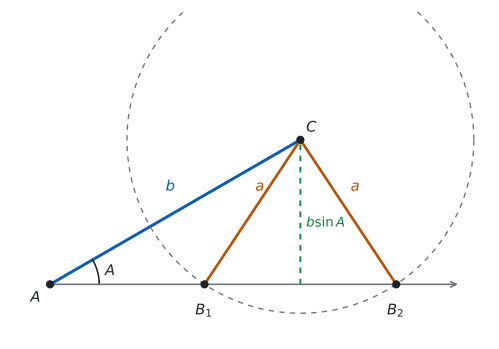
図 6 では、\(\hat{A}\) の一方の辺に \(\mathrm{AC} = b\) を取り、\(C\) を中心とする半径 \(a\) の円が、\(A\) から出るもう一方の半直線と \(2\) 回交わっています。交点が \(B_{1}\) と \(B_{2}\) の \(2\) とおりあるので、三角形も \(2\) つできます。\(2\) 辺とそのはさむ角なら、こうはなりません。 三角形が \(1\) つに決まるからです。
正弦定理(SL 3.2、公式集の 3.2 の欄)を、辺と、その向かいの角の組で使います。
\[ \frac{a}{\sin A} = \frac{b}{\sin B} \tag{7}\]
式 7 から
\[ \sin B = \frac{b\sin A}{a} \tag{8}\]
が出ますが、\(\sin B\) の値が同じ角は、\(0\) と \(\pi\) のあいだに \(2\) つあります(\(\sin B = 1\) のときだけ、\(\dfrac{\pi}{2}\) の \(1\) つです)。\(\sin(\pi - B) = \sin B\)(第 5 節)だからです。
\(C\) から半直線 \(\mathrm{AB}\) までの距離は \(b\sin A\) です。この長さと \(a\) をくらべると、円が \(2\) 回交わるか、接するか、交わらないかが決まります。
| 条件 | \(\sin B\) | 三角形の数 |
|---|---|---|
| \(a < b\sin A\) | \(1\) より大きい | \(0\) |
| \(a = b\sin A\) | ちょうど \(1\) | \(1\)(\(\hat{B} = \dfrac{\pi}{2}\)) |
| \(b\sin A < a < b\) | \(1\) より小さい | \(2\) |
| \(a \ge b\) | \(1\) より小さい | \(1\) |
\(a \ge b\) のとき候補が \(1\) つに減る理由は、\(\hat{B} \le \hat{A}\) となって \(\hat{B}\) が鈍角になれないので、鈍角のほうの候補が消えるからです。\(\hat{A}\) が直角か鈍角のときは、\(a > b\) なら \(1\) つ、そうでなければ \(0\) です。
答案では、次のように進めます。
- \(\sin B\) の値を出したら、いったん止まります。 候補は \(B\) と \(\pi - B\) の \(2\) つです。
- それぞれについて \(\hat{A} + \hat{B} < \pi\) を確かめます。 これをみたさない候補は捨てます。
- 残ったものをすべて書きます。 \(2\) つ残ったら \(2\) つとも書きます。
- 図をかいておくと、捨てた理由が伝わります。
例題 4 In triangle \(\mathrm{ABC}\), \(\hat{\mathrm{A}} = \dfrac{\pi}{6}\) and \(b = 8\), where \(b\) is the side opposite \(\hat{\mathrm{B}}\) and \(a\) is the side opposite \(\hat{\mathrm{A}}\).
(a) Given that \(a = 4\), show that there is exactly one possible triangle, and find \(\hat{\mathrm{B}}\).
(b) Given instead that \(a = 3\), show that no triangle is possible.
(c) Given instead that \(a = 10\), find the number of possible triangles, justifying your answer.
(d) Explain why there is never more than one possible triangle when \(\hat{\mathrm{A}}\) is obtuse.
日本語訳
三角形 \(\mathrm{ABC}\) で \(\hat{\mathrm{A}} = \dfrac{\pi}{6}\)、\(b = 8\) です。\(b\) は \(\hat{\mathrm{B}}\) の向かい、\(a\) は \(\hat{\mathrm{A}}\) の向かいの辺です。
(a) \(a = 4\) のとき、三角形はちょうど \(1\) つであることを示し、\(\hat{\mathrm{B}}\) を求めなさい。
(b) 代わりに \(a = 3\) のとき、三角形ができないことを示しなさい。
(c) 代わりに \(a = 10\) のとき、考えられる三角形の数を、理由をつけて求めなさい。
(d) \(\hat{\mathrm{A}}\) が鈍角のとき、三角形が \(2\) つ以上にならない理由を説明しなさい。
第 7 節の手順どおりに進めます。 \(\sin\hat{\mathrm{B}}\) を出したら、候補 \(B\) と \(\pi - B\) のそれぞれで \(\hat{\mathrm{A}} + \hat{\mathrm{B}} < \pi\) を確かめます。
(a) Show that なので、過程を書きます。
\[ \sin\hat{\mathrm{B}} = \frac{8 \times \frac{1}{2}}{4} = 1 \]
\(\sin\hat{\mathrm{B}} = 1\) となる角は \(0\) と \(\pi\) のあいだに \(\dfrac{\pi}{2}\) だけです。\(\hat{\mathrm{A}} + \hat{\mathrm{B}} = \dfrac{\pi}{6}+\dfrac{\pi}{2} = \dfrac{2\pi}{3} < \pi\) なので、この候補は三角形になります。候補が \(1\) つなので、三角形も \(1\) つです。
\[ \hat{\mathrm{B}} = \frac{\pi}{2} \]
(b) 同じように計算します。
\[ \sin\hat{\mathrm{B}} = \frac{8 \times \frac{1}{2}}{3} = \frac{4}{3} \]
\(\sin\) の値は \(1\) 以下でなければなりません(第 2 節)。\(\dfrac{4}{3} > 1\) なので、そのような角はなく、三角形はできません。
(c) justifying your answer なので、英語で理由を書きます。
\[ \sin\hat{\mathrm{B}} = \frac{8 \times \frac{1}{2}}{10} = \frac{2}{5} \]
試験ではこう書く
Here \(a = 10 > 8 = b\), so \(\hat{\mathrm{A}} > \hat{\mathrm{B}}\) because the larger side faces the larger angle.
Since \(\hat{\mathrm{A}} = \dfrac{\pi}{6}\), this forces \(\hat{\mathrm{B}} < \dfrac{\pi}{6}\), so the obtuse candidate \(\pi - \hat{\mathrm{B}}\) is rejected.
The acute candidate does give a triangle, since \(\hat{\mathrm{A}} + \hat{\mathrm{B}} < \dfrac{\pi}{3} < \pi\).
So there is exactly one possible triangle.
(ここでは \(a = 10 > 8 = b\) なので、大きい辺の向かいに大きい角が来ることから \(\hat{\mathrm{A}} > \hat{\mathrm{B}}\) である。\(\hat{\mathrm{A}} = \dfrac{\pi}{6}\) だから \(\hat{\mathrm{B}} < \dfrac{\pi}{6}\) となり、鈍角のほうの候補は捨てられる。よって三角形はちょうど \(1\) つである、という意味です。)
(d) Explain why なので、英語で理由を書きます。
試験ではこう書く
A triangle has at most one angle that is not acute, because two angles of at least \(\dfrac{\pi}{2}\) would already sum to at least \(\pi\).
If \(\hat{\mathrm{A}}\) is obtuse, then \(\hat{\mathrm{B}}\) must be acute, so of the two candidates \(\hat{\mathrm{B}}\) and \(\pi - \hat{\mathrm{B}}\) only the acute one can be used.
Hence there is at most one triangle.
(三角形で鋭角でない角は多くても \(1\) つである。\(\dfrac{\pi}{2}\) 以上の角が \(2\) つあれば、和がすでに \(\pi\) 以上になってしまうからである。\(\hat{\mathrm{A}}\) が鈍角なら \(\hat{\mathrm{B}}\) は鋭角でなければならず、\(2\) つの候補 \(\hat{\mathrm{B}}\) と \(\pi - \hat{\mathrm{B}}\) のうち鋭角のほうしか使えない。よって三角形は多くても \(1\) つである、という意味です。)
検算((a) について)。 cosine rule(余弦定理)でも見ます(SL 3.2)。\(16 = 64 + c^{2} - 8\sqrt{3}\,c\) から \(c^{2} - 8\sqrt{3}\,c + 48 = 0\) です。discriminant(判別式)は \(192 - 192 = 0\) なので \(c\) はただ \(1\) つ(\(c = 4\sqrt{3}\))で、三角形も \(1\) つ ✓ 正弦定理を通らない道すじでも同じです。
検算((b) について)。 余弦定理でも見ます。 \(9 = 64 + c^{2} - 8\sqrt{3}\,c\) から \(c^{2} - 8\sqrt{3}\,c + 55 = 0\) です。判別式は \(192 - 220 = -28 < 0\) なので、実数の \(c\) がありません ✓ 三角形はできません。
検算((c) について)。 角の和でも確かめます。 \(\sin\hat{\mathrm{B}} = \dfrac{2}{5} < \dfrac{1}{2} = \sin\dfrac{\pi}{6}\) です。\(0\) から \(\dfrac{\pi}{2}\) では \(\sin\) が増えるので、鋭角の候補は \(\dfrac{\pi}{6}\) より小さくなります。すると鈍角の候補はその補角で、\(\pi - \dfrac{\pi}{6} = \dfrac{5\pi}{6}\) より大きくなります。\(\hat{\mathrm{A}} = \dfrac{\pi}{6}\) を足すと \(\pi\) を超えるので、鈍角の候補は捨てられます ✓ 表 4 の \(4\) 行目(\(a \ge b\))とも合っています。
(a) \(\sin\hat{\mathrm{B}} = \dfrac{8\sin\frac{\pi}{6}}{4} = 1\), and only one angle in \(0 < B < \pi\) has sine \(1\); also \(\hat{\mathrm{A}} + \hat{\mathrm{B}} = \dfrac{2\pi}{3} < \pi\) \[\hat{\mathrm{B}} = \frac{\pi}{2}\]
(b) \(\sin\hat{\mathrm{B}} = \dfrac{8\sin\frac{\pi}{6}}{3} = \dfrac{4}{3} > 1\) \[\text{no triangle}\]
(c) \(a > b\) so \(\hat{\mathrm{B}} < \hat{\mathrm{A}} = \dfrac{\pi}{6}\): the obtuse candidate is rejected, and the acute one gives \(\hat{\mathrm{A}} + \hat{\mathrm{B}} < \dfrac{\pi}{3} < \pi\). \[\text{one triangle}\]
(d) A triangle has at most one non-acute angle, so \(\hat{\mathrm{B}}\) must be acute and only one candidate survives.
TI-Nspire で doc → Settings → Document Settings の Angle を Radian にしておけば、\(\cos\left(\dfrac{2\pi}{3}\right)\) のような値も、負号まで正しく出ます。
\(\tan\left(\dfrac{\pi}{2}\right)\) を入れると、undef(未定義)が返ります。 角を小数(\(1.5707963\) など)で入れた場合は、けた数の大きな数が返ることもあります。どちらも「値がない」ことの表れです。電卓の答えをそのまま書き写さないでください。
Paper 1 では使えません。 このページの例題と演習は、すべて手で解ける形にしてあります。
TI-Nspire の \(\sin^{-1}\) は、\(-\dfrac{\pi}{2}\) から \(\dfrac{\pi}{2}\) までの値しか返しません。三角形の角は正なので、返ってくるのは鋭角のほうだけです(\(\sin B = 1\) のときだけ \(\dfrac{\pi}{2}\))。
もう \(1\) つの候補 \(\pi - B\) は、自分で書き足す必要があります。 電卓は「あいまいな場合」を教えてくれません。
Paper 1 では使えません。 このページの例題と演習は、すべて手で解ける形にしてあります。
Why it works
なぜ、直角三角形の定義と同じになるのでしょうか。 \(\theta\) を鋭角とし、\(P\) から \(x\) 軸に垂線を下ろして、その足を \(H\) とします。
三角形 \(OPH\) は直角三角形で、斜辺 \(OP\) は半径なので \(1\) です。\(\theta\) から見ると、\(OH\) が隣辺、\(PH\) が対辺です。だから(SL 3.2)
\[ \cos\theta = \frac{OH}{1} = OH, \qquad \sin\theta = \frac{PH}{1} = PH \]
となり、\(OH\) と \(PH\) はそのまま \(P\) の座標の大きさです。半径を \(1\) にしたので、割り算が消えたわけです。
なぜ、鋭角でない角にも広げてよいのでしょうか。 半径 \(1\) の円では、角 \(\theta\) に対する弧の長さは \(l = r\theta = \theta\) です(SL 3.4)。だから \((1,\ 0)\) から弧を長さ \(|\theta|\) だけたどれば(\(\theta > 0\) なら反時計回り、\(\theta < 0\) なら時計回り)、着く点はちょうど \(1\) つに決まります。だから 式 1 は、どんな \(\theta\) に対しても値を \(1\) つ返します。
\(\theta\) と \(\theta + 2\pi\) のようにちがう角が同じ点になることはありますが、決めているのは「角から点へ」の向きなので、値が \(2\) つになることはありません。鋭角のところで前の定義と一致しているので、これは広げ方として筋が通っています。
なぜ、折り返しで符号だけが変わるのでしょうか。 \(x\) 軸での折り返しは、点 \((x,\ y)\) を \((x,\ -y)\) に写します。単位円は \(x\) 軸について対称なので、写った点も単位円の上にあります。
角のほうを見ると、\(x\) 軸で折り返すことは、回る向きを逆にすることです。つまり角 \(\theta\) の点は角 \(-\theta\) の点に写ります。この \(2\) つを合わせると、式 4 の \(1\) 行目になります。\(y\) 軸、原点についても同じです。
なぜ、原点を通る直線が \(y = x\tan\theta\) なのでしょうか。 その直線が単位円と交わる点の \(1\) つが \((\cos\theta,\ \sin\theta)\) です。原点とその点を通るので、gradient(傾き)は
\[ \frac{\sin\theta - 0}{\cos\theta - 0} = \tan\theta \]
です。原点を通る傾き \(m\) の直線は \(y = mx\) ですから、\(y = x\tan\theta\) になります。\(\cos\theta = 0\) のときは傾きがなく、この形では書けません。
なぜ、あの \(2\) つの三角形から値が出るのでしょうか。 まず正方形です。\(1\) 辺 \(1\) の正方形を対角線で切ると、直角をはさむ \(2\) 辺が \(1\)、\(1\) の直角三角形になります。対角線の長さは
\[ \sqrt{1^{2}+1^{2}} = \sqrt{2} \]
です。残りの \(2\) 角は等しく、和が \(\dfrac{\pi}{2}\) なので、どちらも \(\dfrac{\pi}{4}\) です。
斜辺が \(1\) になるように縮めると、この三角形は単位円の中に入ります。\(\theta\) が鋭角なら、直角三角形の比と単位円の座標は同じ値なので(第 2 節)、辺の比がそのまま \(\sin\)・\(\cos\) の値になります。だから
\[ \sin\frac{\pi}{4} = \frac{1}{\sqrt{2}} = \frac{\sqrt{2}}{2} \]
となります。\(\cos\) も同じ値、\(\tan\) は \(1\) です。
正三角形のほうも同じです。 \(1\) 辺 \(2\) の正三角形を、\(1\) つの頂点から高さで切ります。底辺は半分になって \(1\)、斜辺は \(2\) のままです。高さは
\[ \sqrt{2^{2}-1^{2}} = \sqrt{3} \]
です。もとの角 \(\dfrac{\pi}{3}\) は半分になって \(\dfrac{\pi}{6}\) になり、残りの角が \(\dfrac{\pi}{3}\) です。ここから表の \(\dfrac{\pi}{6}\) と \(\dfrac{\pi}{3}\) の列が読めます。
なぜ、候補が \(2\) つ出るのでしょうか。 式 8 で分かるのは \(\sin B\) の値だけです。\(0 < B < \pi\) の範囲で \(\sin B\) が同じ値になる角は、\(B\) と \(\pi - B\) の \(2\) つあります(\(B = \dfrac{\pi}{2}\) のときだけ、この \(2\) つが重なって \(1\) つです)。
角そのものではなく値しか分からない以上、\(2\) つとも候補です。どちらが本当かは、\(\sin\) 以外の条件で決めるしかありません。
その条件が、角の和です。 三角形の \(3\) 角の和は \(\pi\) なので、\(\hat{A} + \hat{B} < \pi\) でなければなりません。これをみたさない候補は、三角形になりません。
\(a \ge b\) のときに候補が \(1\) つになるのは、大きい辺の向かいに大きい角が来るからです。\(a \ge b\) なら \(\hat{A} \ge \hat{B}\) です。もし \(\hat{B}\) が鈍角なら \(\hat{A}\) も鈍角になり、\(2\) つの鈍角の和が \(\pi\) を超えてしまいます。だから \(\hat{B}\) は鋭角しかありえません。
Common errors
単位円の角は、\(x\) 軸の正の向きから反時計回りです(第 1 節)。方位角とは測り方がちがいます。
第 \(2\) 象限では \(x\) 座標が負なので、\(\cos\theta\) は負です(第 3 節)。座標の符号を見れば決まります。
\(\cos\dfrac{\pi}{2} = 0\) なので、\(\tan\dfrac{\pi}{2}\) は定まりません(第 2 節)。電卓が undef や大きな数を返しても、それは値ではありません。
\(\sin\) は変わらず、\(\cos\) は符号が変わります(式 4)。
単位円では、どちら向きにも、何周でも回れます(第 6 節)。\(2\pi\) を足し引きして直してください。
候補は \(B\) と \(\pi - B\) の \(2\) つです(例題 \(4\))。電卓も、\(1\) つ(ふつうは鋭角のほう)しか返しません。
\(\hat{A} + \hat{B} < \pi\) をみたさない候補は捨てます(例題 \(4\))。\(2\) つ書けばよい、というものではありません。
\(\cos\) の行は \(\sin\) の行を逆に並べたものです(第 4 節)。\(\cos 0 = 1\) から始まる、と覚えると入れかわりません。
\(\sin\) の値は \(-1\) 以上 \(1\) 以下です。\(1\) を超えたら、そこで「三角形はできない」と書きます。
参照角は \(0\) と \(\dfrac{\pi}{2}\) のあいだの角です。聞かれているのがもとの角なら、象限にもどしてから答えます。
Exercises
1 Explain why \(\cos\theta\) and \(\sin\theta\) have a value for every angle \(\theta\), including angles greater than \(2\pi\) and negative angles.
日本語訳
\(2\pi\) より大きい角や負の角もふくめて、どんな角 \(\theta\) でも \(\cos\theta\) と \(\sin\theta\) に値がある理由を説明しなさい。
Measuring \(\theta\) from the positive \(x\)-axis reaches exactly one point of the unit circle, so \(\cos\theta\) and \(\sin\theta\) are defined as its coordinates.
Explain why なので、「角を測ると点が \(1\) つ決まる」ことを根拠として書きます(第 2 節)。向きの決め方(正なら反時計回り、負なら時計回り)にもふれます。
検算。 大きい角でためします。 \(\theta = \dfrac{9\pi}{2}\) から \(2\pi\) を \(2\) 回引くと \(\dfrac{\pi}{2}\) で、点は \((0,\ 1)\) です。\(2\) 周ぶん回っても、行き先は \(1\) つに決まりました ✓
試験ではこう書く
Measure \(\theta\) from the positive \(x\)-axis, anticlockwise if \(\theta > 0\) and clockwise if \(\theta < 0\).
However large \(|\theta|\) is, this reaches exactly one point of the unit circle, because each extra turn of \(2\pi\) returns to the same point.
By definition \(\cos\theta\) and \(\sin\theta\) are the coordinates of that point, so both have a value for every \(\theta\).
2 Explain why \(\tan\theta\) is not defined when \(\theta = \dfrac{\pi}{2}\), and write down all the angles \(\theta\) with \(0 \le \theta < 4\pi\) at which \(\tan\theta\) is not defined.
日本語訳
\(\theta = \dfrac{\pi}{2}\) のとき \(\tan\theta\) が定まらない理由を説明し、\(0 \le \theta < 4\pi\) のうち \(\tan\theta\) が定まらない角をすべて書きなさい。
At \(\theta = \dfrac{\pi}{2}\) the point on the unit circle is \((0,\ 1)\), so \(\cos\dfrac{\pi}{2} = 0\). Since \(\tan\theta = \dfrac{\sin\theta}{\cos\theta}\), this would require division by zero.
\[\theta = \frac{\pi}{2},\ \frac{3\pi}{2},\ \frac{5\pi}{2},\ \frac{7\pi}{2}\]
Explain why なので、\(\cos\dfrac{\pi}{2} = 0\) を根拠として書きます(第 2 節)。
検算。 傾きでも見ます。 原点と \((0,\ 1)\) を結ぶ直線は \(y\) 軸で、傾きがありません。\(\tan\theta\) が傾きだったことと、そろっています ✓
検算(角の並びについて)。 \(\pi\) ずつ増えるか見ます。 点が \(y\) 軸に来るのは半周ごとなので、\(\dfrac{\pi}{2}\) から \(\pi\) ずつ足していけばすべて出ます。\(4\pi\) の手前で止めると \(\dfrac{7\pi}{2}\) までで、\(4\) 個です ✓
試験ではこう書く
By definition, \(\tan\theta = \dfrac{\sin\theta}{\cos\theta}\).
The point on the unit circle at \(\theta = \dfrac{\pi}{2}\) is \((0,\ 1)\), so \(\cos\dfrac{\pi}{2} = 0\) and \(\sin\dfrac{\pi}{2} = 1\).
The quotient \(\dfrac{1}{0}\) has no value, so \(\tan\dfrac{\pi}{2}\) is not defined.
Equivalently, the line through the origin at this angle is the \(y\)-axis, which has no gradient.
3 The angle \(\theta\) lies in the second quadrant. Write down the sign of \(\cos\theta\), the sign of \(\sin\theta\) and the sign of \(\tan\theta\).
日本語訳
角 \(\theta\) は第 \(2\) 象限にあります。\(\cos\theta\)、\(\sin\theta\)、\(\tan\theta\) のそれぞれの符号を書きなさい。
\[\cos\theta < 0, \qquad \sin\theta > 0, \qquad \tan\theta < 0\]
第 \(2\) 象限では \(x\) 座標が負、\(y\) 座標が正です(表 1)。
検算。 割り算で見ます。 \(\tan\theta = \dfrac{\sin\theta}{\cos\theta}\) で、正を負で割るので負です ✓ 符号を別々に覚える必要はありません。
\(\tan\theta\) だけ落とさないでください。 \(3\) つとも聞かれています。
4 Write down the exact value of \(\cos\dfrac{\pi}{3}\), and hence find the exact value of \(\cos\dfrac{2\pi}{3}\).
日本語訳
\(\cos\dfrac{\pi}{3}\) の正確な値を書き、それをもとに \(\cos\dfrac{2\pi}{3}\) の正確な値を求めなさい。
\[\cos\frac{\pi}{3} = \frac{1}{2}\]
reference angle \(\dfrac{\pi}{3}\), second quadrant
\[\cos\frac{2\pi}{3} = -\frac{1}{2}\]
参照角は \(\pi - \dfrac{2\pi}{3} = \dfrac{\pi}{3}\)、第 \(2\) 象限なので \(\cos\) は負です(表 3)。
検算。 \(\dfrac{\pi}{2}\) とくらべます。 \(\dfrac{2\pi}{3}\) は \(\dfrac{\pi}{2}\) より大きいので、\(\cos\) は負でなければなりません ✓ 大きさは \(\cos\dfrac{\pi}{3} = \dfrac{1}{2}\) と同じです。
符号を落とさないでください。 \(\dfrac{1}{2}\) は第 \(1\) 象限の値です。
5 Find the exact value of \(\tan\dfrac{5\pi}{4}\).
日本語訳
\(\tan\dfrac{5\pi}{4}\) の正確な値を求めなさい。
reference angle \(\dfrac{\pi}{4}\), third quadrant
\[\tan\frac{5\pi}{4} = 1\]
第 \(3\) 象限では \(\tan\) が正です(第 3 節)。大きさは \(\tan\dfrac{\pi}{4} = 1\) です。
検算。 \(\pi\) を足す関係で見ます。 \(\dfrac{5\pi}{4} = \dfrac{\pi}{4} + \pi\) なので \(\tan\dfrac{5\pi}{4} = \tan\dfrac{\pi}{4} = 1\) ✓
\(-1\) としないでください。 \(\tan\) が負になるのは第 \(2\) と第 \(4\) 象限です。
6 The point on the unit circle at angle \(\theta\) has coordinates \((p,\ q)\). Write down the coordinates of the point at angle \(-\theta\), and hence write down \(\sin(-\theta)\) in terms of \(\sin\theta\).
日本語訳
角 \(\theta\) にある単位円上の点の座標が \((p,\ q)\) です。角 \(-\theta\) にある点の座標を書き、それをもとに \(\sin(-\theta)\) を \(\sin\theta\) で書きなさい。
\[(p,\ -q)\]
\[\sin(-\theta) = -\sin\theta\]
\(-\theta\) は \(x\) 軸で折り返した角なので、\(y\) 座標だけ符号が変わります(第 5 節)。
検算。 \(2\) 回折り返します。 \((p,\ -q)\) をもう一度 \(x\) 軸で折り返すと \((p,\ q)\) にもどり、角も \(-(-\theta) = \theta\) にもどります ✓
\(\cos\) まで符号を変えないでください。 \(x\) 座標は動きません。
7 Find the exact value of \(\sin\dfrac{13\pi}{6}\).
日本語訳
\(\sin\dfrac{13\pi}{6}\) の正確な値を求めなさい。
\(\dfrac{13\pi}{6} - 2\pi = \dfrac{\pi}{6}\)
\[\sin\frac{13\pi}{6} = \frac{1}{2}\]
まず \(2\pi\) を引いて \(0\) 以上 \(2\pi\) 未満に直します(第 6 節)。\(\dfrac{\pi}{6}\) は第 \(1\) 象限なので、そのまま表の値です。
検算。 範囲をしぼって見ます。 \(\dfrac{13\pi}{6} - 2\pi = \dfrac{\pi}{6}\) は \(\dfrac{\pi}{4}\) より小さいので、\(\sin\) は正で、\(\sin\dfrac{\pi}{4} = \dfrac{\sqrt{2}}{2} \approx 0.71\) より小さいはずです。\(\dfrac{1}{2}\) はその範囲に入っています ✓
\(\dfrac{13\pi}{6}\) を第 \(4\) 象限としないでください。 \(2\pi\) を超えています。
8 In triangle \(\mathrm{ABC}\), \(a = 5\), \(b = 5\sqrt{3}\) and \(\hat{\mathrm{A}} = \dfrac{\pi}{6}\), where \(a\) is opposite \(\hat{\mathrm{A}}\) and \(b\) is opposite \(\hat{\mathrm{B}}\). Show that there are two possible triangles, and find both values of \(\hat{\mathrm{B}}\).
日本語訳
三角形 \(\mathrm{ABC}\) で \(a = 5\)、\(b = 5\sqrt{3}\)、\(\hat{\mathrm{A}} = \dfrac{\pi}{6}\) です(\(a\) は \(\hat{\mathrm{A}}\) の向かい、\(b\) は \(\hat{\mathrm{B}}\) の向かい)。三角形が \(2\) つできることを示し、\(\hat{\mathrm{B}}\) の値を両方とも求めなさい。
\[\sin\hat{\mathrm{B}} = \frac{5\sqrt{3} \times \frac{1}{2}}{5} = \frac{\sqrt{3}}{2}\]
\[\hat{\mathrm{B}} = \frac{\pi}{3} \ \text{ or } \ \hat{\mathrm{B}} = \frac{2\pi}{3}\]
Both give \(\hat{\mathrm{A}} + \hat{\mathrm{B}} < \pi\), so there are two triangles.
式 8 に入れてから、\(2\) つの候補を出します。\(\dfrac{\pi}{6}+\dfrac{\pi}{3} = \dfrac{\pi}{2}\)、\(\dfrac{\pi}{6}+\dfrac{2\pi}{3} = \dfrac{5\pi}{6}\) で、どちらも \(\pi\) より小さいので、どちらも三角形になります。
検算。 余弦定理でも見ます(SL 3.2)。\(25 = 75 + c^{2} - 15c\) から \(c^{2} - 15c + 50 = 0\)、つまり \((c-5)(c-10) = 0\) です。\(c = 5\) と \(c = 10\) の \(2\) つとも正なので、三角形は \(2\) つ ✓ 正弦定理を通らない道すじでも \(2\) つです。
片方だけで終わらせないでください。 「\(2\) つある」ことを示す問題です。
9 In triangle \(\mathrm{ABC}\), \(a = 7\), \(b = 5\) and \(\hat{\mathrm{A}} = \dfrac{2\pi}{3}\), where \(a\) is opposite \(\hat{\mathrm{A}}\) and \(b\) is opposite \(\hat{\mathrm{B}}\). Find the number of possible triangles, justifying your answer.
日本語訳
三角形 \(\mathrm{ABC}\) で \(a = 7\)、\(b = 5\)、\(\hat{\mathrm{A}} = \dfrac{2\pi}{3}\) です(\(a\) は \(\hat{\mathrm{A}}\) の向かい、\(b\) は \(\hat{\mathrm{B}}\) の向かい)。考えられる三角形の数を、理由をつけて求めなさい。
\[\sin\hat{\mathrm{B}} = \frac{5 \times \frac{\sqrt{3}}{2}}{7} = \frac{5\sqrt{3}}{14}\]
\(\hat{\mathrm{A}}\) is obtuse, so \(\hat{\mathrm{B}}\) must be acute and the obtuse candidate is rejected.
\[\text{one triangle}\]
justifying your answer なので、捨てた候補の理由まで書きます(例題 \(4\))。\(\dfrac{5\sqrt{3}}{14} < 1\) なので候補は \(2\) つ出ますが、\(\hat{\mathrm{A}}\) が鈍角なので鋭角のほうだけが残ります。
検算。 余弦定理でも見ます(SL 3.2)。\(49 = 25 + c^{2} + 5c\) から \(c^{2} + 5c - 24 = 0\)、つまり \((c-3)(c+8) = 0\) です。正の解は \(c = 3\) だけなので、三角形は \(1\) つ ✓ 正弦定理を通らない道すじでも \(1\) つです。
試験ではこう書く
From the sine rule \(\sin\hat{\mathrm{B}} = \dfrac{5\sin\frac{2\pi}{3}}{7} = \dfrac{5\sqrt{3}}{14}\), which is less than \(1\), so there are two candidate angles with this sine.
However \(\hat{\mathrm{A}} = \dfrac{2\pi}{3}\) is obtuse, and a triangle cannot have two non-acute angles, so \(\hat{\mathrm{B}}\) must be acute and the obtuse candidate is rejected.
The acute candidate does give a triangle: \(\dfrac{5\sqrt{3}}{14} < \dfrac{7\sqrt{3}}{14} = \sin\dfrac{\pi}{3}\), so \(\hat{\mathrm{B}} < \dfrac{\pi}{3} = \pi - \hat{\mathrm{A}}\) and \(\hat{\mathrm{A}} + \hat{\mathrm{B}} < \pi\).
There is exactly one possible triangle.
10 In triangle \(\mathrm{ABC}\), \(a = 6\), \(b = 8\) and \(\hat{\mathrm{A}} = \dfrac{\pi}{6}\). A student writes \(\sin\hat{\mathrm{B}} = \dfrac{2}{3}\), so \(\hat{\mathrm{B}} = \sin^{-1}\dfrac{2}{3}\), and stops. Identify what the student has missed, and write down the other possible value of \(\hat{\mathrm{B}}\).
日本語訳
三角形 \(\mathrm{ABC}\) で \(a = 6\)、\(b = 8\)、\(\hat{\mathrm{A}} = \dfrac{\pi}{6}\) です。ある生徒が \(\sin\hat{\mathrm{B}} = \dfrac{2}{3}\)、よって \(\hat{\mathrm{B}} = \sin^{-1}\dfrac{2}{3}\) と書いて、そこで止めました。この生徒が見落としたことを指摘し、\(\hat{\mathrm{B}}\) のもう \(1\) つの値を書きなさい。
The student has missed the obtuse candidate with the same sine.
\[\hat{\mathrm{B}} = \pi - \sin^{-1}\frac{2}{3}\]
Identify なので、何が抜けているかを名指しします。\(\sin\hat{\mathrm{B}} = \dfrac{2}{3}\) の計算は正しく、抜けているのはもう \(1\) つの候補です。
\(a = 6 < b = 8\) なので、表 4 の \(3\) 行目にあたるか確かめます。\(b\sin A = 8 \times \dfrac{1}{2} = 4\) で、\(4 < 6 < 8\) ですから三角形は \(2\) つです。
検算。 角の和で見ます。 \(\dfrac{2}{3} > \dfrac{1}{2} = \sin\dfrac{\pi}{6}\) なので、鋭角の候補は \(\dfrac{\pi}{6}\) より大きく \(\dfrac{\pi}{2}\) より小さい角です。鈍角の候補はその補角なので、\(\dfrac{\pi}{2}\) と \(\dfrac{5\pi}{6}\) のあいだにあります。\(\hat{\mathrm{A}} = \dfrac{\pi}{6}\) を足しても \(\pi\) より小さいので、こちらも三角形になります ✓
試験ではこう書く
The equation \(\sin\hat{\mathrm{B}} = \dfrac{2}{3}\) has two solutions with \(0 < \hat{\mathrm{B}} < \pi\), since \(\sin(\pi - \hat{\mathrm{B}}) = \sin\hat{\mathrm{B}}\), and the inverse sine gives only the acute one.
The other candidate is \(\pi - \sin^{-1}\dfrac{2}{3}\).
Here \(a < b\) and \(b\sin\hat{\mathrm{A}} = 4 < a\), so both candidates give a triangle and both should be stated.