AHL 1.15 — Eigenvalues and eigenvectors(固有値と固有ベクトル)
- eigenvector(固有ベクトル)とは、行列を掛けても向きが変わらないベクトルだと言える。
- characteristic equation \(\det(M - \lambda I) = 0\) を書ける(公式集に載っていません)。
- \(2 \times 2\) の eigenvalue(固有値)を、手でも電卓でも出せる。
- それぞれの \(\lambda\) に対する eigenvector を求められる。答えは1つに決まりません。
- eigenvector を列に並べて \(P\)、eigenvalue を対角に並べて \(D\) を作れる。順番をそろえる。
- \(M^{n} = PD^{n}P^{-1}\) を使って、行列の累乗を求められる。
- \(2\) つの町の人口移動などで、長い目で見たときどうなるかを説明できる。
The idea
1. Eigenvectors and eigenvalues(向きが変わらないベクトル)
行列を掛けると、ふつうベクトルは向きも長さも変わります。 ところが、向きだけは変わらない特別なベクトルがあります。
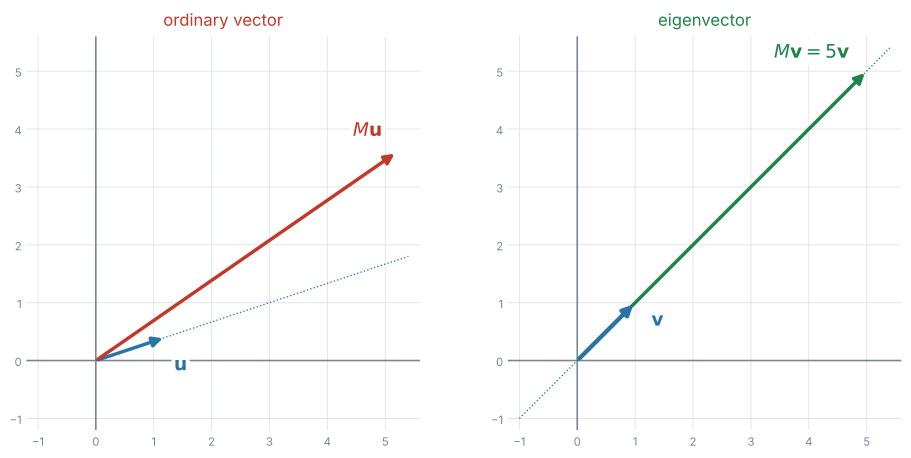
図 1 の左では、\(M\mathbf{u}\) が点線からずれています。向きが変わってしまったわけです。
右では、\(M\mathbf{v}\) が同じ点線の上に乗ったままです。長さが \(5\) 倍になっただけ。この \(\mathbf{v}\) が eigenvector、\(5\) が eigenvalue です。
\[ M\mathbf{v} = \lambda\mathbf{v}, \qquad \mathbf{v} \neq \mathbf{0} \tag{1}\]
\(\mathbf{v} \neq \mathbf{0}\) という条件
\(\mathbf{v} = \mathbf{0}\) なら \(M\mathbf{0} = \lambda\mathbf{0}\) はどんな \(\lambda\) でも成り立ってしまいます。それでは意味がないので、\(\mathbf{0}\) は eigenvector に含めません。
この条件が、次の characteristic equation を生みます。
2. The characteristic equation(固有方程式)
eigenvalue \(\lambda\) は、characteristic equation(固有方程式)という式から求めます。\(\mathbf{v}\) より先に、\(\lambda\) を見つけます。
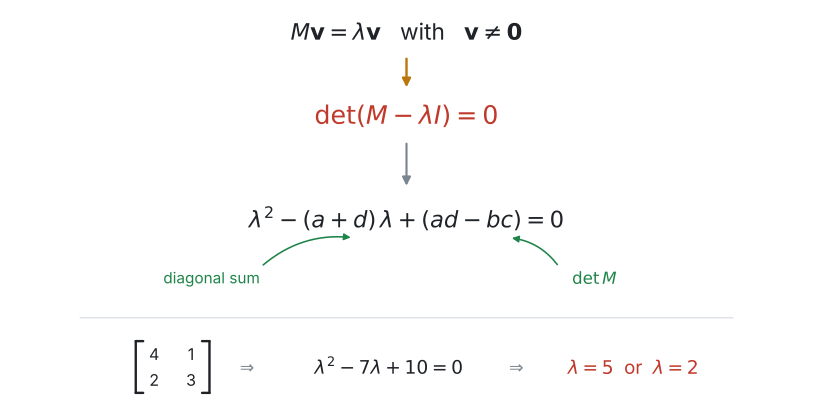
式 1 を移項すると \(M\mathbf{v} - \lambda\mathbf{v} = \mathbf{0}\)、つまり
\[ (M - \lambda I)\mathbf{v} = \mathbf{0} \]
もし \((M - \lambda I)\) に逆行列があったら、両辺に掛けて \(\mathbf{v} = \mathbf{0}\) になってしまいます。それは認めないので、inverse matrix(逆行列)があってはいけません。
逆行列がないのは \(\det = 0\) のときですから、次の式が出ます。
\[ \det(M - \lambda I) = 0 \tag{2}\]
これが characteristic equation です。公式集のどこにも載っていないので、この項目で唯一、覚えなければならない式です。
実際に展開すると
\(M = \begin{pmatrix} a & b \\ c & d \end{pmatrix}\) のとき、
\[ M - \lambda I = \begin{pmatrix} a - \lambda & b \\ c & d - \lambda \end{pmatrix} \]
\(2\times2\) の determinant をとって \(0\) とおきます。
\[ (a-\lambda)(d-\lambda) - bc = 0 \]
\[ \lambda^{2} - (a+d)\lambda + (ad - bc) = 0 \tag{3}\]
これが characteristic polynomial(固有多項式)です。
- \(\lambda\) の係数 … 対角の和(\(a + d\))に \(-\) を付けたもの
- 定数項 … \(\det M\)(\(ad - bc\))
\(M = \begin{pmatrix} 4 & 1 \\ 2 & 3 \end{pmatrix}\) なら、対角の和が \(7\)、\(\det M = 12 - 2 = 10\)。
\[ \lambda^{2} - 7\lambda + 10 = 0 \ \Rightarrow \ (\lambda-5)(\lambda-2) = 0 \]
\(\lambda = 5\) または \(\lambda = 2\) です。展開せずに書けるようになると速いです。
例題 1 Let \(M = \begin{pmatrix} 4 & 1 \\ 2 & 3 \end{pmatrix}\).
(a) Write down the characteristic equation of \(M\).
(b) Hence find the eigenvalues of \(M\).
日本語訳
\(M = \begin{pmatrix} 4 & 1 \\ 2 & 3 \end{pmatrix}\) とします。
(a) \(M\) の characteristic equation を書きなさい。
(b) これを使って、\(M\) の eigenvalue を求めなさい。
(a) 式 2 に入れます。\(M - \lambda I\) は、対角から \(\lambda\) を引くだけです。
\[ \det\begin{pmatrix} 4-\lambda & 1 \\ 2 & 3-\lambda \end{pmatrix} = 0 \]
\[ (4-\lambda)(3-\lambda) - (1)(2) = 0 \]
\[ 12 - 7\lambda + \lambda^{2} - 2 = 0 \ \Rightarrow \ \lambda^{2} - 7\lambda + 10 = 0 \]
(b) 因数分解します。
\[ (\lambda - 5)(\lambda - 2) = 0 \ \Rightarrow \ \lambda = 5 \ \text{or} \ \lambda = 2 \]
対角の和は \(4 + 3 = 7\) ✓(\(\lambda\) の係数)
\(\det M = 4(3) - 1(2) = 10\) ✓(定数項)
展開した式と一致しました。 展開でミスをしていないか、これで確かめられます。
(a) \(\det(M - \lambda I) = 0\)
\((4-\lambda)(3-\lambda) - 2 = 0\), so \(\lambda^{2} - 7\lambda + 10 = 0\)
(b) \((\lambda-5)(\lambda-2) = 0\), so \(\lambda = 5\) or \(\lambda = 2\)
3. Finding eigenvectors(固有ベクトルの求め方)
\(\lambda\) が出たら、式 1 にもどして \(\mathbf{v}\) を探します。\(\lambda = 5\) で試します。
\[ M - 5I = \begin{pmatrix} 4-5 & 1 \\ 2 & 3-5 \end{pmatrix} = \begin{pmatrix} -1 & 1 \\ 2 & -2 \end{pmatrix} \]
\((M - 5I)\mathbf{v} = \mathbf{0}\) を成分で書くと、
\[ -x + y = 0, \qquad 2x - 2y = 0 \]
\(2\)本の式が、同じことを言っています
\(2\) 本目は \(1\) 本目を \(-2\) 倍しただけです。どちらも \(y = x\) と言っています。
そうなるように \(\lambda\) を選んだ、というのがこの項目の仕組みです。\(\det(M - \lambda I) = 0\) は、まさに「\(2\) 本の式が重なる」ための条件でした。
\(2\) 本目を見て「解けない」と思わないでください。\(1\) 本使えば十分です。
\(y = x\) を満たすベクトルなら何でもよいので、いちばん簡単なものを選びます。
\[ \mathbf{v} = \begin{pmatrix} 1 \\ 1 \end{pmatrix} \]
答えは1つに決まりません
eigenvector は向きの話なので、何倍しても eigenvector のままです。
\[ M\begin{pmatrix} 2 \\ 2 \end{pmatrix} = \begin{pmatrix} 10 \\ 10 \end{pmatrix} = 5\begin{pmatrix} 2 \\ 2 \end{pmatrix} \ \checkmark \]
答案にはいちばん簡単な整数を書いてください。採点では、あなたの選んだ \(\mathbf{v}\) がそのまま使われます。
\(\lambda = 2\) も同じようにします。
\[ M - 2I = \begin{pmatrix} 2 & 1 \\ 2 & 1 \end{pmatrix} \ \Rightarrow \ 2x + y = 0 \ \Rightarrow \ y = -2x \]
\[ \mathbf{v} = \begin{pmatrix} 1 \\ -2 \end{pmatrix} \]
例題 2 For the matrix \(M = \begin{pmatrix} 4 & 1 \\ 2 & 3 \end{pmatrix}\), the eigenvalues are \(5\) and \(2\). Find an eigenvector corresponding to each eigenvalue.
日本語訳
行列 \(M = \begin{pmatrix} 4 & 1 \\ 2 & 3 \end{pmatrix}\) の eigenvalue は \(5\) と \(2\) です。それぞれの eigenvalue に対応する eigenvector を \(1\) つずつ求めなさい。
\(\lambda = 5\) のとき。 対角から \(5\) を引きます。
\[ M - 5I = \begin{pmatrix} -1 & 1 \\ 2 & -2 \end{pmatrix} \]
\(1\) 行目から \(-x + y = 0\)、つまり \(y = x\)。(\(2\) 行目も同じことを言っています。)
\[ \mathbf{v}_{1} = \begin{pmatrix} 1 \\ 1 \end{pmatrix} \]
\(\lambda = 2\) のとき。
\[ M - 2I = \begin{pmatrix} 2 & 1 \\ 2 & 1 \end{pmatrix} \]
\(1\) 行目から \(2x + y = 0\)、つまり \(y = -2x\)。
\[ \mathbf{v}_{2} = \begin{pmatrix} 1 \\ -2 \end{pmatrix} \]
検算。 \(M\mathbf{v}_{1} = \begin{pmatrix} 4+1 \\ 2+3 \end{pmatrix} = \begin{pmatrix} 5 \\ 5 \end{pmatrix} = 5\mathbf{v}_{1}\) ✓
\(M\mathbf{v}_{2} = \begin{pmatrix} 4-2 \\ 2-6 \end{pmatrix} = \begin{pmatrix} 2 \\ -4 \end{pmatrix} = 2\mathbf{v}_{2}\) ✓
\(y = -2x\) が出たら、\(x = 1\) とおいて \(y = -2\)。それだけです。
分数が出るときは、分母を払ってください。 \(y = \frac{2}{3}x\) なら \(x = 3\)、\(y = 2\) として \(\begin{pmatrix} 3 \\ 2 \end{pmatrix}\) とします。何倍しても正解なので、整数にしておくほうが、あとの計算が楽になります。
\(\lambda = 5\): \((M - 5I)\mathbf{v} = \mathbf{0}\) gives \(-x + y = 0\), so \(\mathbf{v}_{1} = \begin{pmatrix} 1 \\ 1 \end{pmatrix}\)
\(\lambda = 2\): \((M - 2I)\mathbf{v} = \mathbf{0}\) gives \(2x + y = 0\), so \(\mathbf{v}_{2} = \begin{pmatrix} 1 \\ -2 \end{pmatrix}\)
4. Diagonalization(\(P\) と \(D\) を作る)
eigenvector と eigenvalue を並べて、\(2\) つの行列 \(P\) と \(D\) を作ります。
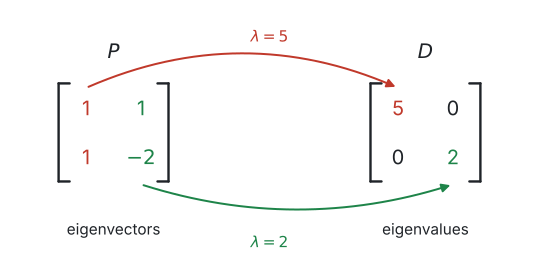
- \(P\) … eigenvector を列に並べる
- \(D\) … eigenvalue を対角に並べる
\[ P = \begin{pmatrix} 1 & 1 \\ 1 & -2 \end{pmatrix}, \qquad D = \begin{pmatrix} 5 & 0 \\ 0 & 2 \end{pmatrix} \]
\(P\) の\(1\) 列目が \(\lambda = 5\) の eigenvector なら、\(D\) の\(1\) 番目も \(5\) です。
片方だけ入れかえると、\(PDP^{-1}\) はもう \(M\) になりません。書いたら \(1\) 度、目で対応を確かめてください。
\[ M = PDP^{-1} \tag{4}\]
これが diagonalization(対角化)です。
試験で扱うのは \(2 \times 2\) の行列だけです。対角化も、eigenvalue が異なる \(2\) つの実数になる場合だけで、repeated root(重解)や複素数の eigenvalue は出ません。
例題 3 The matrix \(M = \begin{pmatrix} 4 & 1 \\ 2 & 3 \end{pmatrix}\) has eigenvalues \(5\) and \(2\), with eigenvectors \(\begin{pmatrix} 1 \\ 1 \end{pmatrix}\) and \(\begin{pmatrix} 1 \\ -2 \end{pmatrix}\).
(a) Write down matrices \(P\) and \(D\) such that \(M = PDP^{-1}\).
(b) Find \(P^{-1}\).
日本語訳
行列 \(M = \begin{pmatrix} 4 & 1 \\ 2 & 3 \end{pmatrix}\) の eigenvalue は \(5\) と \(2\) で、eigenvector はそれぞれ \(\begin{pmatrix} 1 \\ 1 \end{pmatrix}\)、\(\begin{pmatrix} 1 \\ -2 \end{pmatrix}\) です。
(a) \(M = PDP^{-1}\) となる行列 \(P\) と \(D\) を書きなさい。
(b) \(P^{-1}\) を求めなさい。
(a) eigenvector を列に、eigenvalue を対角に。順番をそろえます。
\[ P = \begin{pmatrix} 1 & 1 \\ 1 & -2 \end{pmatrix}, \qquad D = \begin{pmatrix} 5 & 0 \\ 0 & 2 \end{pmatrix} \]
(b) 公式集の逆行列の式を使います。
\[ \det P = 1(-2) - 1(1) = -3 \]
\[ P^{-1} = \frac{1}{-3}\begin{pmatrix} -2 & -1 \\ -1 & 1 \end{pmatrix} = \frac{1}{3}\begin{pmatrix} 2 & 1 \\ 1 & -1 \end{pmatrix} \]
もし \(P = \begin{pmatrix} 1 & 1 \\ -2 & 1 \end{pmatrix}\)(列を入れかえた)としながら \(D\) をそのままにすると、\(PDP^{-1}\) は別の行列になります。
\(1\) 列目は \(\lambda = 5\)、\(2\) 列目は \(\lambda = 2\)。 書いたら指で対応を追ってください。
(a) \(P = \begin{pmatrix} 1 & 1 \\ 1 & -2 \end{pmatrix}\), \(D = \begin{pmatrix} 5 & 0 \\ 0 & 2 \end{pmatrix}\)
(b) \(\det P = -3\); \(P^{-1} = \dfrac{1}{3}\begin{pmatrix} 2 & 1 \\ 1 & -1 \end{pmatrix}\)
5. Powers of a matrix(行列の累乗)
\(P\) と \(D\) を使うと、\(M\) の累乗が一気に計算できます。
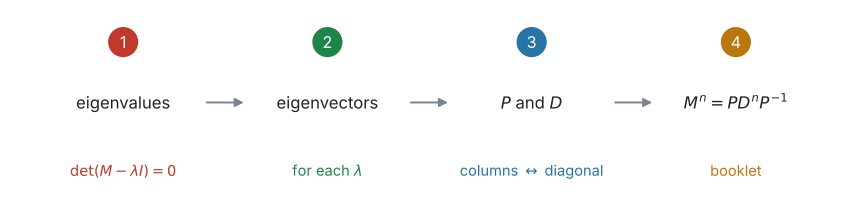
\[ M^{n} = PD^{n}P^{-1} \tag{5}\]
この式は公式集の AHL 1.15 の欄にあります。\(P\) は eigenvector を並べた行列、\(D\) は eigenvalue を並べた対角行列です。
\(D\) は対角行列なので、累乗がそのままです。
\[ D^{n} = \begin{pmatrix} 5^{n} & 0 \\ 0 & 2^{n} \end{pmatrix} \]
\(0\) が邪魔をしないので、\(\begin{pmatrix} 5 & 0 \\ 0 & 2 \end{pmatrix}^{3} = \begin{pmatrix} 125 & 0 \\ 0 & 8 \end{pmatrix}\) になります。
\(M\) を \(3\) 回掛けるより、はるかに楽です。 \(n = 20\) でも同じ手間で出せます。
例題 4 Let \(M = \begin{pmatrix} 4 & 1 \\ 2 & 3 \end{pmatrix}\), with \(P = \begin{pmatrix} 1 & 1 \\ 1 & -2 \end{pmatrix}\) and \(D = \begin{pmatrix} 5 & 0 \\ 0 & 2 \end{pmatrix}\).
Use the result \(M^{n} = PD^{n}P^{-1}\) to find \(M^{3}\).
日本語訳
\(M = \begin{pmatrix} 4 & 1 \\ 2 & 3 \end{pmatrix}\)、\(P = \begin{pmatrix} 1 & 1 \\ 1 & -2 \end{pmatrix}\)、\(D = \begin{pmatrix} 5 & 0 \\ 0 & 2 \end{pmatrix}\) とします。
\(M^{n} = PD^{n}P^{-1}\) を使って \(M^{3}\) を求めなさい。
まず \(D^{3}\) です。対角の数を \(3\) 乗するだけ。
\[ D^{3} = \begin{pmatrix} 5^{3} & 0 \\ 0 & 2^{3} \end{pmatrix} = \begin{pmatrix} 125 & 0 \\ 0 & 8 \end{pmatrix} \]
次に \(PD^{3}\)。
\[ PD^{3} = \begin{pmatrix} 1 & 1 \\ 1 & -2 \end{pmatrix}\begin{pmatrix} 125 & 0 \\ 0 & 8 \end{pmatrix} = \begin{pmatrix} 125 & 8 \\ 125 & -16 \end{pmatrix} \]
最後に \(P^{-1}\) を掛けます。
\[ M^{3} = \begin{pmatrix} 125 & 8 \\ 125 & -16 \end{pmatrix} \cdot \frac{1}{3}\begin{pmatrix} 2 & 1 \\ 1 & -1 \end{pmatrix} \]
\[ = \frac{1}{3}\begin{pmatrix} 250+8 & 125-8 \\ 250-16 & 125+16 \end{pmatrix} = \frac{1}{3}\begin{pmatrix} 258 & 117 \\ 234 & 141 \end{pmatrix} \]
\[ M^{3} = \begin{pmatrix} 86 & 39 \\ 78 & 47 \end{pmatrix} \]
検算。 \(M^{2} = \begin{pmatrix} 18 & 7 \\ 14 & 11 \end{pmatrix}\)、\(M^{2}M = \begin{pmatrix} 86 & 39 \\ 78 & 47 \end{pmatrix}\) ✓
途中で \(\dfrac{1}{3}\) を分配すると分数だらけになります。掛け算を全部すませてから割ると、整数のまま進められます。
\(258 \div 3 = 86\)、\(117 \div 3 = 39\)、\(234 \div 3 = 78\)、\(141 \div 3 = 47\)。
\(n = 3\) なら \(M\) を \(3\) 回掛けたほうが速いかもしれません。この方法の値打ちは \(n\) が大きいときです。\(M^{20}\) でも、手間はまったく同じです。
\(D^{3} = \begin{pmatrix} 125 & 0 \\ 0 & 8 \end{pmatrix}\)
\(M^{3} = PD^{3}P^{-1} = \begin{pmatrix} 125 & 8 \\ 125 & -16 \end{pmatrix}\cdot\dfrac{1}{3}\begin{pmatrix} 2 & 1 \\ 1 & -1 \end{pmatrix} = \begin{pmatrix} 86 & 39 \\ 78 & 47 \end{pmatrix}\)
6. Long-term behaviour(長い目で見たときのようす)
eigenvalue と eigenvector を使うと、\(2\) つの町の人口移動や、捕食者と獲物の数の変化などが、長い目で見てどうなるかが分かります。
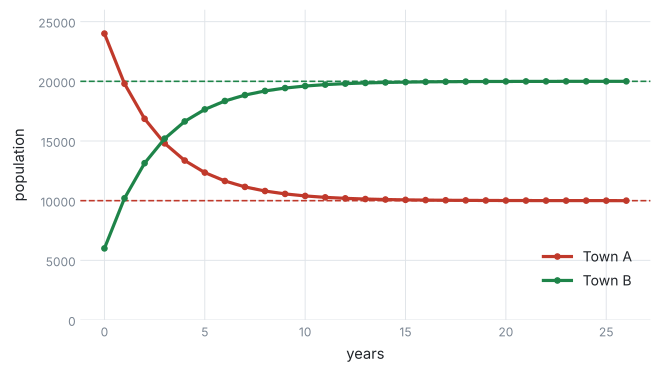
図 5 は、毎年 A 町の \(20\%\) が B 町へ、B 町の \(10\%\) が A 町へ移る場合です。
\[ T = \begin{pmatrix} 0.8 & 0.1 \\ 0.2 & 0.9 \end{pmatrix} \]
固有値は \(\lambda = 1\) と \(\lambda = 0.7\) です。
\(\lambda = 1\) は「掛けても変わらない」という意味です。そこに達したら、もう動きません。
もう一方は \(0.7\) で、\(0.7^{n}\) は \(n\) が大きくなると \(0\) に近づきます。その成分は消えていきます。
だから、どこから始めても \(\lambda = 1\) の eigenvector の比に落ち着きます。ここでは \(\begin{pmatrix} 1 \\ 2 \end{pmatrix}\)、つまり \(1 : 2\) です。
このしくみは AHL 4.19 の transition matrices(推移行列)と Markov chains、そして AHL 5.17 の coupled differential equations につながります。
例題 5 Each year, \(20\%\) of the people living in town A move to town B, and \(10\%\) of the people living in town B move to town A. The total population of the two towns is \(30\,000\) and stays the same.
The movement is modelled by \(\mathbf{s}_{n+1} = T\mathbf{s}_{n}\), where \(T = \begin{pmatrix} 0.8 & 0.1 \\ 0.2 & 0.9 \end{pmatrix}\).
(a) Initially town A has \(24\,000\) people and town B has \(6000\). Find the populations after one year.
(b) Find the eigenvalues of \(T\).
(c) Find an eigenvector corresponding to \(\lambda = 1\).
(d) Hence find the long-term population of each town, and justify your answer.
日本語訳
毎年、A 町に住む人の \(20\%\) が B 町へ、B 町に住む人の \(10\%\) が A 町へ移ります。\(2\) つの町の人口の合計は \(30\,000\) 人で、変わりません。
この移動は \(\mathbf{s}_{n+1} = T\mathbf{s}_{n}\)(\(T = \begin{pmatrix} 0.8 & 0.1 \\ 0.2 & 0.9 \end{pmatrix}\))でモデル化されます。
(a) はじめ A 町に \(24\,000\) 人、B 町に \(6000\) 人いました。\(1\) 年後の人口を求めなさい。
(b) \(T\) の eigenvalue を求めなさい。
(c) \(\lambda = 1\) に対応する eigenvector を \(1\) つ求めなさい。
(d) これを使って、長い目で見たときの各町の人口を求め、その理由を書きなさい。
(a) 行列とベクトルの掛け算です。
\[ \begin{pmatrix} 0.8 & 0.1 \\ 0.2 & 0.9 \end{pmatrix}\begin{pmatrix} 24000 \\ 6000 \end{pmatrix} = \begin{pmatrix} 19200 + 600 \\ 4800 + 5400 \end{pmatrix} = \begin{pmatrix} 19800 \\ 10200 \end{pmatrix} \]
A 町 \(19\,800\) 人、B 町 \(10\,200\) 人。(合計はやはり \(30\,000\) です。)
(b) 対角の和と \(\det\) を読みます。和は \(0.8 + 0.9 = 1.7\)、\(\det T = 0.72 - 0.02 = 0.7\)。
\[ \lambda^{2} - 1.7\lambda + 0.7 = 0 \ \Rightarrow \ (\lambda - 1)(\lambda - 0.7) = 0 \]
\[ \lambda = 1 \ \text{or} \ \lambda = 0.7 \]
(c) \(\lambda = 1\) を入れます。
\[ T - I = \begin{pmatrix} -0.2 & 0.1 \\ 0.2 & -0.1 \end{pmatrix} \]
\(1\) 行目から \(-0.2x + 0.1y = 0\)、つまり \(y = 2x\)。
\[ \mathbf{v} = \begin{pmatrix} 1 \\ 2 \end{pmatrix} \]
(d) \(\lambda = 1\) の eigenvector が落ち着き先です。比は \(1 : 2\) なので、\(30\,000\) を \(3\) 等分して分けます。
\[ \text{A} = \frac{1}{3}(30000) = 10000, \qquad \text{B} = \frac{2}{3}(30000) = 20000 \]
試験ではこう書く
In the long term town A has \(10\,000\) people and town B has \(20\,000\).
The eigenvalue \(\lambda = 1\) has eigenvector \(\begin{pmatrix} 1 \\ 2 \end{pmatrix}\), so a population in the ratio \(1 : 2\) does not change from year to year.
The other eigenvalue is \(0.7\), and \(0.7^{n} \to 0\) as \(n\) increases, so that part of the population distribution dies away.
(意味:長い目で見ると A 町は \(10\,000\) 人、B 町は \(20\,000\) 人になる。\(\lambda = 1\) の eigenvector が \(\begin{pmatrix} 1 \\ 2 \end{pmatrix}\) なので、\(1 : 2\) の人口配分は年が変わっても動かない。もう一方の eigenvalue は \(0.7\) で、\(n\) が大きくなると \(0.7^{n}\) は \(0\) に近づくため、その成分は消えていく。)
justify は、\(2\) つとも書いてください
- \(\lambda = 1\) だから、その配分は変わらない
- もう一方は \(|\lambda| < 1\) だから、\(n\) が増えると消える
\(1\) つ目だけだと「なぜそこに向かうのか」が説明できていません。\(0.7^{n} \to 0\) の一文が要ります。
(a) \(T\begin{pmatrix} 24000 \\ 6000 \end{pmatrix} = \begin{pmatrix} 19800 \\ 10200 \end{pmatrix}\)
(b) \(\lambda^{2} - 1.7\lambda + 0.7 = 0\), so \(\lambda = 1\) or \(\lambda = 0.7\)
(c) \(\lambda = 1\): \(-0.2x + 0.1y = 0\), so \(\mathbf{v} = \begin{pmatrix} 1 \\ 2 \end{pmatrix}\)
(d) Town A: \(10\,000\); town B: \(20\,000\). The eigenvector for \(\lambda = 1\) is \(\begin{pmatrix} 1 \\ 2 \end{pmatrix}\), so the ratio \(1 : 2\) is unchanged each year, and since \(0.7^{n} \to 0\) the other part dies away.
Why it works
なぜ \(M^{n} = PD^{n}P^{-1}\) になるのか。ここだけ説明します。
式 4 より \(M = PDP^{-1}\) です。これを \(2\) 乗してみます。
\[ M^{2} = (PDP^{-1})(PDP^{-1}) \]
結合法則が使えるので、真ん中に注目してください。
\[ M^{2} = PD\,(P^{-1}P)\,DP^{-1} \]
\(P^{-1}P = I\) ですから、真ん中が消えます。
\[ M^{2} = PD\,I\,DP^{-1} = PD^{2}P^{-1} \]
\(3\) 乗でも同じことが起こります。
\[ M^{3} = PD\,(P^{-1}P)\,D\,(P^{-1}P)\,DP^{-1} = PD^{3}P^{-1} \]
間にはさまった \(P^{-1}P\) が、次々と消えていく。 これが \(M^{n} = PD^{n}P^{-1}\) の中身です。
\(P\) と \(P^{-1}\) は両端に \(1\) つずつ残るだけで、まん中には \(D\) が \(n\) 個並びます。だから対角行列の累乗さえ計算できればよい、ということになります。
Common errors
公式集に載っていません。\(\det(M - \lambda I) = 0\) は覚えるしかない式です。
この項目で覚える式は、これ \(1\) つだけです。
引くのは対角だけです。
\[ \begin{pmatrix} a-\lambda & b \\ c & d-\lambda \end{pmatrix} \quad \text{であって} \quad \begin{pmatrix} a-\lambda & b-\lambda \\ c-\lambda & d-\lambda \end{pmatrix} \ \text{ではありません} \]
\(\lambda I\) の \(I\) は対角だけが \(1\) だからです。
そうなるように \(\lambda\) を選んでいます。間違いではありません。
\(1\) 本使えば eigenvector は出ます。 そのまま進めてください。
何倍しても eigenvector です。\(\begin{pmatrix} 1 \\ 2 \end{pmatrix}\) でも \(\begin{pmatrix} 2 \\ 4 \end{pmatrix}\) でも正解です。
いちばん簡単な整数を選んでください。
\(P\) の \(1\) 列目が \(\lambda_{1}\) の eigenvector なら、\(D\) の \(1\) 番目も \(\lambda_{1}\) です(図 3)。
片方だけ入れかえると、\(PDP^{-1}\) は \(M\) になりません。
\(P\) は columns(列)です。eigenvector が \(\begin{pmatrix} 1 \\ 2 \end{pmatrix}\) と \(\begin{pmatrix} 3 \\ -1 \end{pmatrix}\) なら、
\[ P = \begin{pmatrix} 1 & 3 \\ 2 & -1 \end{pmatrix} \quad \text{が正しく、} \quad \begin{pmatrix} 1 & 2 \\ 3 & -1 \end{pmatrix} \quad \text{は誤りです} \]
縦に置く。 ベクトルを書いた形のまま、そのまま立てて入れる、と覚えてください。
\(0^{n} = 0\) なので結果は同じですが、\(D\) 全体を \(n\) 回掛けようとして時間を失うのがもったいないです。
対角の数だけ累乗すれば終わりです。
そうはなりません。間の \(P^{-1}P\) が消えるので、\(P\) と \(P^{-1}\) は両端に \(1\) つずつ残るだけです。
\[ M^{n} = PD^{n}P^{-1} \]
公式集の式を、そのまま写してください。
\(\begin{pmatrix} 1 \\ 2 \end{pmatrix}\) は比であって、人数ではありません。
合計に合わせて分ける必要があります。\(30\,000\) なら \(10\,000\) と \(20\,000\) です。
justify で \(\lambda = 1\) しか書かない
「もう一方の \(\lambda\) の \(n\) 乗が \(0\) に近づく」まで書いて、はじめて理由になります。
\(2\) 文書いてください。
Using your GDC (TI-Nspire CX II)
固有値・固有ベクトルは、電卓に専用のコマンドがあります。ただし返ってくる形が答案用ではないので、そこだけ注意が要ります。
1. Entering and naming a matrix(行列を入れて名前を付ける)
AHL 1.14 と同じです。
menu → Matrix & Vector → Create → Matrix入れたら ctrl + sto→ に続けて m などと打って保存します。
2. Eigenvalues(固有値を出す)
menu → Matrix & Vector → Advanced → EigenvalueseigVl() が出るので、カッコの中に m と入れます。\(\{5, 2\}\) のようにリストで返ってきます。
\(\{5, 2\}\) で返るとは限りません。どちらがどちらか、自分で確かめてください。
対角の和と一致するか(\(5 + 2 = 7\))で検算できます。
3. Eigenvectors(固有ベクトルを出す)
menu → Matrix & Vector → Advanced → EigenvectorseigVc() に m を入れると、行列が返ってきます。各列が eigenvectorです。
電卓は eigenvector を長さ \(1\) に直して返します。
\[ x_{1}^{2} + x_{2}^{2} = 1 \]
になるように調整されるので、\(\begin{pmatrix} 1 \\ 1 \end{pmatrix}\) は
\[ \begin{pmatrix} 0.707\ldots \\ 0.707\ldots \end{pmatrix} \]
と表示されます。\(\begin{pmatrix} 1 \\ -2 \end{pmatrix}\) なら \(\begin{pmatrix} 0.447\ldots \\ -0.894\ldots \end{pmatrix}\) です。
答案には、これを整数の比に直して書いてください。
\(0.447\) と \(-0.894\) は \(1 : -2\) ですから、\(\begin{pmatrix} 1 \\ -2 \end{pmatrix}\) と書きます。何倍しても正解なので、これで問題ありません。
小さいほうで割ります。 \(\dfrac{0.894}{0.447} = 2\) なので \(1 : -2\)。
符号が両方とも逆(\(-0.447\) と \(0.894\))で返ることもありますが、それも正解です。\(-1\) 倍しても eigenvector です。
4. Checking answers(手で出した答えを確かめる)
いちばん確実なのは、定義そのものを打つことです。
m*v\(v\) に自分の出した eigenvector を入れて、\(\lambda\) 倍になっていれば合っています。
\(P\) と \(D\) を作ったあとなら、
\(p \times d \times p^{-1}\)
がもとの \(M\) にもどるかどうかで確かめられます。
Find the eigenvalues は電卓の値だけでも認められることがありますが、Show that や Hence が付いていたら、\(\det(M-\lambda I) = 0\) から書く必要があります。
電卓は検算用と考えるのが安全です。
Exercises
1 Find the eigenvalues of \(M = \begin{pmatrix} 5 & 2 \\ 2 & 2 \end{pmatrix}\).
日本語訳
\(M = \begin{pmatrix} 5 & 2 \\ 2 & 2 \end{pmatrix}\) の eigenvalue を求めなさい。
\(\det(M - \lambda I) = (5-\lambda)(2-\lambda) - 4 = 0\)
\(\lambda^{2} - 7\lambda + 6 = 0\)
\((\lambda - 6)(\lambda - 1) = 0\), so \(\lambda = 6\) or \(\lambda = 1\)
対角の和は \(5 + 2 = 7\)、\(\det M = 10 - 4 = 6\)。だから \(\lambda^{2} - 7\lambda + 6 = 0\) と直接書けます。
展開しても同じです。\(10 - 7\lambda + \lambda^{2} - 4 = \lambda^{2} - 7\lambda + 6\) ✓
2 The matrix \(M = \begin{pmatrix} 5 & 2 \\ 2 & 2 \end{pmatrix}\) has eigenvalues \(6\) and \(1\). Find an eigenvector for each.
日本語訳
行列 \(M = \begin{pmatrix} 5 & 2 \\ 2 & 2 \end{pmatrix}\) の eigenvalue は \(6\) と \(1\) です。それぞれの eigenvector を \(1\) つずつ求めなさい。
\(\lambda = 6\): \(M - 6I = \begin{pmatrix} -1 & 2 \\ 2 & -4 \end{pmatrix}\), so \(-x + 2y = 0\) and \(\mathbf{v} = \begin{pmatrix} 2 \\ 1 \end{pmatrix}\)
\(\lambda = 1\): \(M - I = \begin{pmatrix} 4 & 2 \\ 2 & 1 \end{pmatrix}\), so \(4x + 2y = 0\) and \(\mathbf{v} = \begin{pmatrix} 1 \\ -2 \end{pmatrix}\)
\(\lambda = 6\):\(-x + 2y = 0\) から \(x = 2y\)。\(y = 1\) とおいて \(\begin{pmatrix} 2 \\ 1 \end{pmatrix}\)。
\(\lambda = 1\):\(4x + 2y = 0\) から \(y = -2x\)。\(x = 1\) とおいて \(\begin{pmatrix} 1 \\ -2 \end{pmatrix}\)。
検算。 \(M\begin{pmatrix} 2 \\ 1 \end{pmatrix} = \begin{pmatrix} 12 \\ 6 \end{pmatrix} = 6\begin{pmatrix} 2 \\ 1 \end{pmatrix}\) ✓
3 Find the eigenvalues and eigenvectors of \(M = \begin{pmatrix} 3 & 1 \\ 0 & 2 \end{pmatrix}\).
日本語訳
\(M = \begin{pmatrix} 3 & 1 \\ 0 & 2 \end{pmatrix}\) の eigenvalue と eigenvector を求めなさい。
\((3-\lambda)(2-\lambda) - 0 = 0\), so \(\lambda^{2} - 5\lambda + 6 = 0\) and \(\lambda = 3\) or \(\lambda = 2\)
\(\lambda = 3\): \(\begin{pmatrix} 0 & 1 \\ 0 & -1 \end{pmatrix}\) gives \(y = 0\), so \(\mathbf{v} = \begin{pmatrix} 1 \\ 0 \end{pmatrix}\)
\(\lambda = 2\): \(\begin{pmatrix} 1 & 1 \\ 0 & 0 \end{pmatrix}\) gives \(x + y = 0\), so \(\mathbf{v} = \begin{pmatrix} 1 \\ -1 \end{pmatrix}\)
左下が \(0\) の行列では、eigenvalue が対角の数そのもの(\(3\) と \(2\))になります。\(bc = 0\) だからです。
\(\lambda = 3\) のとき \(2\) 行目は \(0 = 0\) で、何も言っていません。\(1\) 行目の \(y = 0\) だけを使います。\(x\) は自由なので \(x = 1\) とおきます。
\(\lambda = 2\) のときは \(2\) 行目が \(0 = 0\)。\(1\) 行目の \(x + y = 0\) を使います。
4 Let \(M = \begin{pmatrix} 1 & 2 \\ 2 & 1 \end{pmatrix}\).
(a) Find the eigenvalues and eigenvectors of \(M\).
(b) Write down matrices \(P\) and \(D\) such that \(M = PDP^{-1}\).
日本語訳
\(M = \begin{pmatrix} 1 & 2 \\ 2 & 1 \end{pmatrix}\) とします。
(a) \(M\) の eigenvalue と eigenvector を求めなさい。
(b) \(M = PDP^{-1}\) となる行列 \(P\) と \(D\) を書きなさい。
(a) \(\lambda^{2} - 2\lambda - 3 = 0\), so \((\lambda-3)(\lambda+1) = 0\) and \(\lambda = 3\) or \(\lambda = -1\)
\(\lambda = 3\): \(\begin{pmatrix} -2 & 2 \\ 2 & -2 \end{pmatrix}\) gives \(y = x\), so \(\mathbf{v} = \begin{pmatrix} 1 \\ 1 \end{pmatrix}\)
\(\lambda = -1\): \(\begin{pmatrix} 2 & 2 \\ 2 & 2 \end{pmatrix}\) gives \(y = -x\), so \(\mathbf{v} = \begin{pmatrix} 1 \\ -1 \end{pmatrix}\)
(b) \(P = \begin{pmatrix} 1 & 1 \\ 1 & -1 \end{pmatrix}\), \(D = \begin{pmatrix} 3 & 0 \\ 0 & -1 \end{pmatrix}\)
対角の和は \(2\)、\(\det M = 1 - 4 = -3\)。だから \(\lambda^{2} - 2\lambda - 3 = 0\)。
\(\lambda\) が負でも構いません。 \(\lambda = -1\) は「向きが逆になって、長さはそのまま」という意味です。
(b) で \(D\) に \(-1\) を書き忘れないように。\(1\) 列目が \(\lambda = 3\) の eigenvector なので、\(D\) の \(1\) 番目も \(3\) です。
5 For \(M = \begin{pmatrix} 1 & 2 \\ 2 & 1 \end{pmatrix}\), use \(M^{n} = PD^{n}P^{-1}\) to find \(M^{3}\).
日本語訳
\(M = \begin{pmatrix} 1 & 2 \\ 2 & 1 \end{pmatrix}\) について、\(M^{n} = PD^{n}P^{-1}\) を使って \(M^{3}\) を求めなさい。
\(P = \begin{pmatrix} 1 & 1 \\ 1 & -1 \end{pmatrix}\), \(D^{3} = \begin{pmatrix} 27 & 0 \\ 0 & -1 \end{pmatrix}\)
\(\det P = -2\), so \(P^{-1} = \dfrac{1}{2}\begin{pmatrix} 1 & 1 \\ 1 & -1 \end{pmatrix}\)
\(PD^{3} = \begin{pmatrix} 27 & -1 \\ 27 & 1 \end{pmatrix}\)
\(M^{3} = \dfrac{1}{2}\begin{pmatrix} 27-1 & 27+1 \\ 27+1 & 27-1 \end{pmatrix} = \begin{pmatrix} 13 & 14 \\ 14 & 13 \end{pmatrix}\)
\((-1)^{3} = -1\) です。符号を落とさないでください。
\(P^{-1}\) は \(\dfrac{1}{-2}\begin{pmatrix} -1 & -1 \\ -1 & 1 \end{pmatrix}\) を整理して \(\dfrac{1}{2}\begin{pmatrix} 1 & 1 \\ 1 & -1 \end{pmatrix}\) になります。
検算。 \(M^{2} = \begin{pmatrix} 5 & 4 \\ 4 & 5 \end{pmatrix}\)、\(M^{2}M = \begin{pmatrix} 13 & 14 \\ 14 & 13 \end{pmatrix}\) ✓
6 Let \(M = \begin{pmatrix} 2 & 4 \\ 1 & 2 \end{pmatrix}\).
(a) Show that \(\det M = 0\).
(b) Find the eigenvalues of \(M\).
(c) State what you notice, and explain why.
日本語訳
\(M = \begin{pmatrix} 2 & 4 \\ 1 & 2 \end{pmatrix}\) とします。
(a) \(\det M = 0\) となることを示しなさい。
(b) \(M\) の eigenvalue を求めなさい。
(c) 気づいたことを述べ、その理由を説明しなさい。
(a) \(\det M = 2(2) - 4(1) = 4 - 4 = 0\)
(b) \(\lambda^{2} - 4\lambda + 0 = 0\), so \(\lambda(\lambda - 4) = 0\) and \(\lambda = 0\) or \(\lambda = 4\)
(c) One eigenvalue is \(0\). The constant term of the characteristic equation is \(\det M\), so if \(\det M = 0\) then \(\lambda = 0\) is a root.
(b) 対角の和は \(4\)、定数項は \(\det M = 0\)。だから \(\lambda^{2} - 4\lambda = 0\) です。
(c) \(\lambda^{2} - (a+d)\lambda + \det M = 0\) に \(\lambda = 0\) を入れると、残るのは \(\det M\) だけ。\(\det M = 0\) なら成り立つ、というのが理由です。
言いかえると、singular な行列は必ず \(\lambda = 0\) を持ちます。
7 Each year \(30\%\) of the customers of shop A move to shop B, and \(20\%\) of the customers of shop B move to shop A. This is modelled by \(T = \begin{pmatrix} 0.7 & 0.2 \\ 0.3 & 0.8 \end{pmatrix}\). There are \(5000\) customers altogether.
(a) Find the eigenvalues of \(T\).
(b) Find an eigenvector corresponding to \(\lambda = 1\).
(c) Find the long-term number of customers of each shop.
日本語訳
毎年、店 A の客の \(30\%\) が店 B へ、店 B の客の \(20\%\) が店 A へ移ります。これは \(T = \begin{pmatrix} 0.7 & 0.2 \\ 0.3 & 0.8 \end{pmatrix}\) でモデル化されます。客は全部で \(5000\) 人です。
(a) \(T\) の eigenvalue を求めなさい。
(b) \(\lambda = 1\) に対応する eigenvector を \(1\) つ求めなさい。
(c) 長い目で見たときの、それぞれの店の客数を求めなさい。
(a) \(\lambda^{2} - 1.5\lambda + 0.5 = 0\), so \((\lambda - 1)(\lambda - 0.5) = 0\) and \(\lambda = 1\) or \(\lambda = 0.5\)
(b) \(T - I = \begin{pmatrix} -0.3 & 0.2 \\ 0.3 & -0.2 \end{pmatrix}\) gives \(3x = 2y\), so \(\mathbf{v} = \begin{pmatrix} 2 \\ 3 \end{pmatrix}\)
(c) Shop A: \(2000\) customers; shop B: \(3000\) customers.
(a) 対角の和は \(1.5\)、\(\det T = 0.56 - 0.06 = 0.5\)。
推移行列では、\(\lambda = 1\) が必ず出ます(各列の和が \(1\) だからです)。出なかったら計算を疑ってください。
(b) \(-0.3x + 0.2y = 0\) から \(3x = 2y\)。\(x = 2\)、\(y = 3\) とおくと整数になります。
(c) 比は \(2 : 3\)。\(5000\) を \(5\) 等分して \(\begin{pmatrix} 2000 \\ 3000 \end{pmatrix}\)。比のまま書かないでください。
8 A \(2 \times 2\) matrix \(M\) has eigenvalue \(3\) with eigenvector \(\begin{pmatrix} 1 \\ 1 \end{pmatrix}\), and eigenvalue \(1\) with eigenvector \(\begin{pmatrix} 1 \\ -1 \end{pmatrix}\).
(a) Write down \(P\) and \(D\).
(b) Hence find \(M\).
日本語訳
ある \(2 \times 2\) 行列 \(M\) は、eigenvalue \(3\) に対する eigenvector が \(\begin{pmatrix} 1 \\ 1 \end{pmatrix}\)、eigenvalue \(1\) に対する eigenvector が \(\begin{pmatrix} 1 \\ -1 \end{pmatrix}\) です。
(a) \(P\) と \(D\) を書きなさい。
(b) これを使って \(M\) を求めなさい。
(a) \(P = \begin{pmatrix} 1 & 1 \\ 1 & -1 \end{pmatrix}\), \(D = \begin{pmatrix} 3 & 0 \\ 0 & 1 \end{pmatrix}\)
(b) \(P^{-1} = \dfrac{1}{2}\begin{pmatrix} 1 & 1 \\ 1 & -1 \end{pmatrix}\)
\(PD = \begin{pmatrix} 3 & 1 \\ 3 & -1 \end{pmatrix}\)
\(M = PDP^{-1} = \dfrac{1}{2}\begin{pmatrix} 4 & 2 \\ 2 & 4 \end{pmatrix} = \begin{pmatrix} 2 & 1 \\ 1 & 2 \end{pmatrix}\)
これまでと逆向きの問題です。\(P\) と \(D\) から \(M\) を組み立てます。
\(\det P = -1 - 1 = -2\)。\(P^{-1} = \dfrac{1}{-2}\begin{pmatrix} -1 & -1 \\ -1 & 1 \end{pmatrix} = \dfrac{1}{2}\begin{pmatrix} 1 & 1 \\ 1 & -1 \end{pmatrix}\)。
検算。 \(M\begin{pmatrix} 1 \\ 1 \end{pmatrix} = \begin{pmatrix} 3 \\ 3 \end{pmatrix} = 3\begin{pmatrix} 1 \\ 1 \end{pmatrix}\) ✓、\(M\begin{pmatrix} 1 \\ -1 \end{pmatrix} = \begin{pmatrix} 1 \\ -1 \end{pmatrix}\) ✓
9 Let \(M = \begin{pmatrix} 4 & 1 \\ 2 & 3 \end{pmatrix}\), with \(P = \begin{pmatrix} 1 & 1 \\ 1 & -2 \end{pmatrix}\) and \(D = \begin{pmatrix} 5 & 0 \\ 0 & 2 \end{pmatrix}\). Find \(M^{5}\).
日本語訳
\(M = \begin{pmatrix} 4 & 1 \\ 2 & 3 \end{pmatrix}\)、\(P = \begin{pmatrix} 1 & 1 \\ 1 & -2 \end{pmatrix}\)、\(D = \begin{pmatrix} 5 & 0 \\ 0 & 2 \end{pmatrix}\) とします。\(M^{5}\) を求めなさい。
\(D^{5} = \begin{pmatrix} 3125 & 0 \\ 0 & 32 \end{pmatrix}\)
\(PD^{5} = \begin{pmatrix} 3125 & 32 \\ 3125 & -64 \end{pmatrix}\)
\(M^{5} = \dfrac{1}{3}\begin{pmatrix} 6282 & 3093 \\ 6186 & 3189 \end{pmatrix} = \begin{pmatrix} 2094 & 1031 \\ 2062 & 1063 \end{pmatrix}\)
\(5^{5} = 3125\)、\(2^{5} = 32\)。ここは電卓を使ってかまいません。
\(P^{-1} = \dfrac{1}{3}\begin{pmatrix} 2 & 1 \\ 1 & -1 \end{pmatrix}\) です(例題 3 と同じ)。
\(\dfrac{1}{3}\) は最後まで外に出したままにします。\(6282 \div 3 = 2094\)。
この大きさになると、\(M\) を \(5\) 回掛けるよりこちらのほうが速くて確実です。
10 Each year \(10\%\) of the birds nesting on island A move to island B, and \(15\%\) of the birds on island B move to island A. This is modelled by \(T = \begin{pmatrix} 0.9 & 0.15 \\ 0.1 & 0.85 \end{pmatrix}\). There are \(40\,000\) birds altogether.
(a) Show that \(\lambda = 1\) is an eigenvalue of \(T\).
(b) Find the long-term number of birds on each island.
(c) Justify your answer to part (b).
日本語訳
毎年、島 A に巣を作る鳥の \(10\%\) が島 B へ、島 B の鳥の \(15\%\) が島 A へ移ります。これは \(T = \begin{pmatrix} 0.9 & 0.15 \\ 0.1 & 0.85 \end{pmatrix}\) でモデル化されます。鳥は全部で \(40\,000\) 羽です。
(a) \(\lambda = 1\) が \(T\) の eigenvalue であることを示しなさい。
(b) 長い目で見たときの、それぞれの島の鳥の数を求めなさい。
(c) (b) の答えの理由を書きなさい。
(a) \(\lambda^{2} - 1.75\lambda + 0.75 = 0\)
\((\lambda - 1)(\lambda - 0.75) = 0\), so \(\lambda = 1\) is an eigenvalue (the other is \(0.75\)).
(b) \(T - I = \begin{pmatrix} -0.1 & 0.15 \\ 0.1 & -0.15 \end{pmatrix}\) gives \(2x = 3y\), so \(\mathbf{v} = \begin{pmatrix} 3 \\ 2 \end{pmatrix}\)
Island A: \(\dfrac{3}{5}(40\,000) = 24\,000\); island B: \(\dfrac{2}{5}(40\,000) = 16\,000\)
(c) The eigenvector for \(\lambda = 1\) is \(\begin{pmatrix} 3 \\ 2 \end{pmatrix}\), so a population in the ratio \(3 : 2\) is unchanged each year. The other eigenvalue is \(0.75\), and \(0.75^{n} \to 0\) as \(n\) increases, so any other part of the distribution dies away.
(a) 対角の和は \(1.75\)、\(\det T = 0.765 - 0.015 = 0.75\)。
Show that なので、characteristic equation を書いて因数分解するところまで必要です。「\(\lambda = 1\) です」だけでは点になりません。
(b) \(-0.1x + 0.15y = 0\) の両辺を \(20\) 倍すると \(-2x + 3y = 0\)、つまり \(2x = 3y\)。\(x = 3\)、\(y = 2\)。
比は \(3 : 2\) なので \(5\) 等分して \(24\,000\) と \(16\,000\)。
(c) \(2\) 文とも書いてください。\(\lambda = 1\) の話だけでは、なぜそこに向かうのかが説明できていません。