AHL 5.17b — Phase portraits: complex eigenvalues(複素固有値の相図)
- characteristic equation(固有方程式)に実数解がない場合を見分けられる。
- complex number(複素数)の eigenvalue(固有値)を、\(a \pm bi\) の形で書ける。
- real part(実部)の符号から、原点へ近づくか離れるかを言える。
- 純虚数のとき、軌道が閉じた曲線(円・楕円)になることを言える。
- 回る向きを、\(1\) 点を代入して決められる。
- \(6\) 通りの場合を、すべて見分けられる。
The idea
1. Complex eigenvalues(実数の固有値がないとき)
扱う連立系は AHL 5.17a と同じ形で、固有値の出し方も同じです。違うのは、\(\lambda\) が虚数になる場合(固有方程式の解が実数にならない場合)を見ることです。
| 判別式 | 固有値 | 絵 | ページ |
|---|---|---|---|
| \(> 0\) | 実数で \(2\) つ | 直線・node・saddle | AHL 5.17a |
| \(< 0\) | 複素数(\(a \pm bi\)) | spiral・円・楕円 | このページ |
このページでは、厳密解を求めません。 この課程で exact solution(厳密解)を求めるのは、固有値が異なる \(2\) つの実数のときだけだからです。求められるのは qualitative analysis(定性的な分析)——固有値を出して、絵の形を答えることだけです。同じ理由で、複素数の eigenvector(固有ベクトル)も求めません。
固有値は、AHL 5.17a と同じく \(\det(M - \lambda I) = 0\) から出します。この式は公式集に載っていません(AHL 1.15)。このページでも使うので、覚えてください。
たとえば \(M = \begin{pmatrix} -1 & -2 \\ 2 & -1 \end{pmatrix}\) でやってみます。
\[ \det(M - \lambda I) = \begin{vmatrix} -1 - \lambda & -2 \\ 2 & -1 - \lambda \end{vmatrix} = (-1 - \lambda)^{2} + 4 = 0 \]
展開して整理します。
\[ \lambda^{2} + 2\lambda + 5 = 0 \]
これは \(\lambda\) の \(2\) 次方程式です。discriminant(判別式)が負なら、解は複素数になります(AHL 1.12a)。
\[ \Delta = 2^{2} - 4(5) = 4 - 20 = -16 < 0 \]
ですから、解は複素数です。
\[ \lambda = \frac{-2 \pm \sqrt{4 - 20}}{2} = \frac{-2 \pm \sqrt{-16}}{2} = \frac{-2 \pm 4i}{2} = -1 \pm 2i \]
対角に並ぶ \(2\) つの数の和を trace(対角の和)といいます。対角の和と \(\det M\) を使えば、determinant(行列式)を展開せずに書けます(AHL 5.17a)。
\[ \lambda^{2} - (\text{対角の和})\lambda + \det M = 0 \]
この例なら対角の和が \(-2\)、\(\det M = 1 + 4 = 5\) なので、同じ \(\lambda^{2} + 2\lambda + 5 = 0\) になります。判別式も
\[ \Delta = (\text{対角の和})^{2} - 4\det M \]
で出せます。
係数が実数なので、複素数の解は conjugate pair(共役な組)になります。
\[ a + bi \quad \text{と} \quad a - bi \]
片方だけ、ということはありません。 \(-1 + 2i\) が出たら、もう \(1\) つは必ず \(-1 - 2i\) です。
ですから、答えは \(\lambda = -1 \pm 2i\) と \(1\) 行で書けます。
\(\sqrt{-16}\) を \(-4\) と書かないでください。
\[ \sqrt{-16} = \sqrt{16}\sqrt{-1} = 4i \]
\(2\) で割るのを忘れないでください。\(\dfrac{-2 \pm 4i}{2} = -1 \pm 2i\) です。
2. The sign of the real part(実部の符号で、近づくか離れるかが決まる)
固有値が複素数 \(a \pm bi\) のとき、軌道は原点のまわりを回ります。原点へ近づくか離れるかは、実部 \(a\) の符号で決まります。
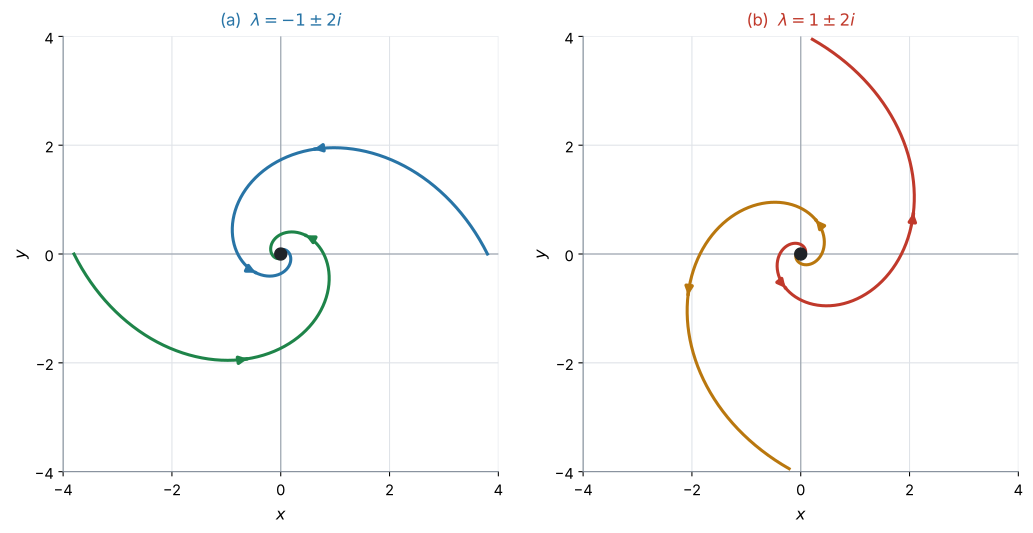
図 1 の (a) と (b) を見くらべてください。どちらも回っていますが、片方は内へ、もう片方は外へ向かっています。
固有値が複素数なら、解は spiral(渦)を描きます。これは「形」の話です。
近づくか離れるかは、これとは別に、実部の符号で決まります。実部が正なら原点から離れ、負なら原点に近づきます。固有値が実数のときも、正なら離れ、負なら近づきます。
\(\lambda = -1 \pm 2i\) なら、\(2\) つとも答えます。
試験ではこう書く
The eigenvalues are complex, so the solutions form a spiral.
The real part is \(-1\), which is negative, so all solutions move towards the origin.
(固有値は複素数なので、解は渦を巻く。実部は \(-1\) で負なので、すべての解は原点に近づく、という意味です。)
AHL 1.13 の exponential form(指数形式)を思い浮かべてください。
\[ e^{(a + bi)t} = e^{at} \times e^{ibt} \]
\(e^{at}\) が大きさ、\(e^{ibt}\) が回転です。大きさを決めるのは \(a\)、つまり実部だけです。
AI HL では、この式を書く必要はありません。 「実部が大きさ、imaginary part(虚部)が回転」とだけ覚えてください。
3. Purely imaginary eigenvalues(純虚数なら閉じた曲線)
実部が \(0\) のとき、\(\lambda = \pm bi\) です。大きさが変わらないので、同じところを回り続けます。
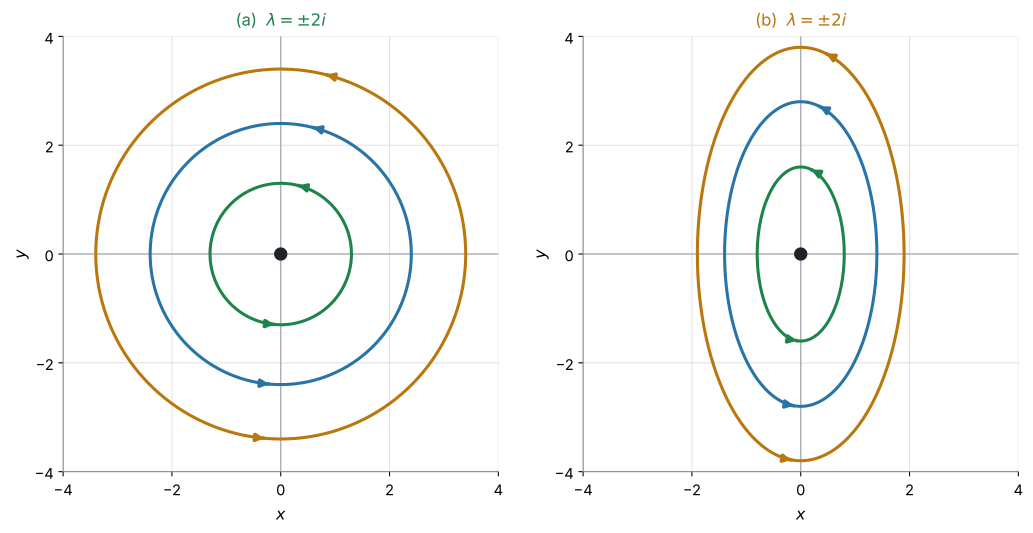
図 2 の (a) と (b) が、その \(2\) つです。
図 2 の (a) と (b) は、固有値が同じ \(\pm 2i\) です。それでも、片方は円、もう片方は楕円です。
固有値だけでは円か楕円かは決まらないので、答えは a circle or ellipse と両方書きます。
State the shape of the trajectories と問われたら、「円または楕円」と答えるのが安全です。\(M\) を見ただけで、どちらかを断定することは求められていません。
\(2\) つの固有値の和は、対角の和に等しいのでした(AHL 1.15)。
\[ (a + bi) + (a - bi) = 2a = (\text{対角の和}) \]
対角の和が \(0\) ⟺ 実部が \(0\) です。\(M = \begin{pmatrix} 0 & -2 \\ 2 & 0 \end{pmatrix}\) は対角の和が \(0\) なので、計算する前に純虚数だと分かります。
例題 1 Consider the system \(\dfrac{dx}{dt} = -2y\), \(\ \dfrac{dy}{dt} = 2x\).
(a) Show that the eigenvalues are purely imaginary.
(b) State the shape of the trajectories.
(c) Show that \(x^{2} + y^{2}\) is constant along a trajectory.
日本語訳
\(\dfrac{dx}{dt} = -2y\)、\(\dfrac{dy}{dt} = 2x\) を考えます。
purely imaginary は「純虚数」、constant along a trajectory は「軌道に沿って一定」という意味です。
(a) 固有値が純虚数であることを示しなさい。
(b) 軌道の形を述べなさい。
(c) 軌道に沿って \(x^{2} + y^{2}\) が一定であることを示しなさい。
(a) \(M = \begin{pmatrix} 0 & -2 \\ 2 & 0 \end{pmatrix}\)、対角の和 \(0\)、\(\det M = 0 + 4 = 4\)。
\[ \lambda^{2} - 0\lambda + 4 = 0 \ \Longrightarrow \ \lambda^{2} = -4 \ \Longrightarrow \ \lambda = \pm 2i \]
実部が \(0\) なので、純虚数です。
(b)
試験ではこう書く
The eigenvalues are purely imaginary, so the trajectories are closed curves: circles or ellipses.
(固有値は純虚数なので、軌道は閉じた曲線、すなわち円または楕円である、という意味です。)
(c)
\[ \frac{d}{dt}(x^{2} + y^{2}) = 2x\frac{dx}{dt} + 2y\frac{dy}{dt} = 2x(-2y) + 2y(2x) = -4xy + 4xy = 0 \]
微分が \(0\) なので、\(x^{2} + y^{2}\) は一定です。
検算。 \(x^{2} + y^{2}\) が一定ということは、原点からの距離が変わらないということです。この系では、軌道は円になります ✓ 図 2 の (a) と一致します。
対角の和が \(0\) なので、第3節のとおり実部は \(0\) です ✓ 計算する前に分かります。
- でこの系が円だと分かりますが、(b) の時点では固有値しか使っていません。
固有値が \(\pm 2i\) の系には、円になるものも楕円になるものもあります(図 2 の (a) と (b))。ですから、(b) の答えは circles or ellipses です。
\(x\) は \(t\) の関数なので、chain rule が要ります(AHL 5.9)。
\[ \frac{d}{dt}(x^{2}) = 2x \cdot \frac{dx}{dt} \]
\(\dfrac{dx}{dt}\) を掛け忘れないでください。 ここを落とすと、(c) が示せません。
(a) \(M = \begin{pmatrix} 0 & -2 \\ 2 & 0 \end{pmatrix}\) \[ \lambda^{2} + 4 = 0, \qquad \lambda = \pm 2i \] The real part is \(0\), so the eigenvalues are purely imaginary.
(b)
The trajectories are closed curves: circles or ellipses.
(c) \[ \frac{d}{dt}(x^{2} + y^{2}) = 2x(-2y) + 2y(2x) = 0 \] So \(x^{2} + y^{2}\) is constant along a trajectory.
4. Direction of rotation(回る向きは \(1\) 点を代入して決める)
渦や閉じた曲線が時計回りか反時計回りかも、答えることがあります。
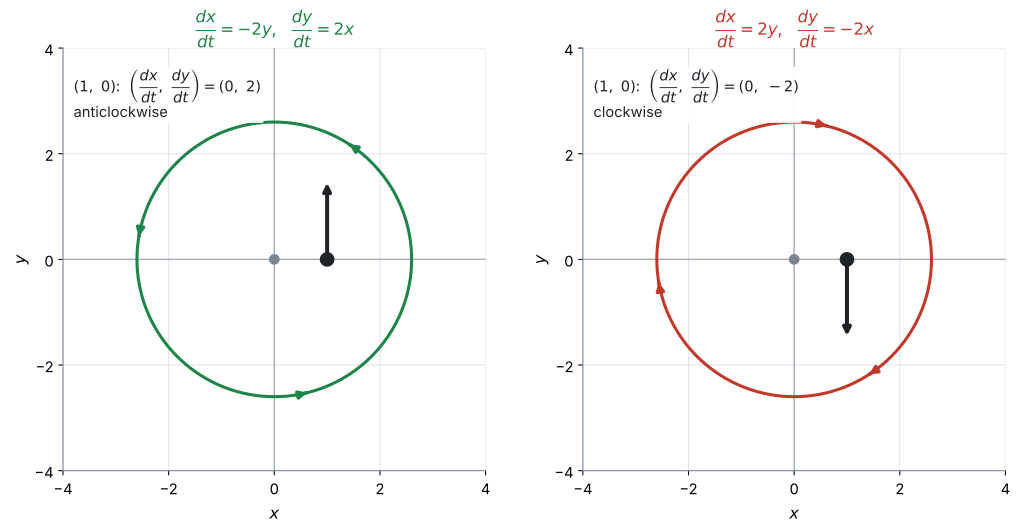
固有値だけでは、回る向きは分かりません。 図 3 の \(2\) つは、どちらも \(\lambda = \pm 2i\) ですが、逆向きに回っています。
やり方は \(1\) つです。 分かりやすい点、たとえば \((1,\ 0)\) を右辺に代入します。
\[ \frac{dx}{dt} = -2y, \qquad \frac{dy}{dt} = 2x \]
\((1,\ 0)\) を入れると
\[ \left(\frac{dx}{dt},\ \frac{dy}{dt}\right) = (0,\ 2) \]
上を向いています。 \(x\) 軸の正の側で上向きなら、anticlockwise(反時計回り)です。
| \((1,\ 0)\) での \(\dfrac{dy}{dt}\) | 回る向き |
|---|---|
| 正(上向き) | anticlockwise(反時計回り) |
| 負(下向き) | clockwise(時計回り) |
\[ \begin{pmatrix} a & b \\ c & d \end{pmatrix}\begin{pmatrix} 1 \\ 0 \end{pmatrix} = \begin{pmatrix} a \\ c \end{pmatrix} \]
つまり、\(c\)(左下の数)の符号だけを見れば決まります。
\(c > 0\) なら反時計回り、\(c < 0\) なら時計回りです。
答案には、代入したところを書いてください。 「左下の数を見た」だけでは、根拠として弱いです。
\((0,\ 0)\) は平衡点なので、\((0,\ 0)\) が返ってきて何も分かりません。
\((1,\ 0)\) か \((0,\ 1)\) が便利です。\((0,\ 1)\) を使うなら、\(\dfrac{dx}{dt}\) の符号を見ます(左向きなら反時計回り)。
例題 2 Consider the system
\[ \frac{dx}{dt} = -x - 2y, \qquad \frac{dy}{dt} = 2x - y \]
(a) Find the eigenvalues.
(b) Describe the behaviour of the solutions as \(t\) increases.
(c) Determine whether the trajectories are traced clockwise or anticlockwise, giving a reason.
日本語訳
上の連立系を考えます。
traced は「たどられる」、clockwise は「時計回り」、anticlockwise は「反時計回り」という意味です。
(a) 固有値を求めなさい。
(b) \(t\) が増えるときの解のふるまいを述べなさい。
(c) 軌道が時計回りか反時計回りかを、理由を付けて判定しなさい。
(a) \(M = \begin{pmatrix} -1 & -2 \\ 2 & -1 \end{pmatrix}\)、対角の和 \(-2\)、\(\det M = 1 + 4 = 5\)。
\[ \lambda^{2} + 2\lambda + 5 = 0 \]
\[ \lambda = \frac{-2 \pm \sqrt{4 - 20}}{2} = \frac{-2 \pm 4i}{2} = -1 \pm 2i \]
(b)
試験ではこう書く
The eigenvalues are complex, so the solutions form a spiral.
The real part is \(-1\), which is negative, so all solutions move towards the origin.
The trajectories spiral inwards, getting closer and closer to the origin without reaching it.
(固有値は複素数なので、解は渦を巻く。実部は \(-1\) で負なので、すべての解は原点に近づく。軌道は内向きに渦を巻き、原点に達することなく近づいていく、という意味です。)
(c) \((1,\ 0)\) を代入します(第4節)。
\[ \frac{dx}{dt} = -1 - 0 = -1, \qquad \frac{dy}{dt} = 2 - 0 = 2 \]
試験ではこう書く
At the point \((1,\ 0)\) the equations give \(\dfrac{dx}{dt} = -1\) and \(\dfrac{dy}{dt} = 2\).
Since \(\dfrac{dy}{dt} > 0\), the path is moving upwards on the positive \(x\)-axis, so the trajectories are traced anticlockwise.
(点 \((1,\ 0)\) で式は \(\dfrac{dx}{dt} = -1\)、\(\dfrac{dy}{dt} = 2\) を与える。\(\dfrac{dy}{dt} > 0\) なので、\(x\) 軸の正の側で経路は上向きに動いており、したがって軌道は反時計回りにたどられる、という意味です。)
検算。 判別式は \((-2)^{2} - 4(5) = 4 - 20 = -16 < 0\) ✓ 複素数になるはずです。
固有値の和は \((-1+2i) + (-1-2i) = -2\) で、対角の和 \(-1 + (-1) = -2\) と一致 ✓
積は \((-1)^{2} - (2i)^{2} = 1 + 4 = 5\) で、\(\det M = 5\) と一致 ✓
図 1 の (a) が、この系の絵です。
「渦を巻く」(複素数だから)と「原点に近づく」(実部が負だから)は、別のことです(第2節)。
片方だけだと、点が半分になります。
(a) \(M = \begin{pmatrix} -1 & -2 \\ 2 & -1 \end{pmatrix}\) \[ \lambda^{2} + 2\lambda + 5 = 0, \qquad \lambda = \frac{-2 \pm \sqrt{-16}}{2} = -1 \pm 2i \]
(b)
The eigenvalues are complex, so the solutions form a spiral.
The real part \(-1\) is negative, so all solutions move towards the origin.
(c) At \((1,\ 0)\): \(\ \dfrac{dx}{dt} = -1\), \(\ \dfrac{dy}{dt} = 2\).
Since \(\dfrac{dy}{dt} > 0\) on the positive \(x\)-axis, the trajectories are traced anticlockwise.
5. Summary of the six cases(\(6\) 通りの場合のまとめ)
AHL 5.17a とこのページの内容をあわせると、原点のまわりの動き方は次の \(6\) 通りに分けられます。「どちらへ動くか」(実部の符号)と「どんな形か」(実数か複素数か)を組み合わせたものです。
| 固有値 | 原点の呼び名 | 絵 |
|---|---|---|
| 実数、両方正 | unstable node | 原点以外の軌道は原点から離れる |
| 実数、両方負 | stable node | 原点以外の軌道は原点に近づく |
| 実数、符号が違う | saddle point | 向きによって近づくものと離れるものがある(AHL 5.17a) |
| 複素数、実部が正 | unstable spiral | 外へ渦を巻く |
| 複素数、実部が負 | stable spiral | 内へ渦を巻く |
| 純虚数(実部 \(0\)) | centre(下の注意を見てください) | 円または楕円 |
上の \(3\) 行が AHL 5.17a、下の \(3\) 行がこのページです。
- \(\det(M - \lambda I) = 0\) から \(\lambda\) を求める(または固有方程式の判別式だけを見る)
- 実数なら → AHL 5.17a の \(3\) つ
- 複素数なら → このページ
- 複素数なら、実部の符号を見る
- 回る向きが要るなら、\((1,\ 0)\) を代入する
この順番でやれば、迷いません。
node と centre は、IB の用語ではありません
IB の問題で使われる呼び名は saddle point(鞍点)、equilibrium point(平衡点)、stable population(安定した個体数)の \(3\) つです。
node(結節点)も centre(中心)も、教科書で広く使われている便利な呼び名ですが、IB の用語ではありません。
答案では、呼び名だけで済ませず、どう動くかを必ず書いてください。
- node →
all solutions move away from / towards the origin - centre →
the solutions form a circle or ellipse
呼び名を書くのは構いません。 動きの説明を添えれば、どちらの採点者にも通じます。
例題 3 For each system, describe the behaviour of the solutions near the origin.
(a) \(\dfrac{dx}{dt} = 2x - y\), \(\ \dfrac{dy}{dt} = x + 2y\)
(b) \(\dfrac{dx}{dt} = -2x - 3y\), \(\ \dfrac{dy}{dt} = 3x - 2y\)
(c) \(\dfrac{dx}{dt} = 3x + y\), \(\ \dfrac{dy}{dt} = x + 3y\)
日本語訳
それぞれの系について、原点の近くでの解のふるまいを述べなさい。
判別式を先に見ます(第5節)。
(a) 対角の和 \(4\)、\(\det = 4 + 1 = 5\)。判別式 \(16 - 20 = -4 < 0\)。
\[ \lambda^{2} - 4\lambda + 5 = 0 \ \Longrightarrow \ \lambda = \frac{4 \pm \sqrt{-4}}{2} = 2 \pm i \]
Complex with positive real part \(2\), so the solutions spiral outwards, away from the origin.
(b) 対角の和 \(-4\)、\(\det = 4 + 9 = 13\)。判別式 \(16 - 52 = -36 < 0\)。
\[ \lambda^{2} + 4\lambda + 13 = 0 \ \Longrightarrow \ \lambda = \frac{-4 \pm \sqrt{-36}}{2} = -2 \pm 3i \]
Complex with negative real part \(-2\), so the solutions spiral inwards, towards the origin.
(c) 対角の和 \(6\)、\(\det = 9 - 1 = 8\)。判別式 \(36 - 32 = 4 > 0\)。
\[ \lambda^{2} - 6\lambda + 8 = 0 \ \Longrightarrow \ \lambda = 4,\ 2 \]
Real and both positive, so all solutions move away from the origin (an unstable node).
検算。 (c) だけ判別式が正でした。\(36 - 32 = 4\) で、\(\sqrt{4} = 2\) ときれいな数になります ✓ 実数解が出るはずです。
- と (b) は、固有値の積を確かめます。\((2+i)(2-i) = 4 + 1 = 5\) ✓、\((-2+3i)(-2-3i) = 4 + 9 = 13\) ✓ どちらも \(\det M\) と一致しました。
\[ \Delta = (\text{対角の和})^{2} - 4\det M \]
- は \(4^2 - 4(5) = 16 - 20\)、(b) は \((-4)^2 - 4(13) = 16 - 52\) です。
符号だけ分かれば十分なので、正確な値を出す必要はありません。
(a) \(\lambda^{2} - 4\lambda + 5 = 0\), \(\ \lambda = 2 \pm i\)
Complex with positive real part, so the solutions spiral outwards, away from the origin.
(b) \(\lambda^{2} + 4\lambda + 13 = 0\), \(\ \lambda = -2 \pm 3i\)
Complex with negative real part, so the solutions spiral inwards, towards the origin.
(c) \(\lambda^{2} - 6\lambda + 8 = 0\), \(\ \lambda = 4,\ 2\)
Real and both positive, so all solutions move away from the origin (an unstable node).
6. Sketching trajectories(軌道のかき方)
複素数の場合、eigenvector の直線がありません。 ですから AHL 5.17a とは手順が変わります。
- 原点に印を付ける
- \((1,\ 0)\) を代入して、回る向きを決める
- 実部の符号にしたがって、内へ・外へ・閉じたままをかく
- 矢印を付ける
渦の絵は、矢印の向きを変えるだけで意味が逆になります。
同じ渦の絵 + 内向きの矢印 → stable
同じ渦の絵 + 外向きの矢印 → unstable
矢印は必ず付けてください。
7. Interpreting in context(文脈での読み方)
文章題では、相図から equilibrium point(平衡点)や stable population(安定した個体数)などを読み取り、その意味を文脈で説明します。渦や閉じた曲線は、振動を表します。
| 絵 | 文脈での意味 |
|---|---|
| stable spiral(内向き) | 振動しながら落ち着く |
| unstable spiral(外向き) | 振動が大きくなっていく |
| 円・楕円 | 同じ振れ幅で振動し続ける |
stable populations とは、落ち着き先のことです
例題 4 Two coupled tanks are disturbed from their normal levels. Let \(x\) and \(y\) be the differences (in cm) from the normal levels, \(t\) minutes later. They satisfy
\[ \frac{dx}{dt} = -0.2x - 3y, \qquad \frac{dy}{dt} = 3x - 0.2y. \]
(a) Find the eigenvalues.
(b) Sketch the trajectory that starts at \((4,\ 0)\).
(c) Comment on what the model predicts for the tanks.
日本語訳
つながった \(2\) つのタンクが、通常の水位から乱されました。\(t\) 分後の通常水位からの差(cm)を \(x\)、\(y\) とします。上の式を満たします。
disturbed は「乱された」、normal levels は「通常の水位」という意味です。
(a) 固有値を求めなさい。
(b) \((4,\ 0)\) から始まる軌道をかきなさい。
(c) このモデルがタンクについて予測することをコメントしなさい。
(a) 対角の和 \(-0.4\)、\(\det M = 0.04 + 9 = 9.04\)。
\[ \lambda^{2} + 0.4\lambda + 9.04 = 0 \]
\[ \lambda = \frac{-0.4 \pm \sqrt{0.16 - 36.16}}{2} = \frac{-0.4 \pm \sqrt{-36}}{2} = \frac{-0.4 \pm 6i}{2} = -0.2 \pm 3i \]
(b) 手順は 第6節 のとおりです。
\((1,\ 0)\) を代入すると \(\dfrac{dy}{dt} = 3 > 0\) なので、反時計回りです。
実部が \(-0.2\) で負なので、内向きの渦をかきます。\((4,\ 0)\) に印を付けて、そこから反時計回りに、少しずつ原点へ近づく渦をかきます。
(c)
試験ではこう書く
The eigenvalues are complex with a small negative real part, so the levels oscillate about their normal values while the size of the oscillation slowly dies away.
The model predicts that both tanks eventually settle back to their normal levels, but only after many oscillations, because the real part \(-0.2\) is small compared with the imaginary part \(3\).
(固有値は複素数で実部が小さな負の値なので、水位は通常の値のまわりで振動し、振動の大きさはゆっくり小さくなる。このモデルは、両方のタンクが最終的に通常の水位に戻ることを予測しているが、実部 \(-0.2\) が虚部 \(3\) にくらべて小さいため、それには何度も振動を繰り返す必要がある、という意味です。)
検算。 判別式 \(0.16 - 4(9.04) = 0.16 - 36.16 = -36 < 0\) ✓ 複素数です。
固有値の和 \((-0.2 + 3i) + (-0.2 - 3i) = -0.4\) ✓ 対角の和と一致。
積 \((-0.2)^{2} + 3^{2} = 0.04 + 9 = 9.04\) ✓ \(\det M\) と一致。
\(1\) 周まわるのにかかる時間は、虚部で決まります。振幅が \(e^{-0.2t}\) で減るので、\(1\) 周のあいだにはあまり減りません。
「ゆっくり落ち着く」というのが、この系の姿です。実部が \(-3\) なら、\(1\) 周もしないうちに収まります。
AI HL では、周期の計算までは求められません。 「実部が小さいので、ゆっくり」と言えれば十分です。
AHL 5.17a と同じで、この形の系には定数項が付きません。ですから、問題文は基準からのずれを変数にしています。
原点に近づく = 通常の水位に戻る、という読みかえが要ります。
(a) \[ \lambda^{2} + 0.4\lambda + 9.04 = 0, \qquad \lambda = \frac{-0.4 \pm \sqrt{-36}}{2} = -0.2 \pm 3i \]
(b) (sketch: mark \((4,\ 0)\); at \((1,\ 0)\), \(\dfrac{dy}{dt} = 3 > 0\) so the motion is anticlockwise; the real part is negative so draw a spiral winding anticlockwise slowly inwards towards the origin, with arrows)
(c)
The eigenvalues are complex with a small negative real part, so the levels oscillate about their normal values while the oscillation slowly dies away.
Both tanks eventually settle back to their normal levels, but only after many oscillations.
Why it works
なぜ回るのか
いちばん簡単な例で見ます。
\[ \frac{dx}{dt} = -y, \qquad \frac{dy}{dt} = x \]
\(r^{2} = x^{2} + y^{2}\) とおいて、\(t\) で微分してみます。
\[ \frac{d}{dt}(x^{2} + y^{2}) = 2x\frac{dx}{dt} + 2y\frac{dy}{dt} = 2x(-y) + 2y(x) = 0 \]
原点からの距離が変わりません。 ですから、円を描きます。
この \(M = \begin{pmatrix} 0 & -1 \\ 1 & 0 \end{pmatrix}\) の固有値は、対角の和 \(0\)、\(\det = 1\) なので
\[ \lambda^{2} + 1 = 0 \ \Longrightarrow \ \lambda = \pm i \]
純虚数です。 実部 \(0\) と「距離が変わらない」が、ちょうど対応しています。
実部があると、渦になります
\[ \frac{dx}{dt} = ax - y, \qquad \frac{dy}{dt} = x + ay \]
同じ計算をします。
\[ \frac{d}{dt}(x^{2} + y^{2}) = 2x(ax - y) + 2y(x + ay) = 2ax^{2} + 2ay^{2} = 2a(x^{2} + y^{2}) \]
\(r^2 = x^2+y^2\) と書けば \(\dfrac{dr^{2}}{dt} = 2a\,r^{2}\) で、AHL 5.14 の形です。
\[ r^{2} = r_0^{2}\,e^{2at} \]
\(a > 0\) なら距離が増え、\(a < 0\) なら減ります。 回りながら、そうなる——それが渦です。
この \(M\) の固有値は、対角の和 \(2a\)、\(\det = a^{2} + 1\) なので
\[ \lambda^{2} - 2a\lambda + (a^{2} + 1) = 0 \ \Longrightarrow \ \lambda = a \pm i \]
実部がちょうど \(a\) です ✓ 第2節の規則が、ここから出ています。
この計算は AI HL では問われません。 「実部が大きさを決める」と言えれば十分です。
なぜ楕円になることがあるのか
\[ \frac{dx}{dt} = -y, \qquad \frac{dy}{dt} = 4x \]
今度は \(4x^{2} + y^{2}\) を微分してみます。
\[ \frac{d}{dt}(4x^{2} + y^{2}) = 8x(-y) + 2y(4x) = -8xy + 8xy = 0 \]
\(4x^{2} + y^{2}\) が一定です。これは楕円の式です。
\(x^{2} + y^{2}\) ではなく \(4x^{2} + y^{2}\) が保たれるので、円ではなく楕円になります。どちらが保たれるかは、係数で決まります。
Common errors
\(\sqrt{-16} = 4i\) です(第1節)。
\(\dfrac{-2 \pm 4i}{2} = -1 \pm 2i\) です。分母の \(2\) は、両方の項に効きます(第1節)。
\(-1 \pm 2i\) の実部は \(-1\)、虚部は \(2\) です。近づくか離れるかを決めるのは実部です(第2節)。
複素数なら渦、実部の符号で内か外——\(2\) つとも要ります(例 2)。
circle or ellipse です(第3節)。固有値だけでは、どちらかは決まりません。
固有値では決まりません。\(1\) 点を代入してください(第4節)。
平衡点なので \((0,\ 0)\) が返ってきます(第4節)。\((1,\ 0)\) を使ってください。
渦の絵は、矢印が無いと内向きか外向きか分かりません(第6節)。
AI HL では求められません(第1節)。厳密解が要るのは実数で異なる場合だけです。
\(2x \cdot \dfrac{dx}{dt}\) です(例 1)。
Using your GDC (TI-Nspire CX II)
AHL 1.15 と同じコマンドです。
menu → Matrix & Vector → Advanced → Eigenvalues\(\{-1 - 2 \cdot i,\ -1 + 2 \cdot i\}\) のように、i の付いた形で返ります。
Complex number setting(複素数を表示させる設定)
機種の設定によっては、複素数の答えが出ないことがあります。
doc → Settings → Document SettingsReal or Complex を Rectangular にしておいてください。Real のままだと、Error: Non-real result のようになります。
Rectangular は \(a + bi\) の形のことです
Polar にすると、\(r\,e^{i\theta}\) の形で返ってきます(AHL 1.13 の指数形式)。
この項目では実部が見たいので、Rectangular が便利です。
Checking the discriminant(判別式だけを見る)
固有値まで出さなくても、判別式の符号が分かれば場合分けはできます(第5節)。
\((\text{対角の和})^{2} - 4 \times (\texttt{det})\)
det() は次のところにあります。
menu → Matrix & Vectorの中の Determinant から入れられます(AHL 1.14 と同じです)。
Find the eigenvalues と問われたら、固有方程式を書いて解く過程が要ります。
判別式は、場合分けの見当をつけるためのものです。
Plotting trajectories(軌道を描いてみる)
AHL 5.17a と同じく、Graphs のパラメトリック表示が使えます。ただし複素数の場合、\(x(t)\) と \(y(t)\) の式を自分で作る必要があります(このページでは求めません)。
もっと手軽なのは、AHL 5.16b の Lists & Spreadsheet で Euler 法を回し、scatter diagram(散布図)にする方法です。渦の形がそのまま出ます。
AHL 5.16b で見たとおり、\(h\) が大きいと外へ広がる誤差が出ます。
純虚数の場合(本当は閉じた曲線)でも、\(h\) が大きいと外向きの渦に見えてしまいます。 \(h = 0.01\) くらいにしてください。
Exercises
1 Find the eigenvalues of \(M = \begin{pmatrix} 2 & -1 \\ 1 & 2 \end{pmatrix}\).
日本語訳
\(M = \begin{pmatrix} 2 & -1 \\ 1 & 2 \end{pmatrix}\) の固有値を求めなさい。
\[ \lambda^{2} - 4\lambda + 5 = 0 \] \[ \lambda = \frac{4 \pm \sqrt{16 - 20}}{2} = \frac{4 \pm 2i}{2} = 2 \pm i \]
2 For the system \(\dfrac{dx}{dt} = -2x - 3y\), \(\ \dfrac{dy}{dt} = 3x - 2y\):
(a) Find the eigenvalues.
(b) Describe the behaviour of the solutions as \(t\) increases.
(c) Sketch the phase portrait, showing the direction of motion.
日本語訳
連立系 \(\dfrac{dx}{dt} = -2x - 3y\)、\(\dfrac{dy}{dt} = 3x - 2y\) について。
(a) 固有値を求めなさい。
(b) \(t\) が増えるときの解のふるまいを述べなさい。
(c) 運動の向きを示して、相図をかきなさい。
(a) \[ \lambda^{2} + 4\lambda + 13 = 0, \qquad \lambda = \frac{-4 \pm \sqrt{-36}}{2} = -2 \pm 3i \]
(b)
The eigenvalues are complex, so the solutions form a spiral.
The real part \(-2\) is negative, so all solutions move towards the origin: the trajectories spiral inwards.
(c) At \((1,\ 0)\): \(\ \dfrac{dy}{dt} = 3 > 0\), so the motion is anticlockwise.
(sketch: a spiral winding anticlockwise inwards towards the origin, with arrows on it)
3 For the system \(\dfrac{dx}{dt} = -3y\), \(\ \dfrac{dy}{dt} = 3x\):
(a) Show that the eigenvalues are purely imaginary.
(b) State the shape of the trajectories.
(c) Determine the direction in which they are traced.
日本語訳
連立系 \(\dfrac{dx}{dt} = -3y\)、\(\dfrac{dy}{dt} = 3x\) について。
(a) 固有値が純虚数であることを示しなさい。
(b) 軌道の形を述べなさい。
(c) たどられる向きを判定しなさい。
(a) \(M = \begin{pmatrix} 0 & -3 \\ 3 & 0 \end{pmatrix}\), trace \(= 0\), \(\det = 9\). \[ \lambda^{2} + 9 = 0, \qquad \lambda = \pm 3i \] The real part is \(0\), so the eigenvalues are purely imaginary.
(b)
The trajectories are closed curves: circles or ellipses.
(c) At \((1,\ 0)\): \(\ \dfrac{dy}{dt} = 3 > 0\).
The motion is upwards on the positive \(x\)-axis, so the trajectories are traced anticlockwise.
対角の和が \(0\) なので、計算する前に実部が \(0\) だと分かります(第3節)。
(c) \((1,\ 0)\) を代入すると \(\dfrac{dx}{dt} = 0\)、\(\dfrac{dy}{dt} = 3\) です。まっすぐ上を向いています。
検算。 \(\dfrac{d}{dt}(x^{2} + y^{2}) = 2x(-3y) + 2y(3x) = 0\) ✓ 距離が一定なので、この系では円になります(Why it works)。
4 For the system \(\dfrac{dx}{dt} = 4y\), \(\ \dfrac{dy}{dt} = -x\):
(a) Find the eigenvalues.
(b) Determine the direction in which the trajectories are traced, giving a reason.
日本語訳
連立系 \(\dfrac{dx}{dt} = 4y\)、\(\dfrac{dy}{dt} = -x\) について。
(a) 固有値を求めなさい。
(b) 軌道のたどられる向きを、理由を付けて判定しなさい。
(a) \(M = \begin{pmatrix} 0 & 4 \\ -1 & 0 \end{pmatrix}\), trace \(= 0\), \(\det = 0 - (4)(-1) = 4\). \[ \lambda^{2} + 4 = 0, \qquad \lambda = \pm 2i \]
(b) At \((1,\ 0)\): \(\ \dfrac{dx}{dt} = 0\), \(\ \dfrac{dy}{dt} = -1\).
Since \(\dfrac{dy}{dt} < 0\), the motion is downwards on the positive \(x\)-axis, so the trajectories are traced clockwise.
\(\det = ad - bc = 0 \times 0 - 4 \times (-1) = 4\) です。マイナス同士で正になります。
(b) 問題3とくらべてください。固有値は \(\pm 3i\) と \(\pm 2i\) で似ていますが、向きが逆です(第4節)。
左下の数を見ると、問題3は \(+3\)、この問題は \(-1\) です。符号が違うので、向きも逆になります。
検算。 \(\dfrac{d}{dt}(x^{2} + 4y^{2}) = 2x(4y) + 8y(-x) = 8xy - 8xy = 0\) ✓ \(x^{2} + 4y^{2}\) が一定なので、これは楕円です(Why it works)。円ではありません。
5 For each system, state whether the origin is a node, a saddle point, a spiral, or closed curves (a centre).
(a) \(\dfrac{dx}{dt} = x - 2y\), \(\ \dfrac{dy}{dt} = 2x + y\)
(b) \(\dfrac{dx}{dt} = 2x + 3y\), \(\ \dfrac{dy}{dt} = x\)
(c) \(\dfrac{dx}{dt} = -x - 5y\), \(\ \dfrac{dy}{dt} = x + y\)
日本語訳
それぞれの系について、原点が node、saddle point、spiral、閉じた曲線(centre)のどれかを述べなさい。
(a) trace \(= 2\), \(\det = 1 + 4 = 5\), \(\Delta = 4 - 20 = -16 < 0\) \[ \lambda = 1 \pm 2i \]
A spiral, moving outwards away from the origin.
(b) trace \(= 2\), \(\det = 0 - 3 = -3\), \(\Delta = 4 + 12 = 16 > 0\) \[ \lambda = 3,\ -1 \]
A saddle point.
(c) trace \(= 0\), \(\det = -1 + 5 = 4\), \(\Delta = 0 - 16 = -16 < 0\) \[ \lambda = \pm 2i \]
Closed curves (a centre): the solutions form a circle or ellipse.
判別式 → 実部の順です(第5節)。
(a) \(\Delta < 0\) で複素数、実部 \(1 > 0\) なので外向きの spiral。
(b) \(\Delta > 0\) で実数。\(\det < 0\) なので符号が違い、saddle です(AHL 5.17a)。
(c) 対角の和 \(0\) なので実部 \(0\)、閉じた曲線です。
検算。 (c) は \(\det = (-1)(1) - (-5)(1) = -1 + 5 = 4\) です。\(\lambda^{2} + 4 = 0\) ✓
\(\lambda = \pm 2i\) の積は \((2i)(-2i) = -4i^{2} = 4\) ✓ \(\det\) と一致します。
6 A system has eigenvalues \(\lambda = -0.5 \pm 4i\).
(a) Describe the trajectories.
(b) Explain why the trajectories take many turns before getting close to the origin.
日本語訳
ある系の固有値が \(\lambda = -0.5 \pm 4i\) です。
(a) 軌道を述べなさい。
(b) 軌道が原点に近づくまでに何回も回る理由を説明しなさい。
(a)
The eigenvalues are complex, so the trajectories form a spiral.
The real part \(-0.5\) is negative, so they spiral inwards towards the origin.
(b)
The imaginary part \(4\) controls how fast the path turns, and the real part \(-0.5\) controls how fast it shrinks.
Here the imaginary part is eight times the size of the real part, so the path goes round many times while the distance from the origin is still only shrinking slowly.
大きさは \(e^{-0.5t}\) で減り、回転は \(4t\) で進みます。 \(1\) 周(\(2\pi\) ラジアン)に要するのは \(t = \dfrac{2\pi}{4} \approx 1.57\) で、そのあいだに大きさは \(e^{-0.5 \times 1.57} = e^{-0.785} = 0.456\) 倍にしかなりません。
\(1\) 周ごとに半分ほどになるだけなので、小さくなりきるまでに何周もします。
AI HL では、この計算までは求められません。 「虚部が実部よりずっと大きいから」と言えれば十分です。
検算。 実部が \(-4\)、虚部が \(0.5\) だったら逆になります。\(1\) 周に \(t = \dfrac{2\pi}{0.5} \approx 12.6\) かかり、そのあいだに \(e^{-4 \times 12.6}\) でほぼ \(0\) です。\(1\) 周する前に原点に着いてしまいます ✓
7 A student is asked to find the eigenvalues of \(M = \begin{pmatrix} -1 & -4 \\ 1 & -1 \end{pmatrix}\) and writes:
\(\lambda^2 + 2\lambda + 5 = 0\), so \(\lambda = \dfrac{-2 \pm \sqrt{-16}}{2} = -2 \pm 4i\).
Identify the error, and give the correct eigenvalues.
日本語訳
ある生徒が \(M = \begin{pmatrix} -1 & -4 \\ 1 & -1 \end{pmatrix}\) の固有値を求めるよう言われ、上のように書きました。
誤りを指摘し、正しい固有値を述べなさい。
The student has not divided both terms by \(2\).
Since \(\sqrt{-16} = 4i\), the correct working is \(\dfrac{-2 \pm 4i}{2} = -1 \pm 2i\), not \(-2 \pm 4i\).
\[ \lambda = -1 \pm 2i \]
characteristic equation は合っています。 対角の和 \(-2\)、\(\det = 1 + 4 = 5\) で \(\lambda^{2} + 2\lambda + 5 = 0\) ✓
間違いは最後の \(1\) 行だけです。分母の \(2\) が、両方の項に効きます(第1節)。
検算。 生徒の答え \(-2 \pm 4i\) の和は \(-4\) です。対角の和は \(-2\) なので合いません ✓ 正しい \(-1 \pm 2i\) の和は \(-2\) で一致します。
積でも確かめられます。\((-1)^{2} + 2^{2} = 5\) ✓ 生徒の答えなら \(4 + 16 = 20\) で、\(\det = 5\) と合いません。
複素数でも、和 = 対角の和、積 = \(\det\) はそのまま成り立ちます(AHL 1.15)。
\[ (a+bi)(a-bi) = a^{2} + b^{2} \]
\(10\) 秒で確かめられます。
8 図 2 parts (a) and (b) both come from systems with eigenvalues \(\pm 2i\), yet the pictures are different.
(a) State what the two pictures have in common.
(b) Explain why knowing the eigenvalues is not enough to decide between a circle and an ellipse.
日本語訳
図 2 の (a) と (b) は、どちらも固有値が \(\pm 2i\) の系から来ていますが、絵は違います。
(a) \(2\) つの絵に共通することを述べなさい。
(b) 固有値を知るだけでは円と楕円を区別できない理由を説明しなさい。
(a)
In both pictures the trajectories are closed curves around the origin, traced in the same direction, and neither moves towards nor away from the origin.
(b)
The eigenvalues depend only on the trace and the determinant of the matrix, which are two numbers, while the matrix has four entries.
Different matrices can share the same trace and determinant but stretch the plane differently, so the closed curves can be circles in one case and ellipses in another.
(b) ここが要点です。\(\lambda\) を決めるのは対角の和と \(\det\) の \(2\) つの数だけですが、行列には\(4\) つの数があります。
\[ \begin{pmatrix} 0 & -2 \\ 2 & 0 \end{pmatrix} \quad \text{と} \quad \begin{pmatrix} 0 & -1 \\ 4 & 0 \end{pmatrix} \]
どちらも対角の和 \(0\)、\(\det = 4\) です。それでも中身は違います。
だから、固有値だけでは円か楕円かを決められず、答えは a circle or ellipse と両方書きます(第3節)。
検算。 \(2\) つ目の行列で \(\dfrac{d}{dt}(4x^{2} + y^{2}) = 8x(-y) + 2y(4x) = 0\) ✓ \(4x^{2} + y^{2}\) が一定なので楕円です。\(1\) つ目では \(x^{2} + y^{2}\) が一定で、円です(Why it works)。
9 In a mechanical system, \(x\) is the displacement from equilibrium (in cm) and \(y\) is a related quantity, \(t\) seconds after the start. They satisfy
\[ \frac{dx}{dt} = -0.1x - 2y, \qquad \frac{dy}{dt} = 2x - 0.1y, \]
with \(x = 3\) and \(y = 0\) when \(t = 0\).
(a) Find the eigenvalues.
(b) Determine the direction in which the trajectory is traced.
(c) Comment on what the model predicts for the displacement.
日本語訳
ある機械の系で、開始 \(t\) 秒後の平衡位置からの変位(cm)を \(x\)、関連する量を \(y\) とします。上の式を満たし、\(t = 0\) のとき \(x = 3\)、\(y = 0\) です。
displacement は「変位」、mechanical は「機械の」という意味です。
(a) 固有値を求めなさい。
(b) 軌道のたどられる向きを判定しなさい。
(c) このモデルが変位について予測することをコメントしなさい。
(a) trace \(= -0.2\), \(\det = 0.01 + 4 = 4.01\) \[ \lambda^{2} + 0.2\lambda + 4.01 = 0, \qquad \lambda = \frac{-0.2 \pm \sqrt{-16}}{2} = -0.1 \pm 2i \]
(b) At \((1,\ 0)\): \(\ \dfrac{dy}{dt} = 2 > 0\).
The motion is upwards on the positive \(x\)-axis, so the trajectory is traced anticlockwise.
(c)
The eigenvalues are complex with a small negative real part, so the displacement oscillates about the equilibrium position while the size of the oscillation slowly decreases.
The model predicts that the system eventually comes to rest at equilibrium, but only after many oscillations, since \(0.1\) is small compared with \(2\).
判別式は \((-0.2)^{2} - 4(4.01) = 0.04 - 16.04 = -16\) です。
\[ \sqrt{-16} = 4i, \qquad \lambda = \frac{-0.2 \pm 4i}{2} = -0.1 \pm 2i \]
(c) 例 4 と同じ形です。振動しながら、ゆっくり収まる——これが答えです。
検算。 和 \(-0.2\) ✓ 積 \((-0.1)^{2} + 2^{2} = 0.01 + 4 = 4.01\) ✓ \(\det\) と一致しました。
\(1\) 周に \(t = \dfrac{2\pi}{2} \approx 3.14\) 秒かかり、そのあいだに振幅は \(e^{-0.1 \times 3.14} = 0.73\) 倍です。\(1\) 周で \(3\) 割ほどしか減りません。
10 Consider the family of systems
\[ \frac{dx}{dt} = kx - y, \qquad \frac{dy}{dt} = x + ky, \]
where \(k\) is a constant.
(a) Show that the eigenvalues are \(k \pm i\).
(b) State the value of \(k\) for which the trajectories are closed curves.
(c) Describe how the phase portrait changes as \(k\) increases through that value.
日本語訳
\(k\) を定数として、上の連立系の族を考えます。
the family of systems は「系の族」、increases through that value は「その値を通り越して増える」という意味です。
(a) 固有値が \(k \pm i\) であることを示しなさい。
(b) 軌道が閉じた曲線になる \(k\) の値を書きなさい。
(c) \(k\) がその値を通り越して増えるとき、相図がどう変わるかを述べなさい。
(a) \(M = \begin{pmatrix} k & -1 \\ 1 & k \end{pmatrix}\), trace \(= 2k\), \(\det = k^{2} + 1\). \[ \lambda^{2} - 2k\lambda + (k^{2} + 1) = 0 \] \[ \lambda = \frac{2k \pm \sqrt{4k^{2} - 4(k^{2} + 1)}}{2} = \frac{2k \pm \sqrt{-4}}{2} = \frac{2k \pm 2i}{2} = k \pm i \]
(b) \(k = 0\)
(c)
For \(k < 0\) the real part is negative, so the trajectories spiral inwards towards the origin.
At \(k = 0\) the eigenvalues are purely imaginary and the trajectories are closed curves.
For \(k > 0\) the real part is positive, so the trajectories spiral outwards, away from the origin.
(a) 判別式が \(-4\) で、\(k\) によらず負です。ですから、どんな \(k\) でも固有値は複素数になります。
\[ 4k^{2} - 4(k^{2} + 1) = 4k^{2} - 4k^{2} - 4 = -4 \]
\(k^{2}\) が消えるところが、この問題のしかけです。
(b) 実部が \(k\) なので、\(k = 0\) で純虚数です(第3節)。
(c) as \(k\) increases through that value は「\(k\) が \(0\) より小さいところから、\(0\) を通って、\(0\) より大きくなるとき」という意味です。\(3\) つの場合を、順に書いてください。
検算。 \(k = 0\) なら \(M = \begin{pmatrix} 0 & -1 \\ 1 & 0 \end{pmatrix}\) で、Why it works で扱った系そのものです ✓ 円になります。
\(k = 1\) なら \(\lambda = 1 \pm i\) で、例 3 の (a) と同じ実部の符号です ✓ 外向きの渦になります。
\(k = 0\) が境目です。境目のところで何が起こるかを書けるようにしてください。
この系では、内向きの渦 → 閉じた曲線 → 外向きの渦、と連続的に変わります。