AHL 5.14 — Setting up a differential equation(微分方程式を立てる)
- 問題文のことばから、differential equation(微分方程式)を立てられる。
- 「〜に比例する」を \(= k \times (\text{〜})\) と書ける。
- 「減る」のときに、\(k\) の前にマイナスを付けられる。
- separation of variables(変数分離)で解ける。
- general solution(一般解)と particular solution(特殊解)を区別できる。
- \(\dfrac{dy}{dx} = ky\) の解が exponential function(指数関数)になることを示せる。
The idea
1. Differential equations(微分方程式とは)
ふつうの方程式では、分からないのは数です。
\[ 2x + 3 = 11 \ \Longrightarrow \ x = 4 \]
differential equation(微分方程式)では、分からないのは関数です。
\[ \frac{dy}{dx} = 2x \ \Longrightarrow \ y = x^2 + C \]
答えが \(x^2 + C\) という関数になっています。
新しいのは、ことばから式を立てること(第2節)と、その式を積分で解くこと(第4節)の \(2\) つだけです。計算そのものは SL 5.3 と SL 5.5、それに AHL 5.11a の積分で足ります。
公式集(formula booklet)に 5.14 の欄はありません。 AI HL の公式集の Topic 5 は、5.13 の次が 5.16 です。変数分離のやり方は書かれていないので、やり方そのものを覚える必要があります。 使う積分のほうは載っていて、\(\dfrac{1}{x}\) と \(e^x\) は 5.11 の Standard integrals の欄、べき乗のほうは 5.5 の欄です。
\(\dfrac{dy}{dx}\) や \(\dfrac{dP}{dt}\) が式の中に出てくれば、それは微分方程式です。
解くとは、その式を満たす関数を見つけることです。
上の例なら、\(y = x^2 + C\) を微分すると \(2x\) になります。もとの式が成り立っています。 これが「解けた」ということです。
SL 5.5 で「微分の逆」として積分を学びました。微分方程式を解くのは、その延長です。
2. Setting up a differential equation(ことばから式を立てる)
問題文の場面を読んで、微分方程式を作ります。この項目でいちばん問われるところです。
やることは \(3\) つの読みかえだけです。
| 問題文のことば | 式にすると |
|---|---|
the rate of change of \(P\) / \(P\) grows at a rate |
\(\dfrac{dP}{dt}\) |
is proportional to \((\ \cdot\ )\) |
\(= k \times (\ \cdot\ )\) |
decreases / falls / is lost |
\(k\) の前に \(-\) |
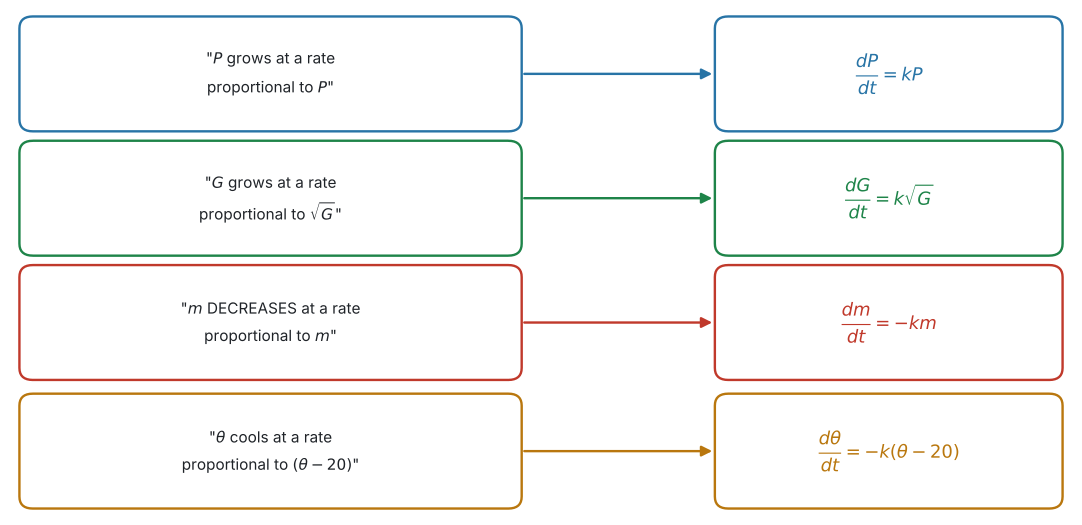
図 1 に、この \(3\) つを組み合わせた \(4\) 例を並べました。出題のほとんどが、この形です。
「時刻 \(t\) での藻の量 \(G\) の増える速さが、\(\sqrt{G}\) に比例する」という場面は、この項目の代表的な例です。
これを式にすると
\[ \frac{dG}{dt} = k\sqrt{G} \]
です。例 2 で、実際に解きます。
proportional to の直後にあるものが、\(k\) に掛かります。
| 文 | 式 |
|---|---|
the rate is proportional to \(P\) |
\(\dfrac{dP}{dt} = kP\) |
the rate is proportional to \(P^2\) |
\(\dfrac{dP}{dt} = kP^2\) |
the rate is proportional to \(t\) |
\(\dfrac{dP}{dt} = kt\) |
the rate is inversely proportional to \(P\) |
\(\dfrac{dP}{dt} = \dfrac{k}{P}\) |
the rate is constant, at \(5\) per minute |
\(\dfrac{dP}{dt} = 5\) |
\(P\) に比例するのか、\(t\) に比例するのか——読み違えると、解の形がまるごと変わります。
proportional to the difference between \(\theta\) and \(20\) なら、比例するのは \((\theta - 20)\) です。
\[ \frac{d\theta}{dt} = -k(\theta - 20) \]
カッコを忘れて \(-k\theta - 20\) と書かないでください。 まったく別の式になります。
これは Newton’s law of cooling(ニュートンの冷却の法則)と呼ばれ、\(20\) は周りの温度です。例 4 で扱います。
Water flows in at \(5\) litres per minute and leaks out at a rate proportional to \(\sqrt{V}\) のような場面では、\(2\) つを組み合わせます。
\[ \frac{dV}{dt} = \underbrace{5}_{\text{入る}} - \underbrace{k\sqrt{V}}_{\text{出る}} \]
\(\dfrac{dV}{dt}\) は「増える向き」を正にとるので、入るぶんが \(+\)、出るぶんが \(-\) です。
一定の割合で入るぶんには、\(V\) が付きません。 「毎分 \(5\) リットル」は、水そうにどれだけ入っていても \(5\) だからです。
(この形は変数分離では手で解きにくいので、AI HL では式を立てるところまでが問われます。解くほうは、AHL 5.16a の Euler’s method(オイラー法)で扱います。)
3. Constant of proportionality(比例定数 \(k\) の符号)
「〜に比例する」を式にするときの比例定数 \(k\) は、問題文には出てきません。自分で置きます。
\(k\) は正の定数として置くのがふつうです。
そのうえで、減るときはマイナスを付けます。
| 場面 | 式 |
|---|---|
| 増える | \(\dfrac{dP}{dt} = kP\) |
| 減る | \(\dfrac{dP}{dt} = -kP\) |
\(k\) を「符号込み」で置いて、\(\dfrac{dP}{dt} = kP\) のまま「\(k\) が負なら減る」としても間違いではありません。どちらでも構いませんが、答案の中で一貫させてください。
この本では、\(k > 0\) として置き、減るときは \(-k\) と書くほうで統一します。
\(k\) が最初から数で与えられることは、あまりありません。
データが \(2\) 組与えられて、そこから \(k\) を求める——これが典型的な流れです(例 4)。
\(1\) 組だけなら積分定数 \(C\) が決まり、\(2\) 組あれば \(C\) と \(k\) の両方が決まります。
例題 1 Write down a differential equation for each of the following situations. In each case \(k\) is a positive constant.
(a) The number of bacteria, \(N\), in a dish increases at a rate proportional to \(N\).
(b) The mass, \(m\) grams, of a radioactive substance decreases at a rate proportional to \(m\).
(c) The depth of water, \(h\) cm, in a leaking tank falls at a rate proportional to \(\sqrt{h}\).
(d) The temperature, \(\theta\ ^\circ\)C, of a drink changes at a rate proportional to the difference between \(\theta\) and the room temperature of \(22\ ^\circ\)C. The drink is hotter than the room.
日本語訳
次のそれぞれの場面について、微分方程式を書きなさい。どの場合も \(k\) は正の定数とします。
dish は「(実験用の)皿」、radioactive substance は「放射性物質」、leaking tank は「水がもれる水そう」という意味です。
(a) 皿の中の細菌の数 \(N\) が、\(N\) に比例する割合で増える。
(b) 放射性物質の質量 \(m\) グラムが、\(m\) に比例する割合で減る。
(c) 水がもれる水そうの水の深さ \(h\) cm が、\(\sqrt{h}\) に比例する割合で下がる。
(d) 飲み物の温度 \(\theta\ ^\circ\)C が、\(\theta\) と室温 \(22\ ^\circ\)C の差に比例する割合で変化する。飲み物は室温より熱い。
この例題には、計算がありません。 ことばを式に直すだけです(第2節)。
(a) 「増える」ので、そのままです。
\[ \frac{dN}{dt} = kN \]
(b) 「減る」ので、マイナスを付けます(第3節)。
\[ \frac{dm}{dt} = -km \]
(c) 「下がる」のでマイナス、比例するのは \(\sqrt{h}\) です。
\[ \frac{dh}{dt} = -k\sqrt{h} \]
(d) 差なので、カッコで囲みます。
\[ \frac{d\theta}{dt} = -k(\theta - 22) \]
検算。 飲み物は室温より熱いので \(\theta > 22\)、つまり \((\theta - 22) > 0\) です。\(-k(\theta - 22) < 0\) なので、温度は下がります ✓ 熱い飲み物は冷めるので、正しい向きです。
比例するのは差そのものです。カッコが必要です(第2節)。
\(-k\theta - 22\) だと「\(\theta\) に比例する部分から \(22\) を引く」という、まったく別の意味になります。
(a) \[ \frac{dN}{dt} = kN \]
(b) \[ \frac{dm}{dt} = -km \]
(c) \[ \frac{dh}{dt} = -k\sqrt{h} \]
(d) \[ \frac{d\theta}{dt} = -k(\theta - 22) \]
4. Separation of variables(変数分離)
変数分離は、微分方程式を積分で解く方法です。やり方は \(3\) 段階です。
\[ \frac{dy}{dx} = f(x)\,g(y) \]
のように、右辺が「\(x\) だけの式」と「\(y\) だけの式」の積になっているときに使えます。
手順1. \(y\) を左、\(x\) を右に集めます(\(dy\)、\(dx\) も含めて)。
\[ \frac{1}{g(y)}\, dy = f(x)\, dx \]
手順2. 両辺を積分します。
\[ \int \frac{1}{g(y)}\, dy = \int f(x)\, dx \]
手順3. constant of integration(積分定数)\(C\) を片側だけに付けて、\(y\) について解きます。
両辺に \(C_1\) と \(C_2\) を付けても、移項すれば \(1\) つにまとまります。
\[ C_2 - C_1 = C \]
最初から右辺に \(1\) つだけ書いてください。 答案が短くなります。
\(\dfrac{dy}{dx}\) は分数ではありません。ですから、本当は「移項」ではありません。
なぜこの操作が許されるのかは、Why it works で説明します(折りたたみを開いてください)。
試験では、この形で書いて構いません。 採点でも認められています。
5. General and particular solutions(一般解と特殊解)
general solution(一般解)… \(C\)(または \(A\))が入ったままの解。曲線の族を表します。
particular solution(特殊解)… 条件から \(C\) が決まった、\(1\) 本だけの解。
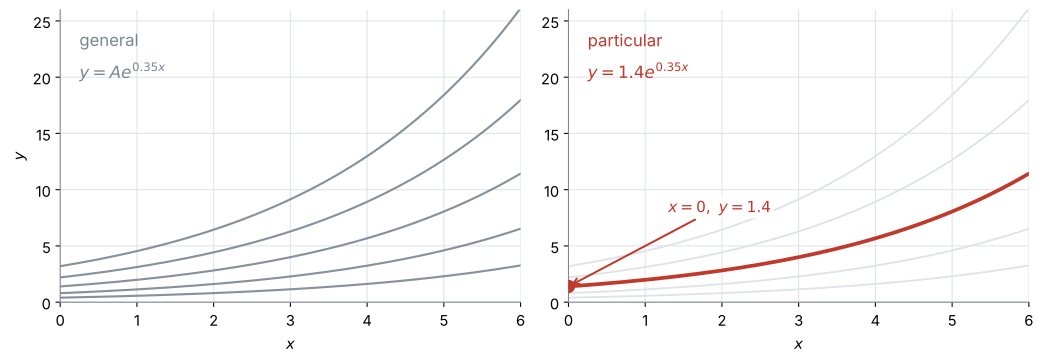
図 2 の左は、\(A\) を変えて描いた曲線です。どれも同じ微分方程式を満たします。 右のように「\(x = 0\) のとき \(y = 1.4\)」と言われて初めて、\(1\) 本に決まります。
boundary condition や initial condition と呼ばれます
「\(t = 0\) のとき \(P = 500\)」のような情報です。\(t = 0\) のものを initial condition(初期条件)といいます。
SL 5.5 で、積分定数を決めるのに同じことをしました。まったく同じ作業です。
Find the general solution に、\(C\) を消して答えない
問題文が general solution と言っているなら、\(C\)(または \(A\))は残したままが答えです。
逆に、条件が与えられているのに \(C\) を残したままだと、答えになっていません。
問題文がどちらを求めているか、必ず確かめてください。
例題 2 The mass of algae in a pond, \(G\) grams at time \(t\) days, grows at a rate proportional to \(\sqrt{G}\).
When \(t = 0\) the mass is \(4\) grams, and when \(t = 2\) the mass is \(16\) grams.
(a) Write down a differential equation for \(G\).
(b) Solve the differential equation to find \(G\) in terms of \(t\).
(c) Find the mass of algae when \(t = 5\).
日本語訳
池の藻の質量 \(G\) グラムは、時刻 \(t\) 日において \(\sqrt{G}\) に比例する割合で増えます。
algae は「藻」、pond は「池」という意味です。
\(t = 0\) のとき質量は \(4\) グラム、\(t = 2\) のとき \(16\) グラムです。
(a) \(G\) についての微分方程式を書きなさい。
(b) 微分方程式を解いて、\(G\) を \(t\) の式で表しなさい。
(c) \(t = 5\) のときの藻の質量を求めなさい。
(a) 第2節 で見た、藻の成長の式そのものです。
\[ \frac{dG}{dt} = k\sqrt{G} \]
(b) 変数分離します(第4節)。\(G\) を左、\(t\) を右へ。
\[ \frac{1}{\sqrt{G}}\, dG = k\, dt \]
\(\dfrac{1}{\sqrt{G}} = G^{-\frac{1}{2}}\) なので、べき乗の積分の公式が使えます(SL 5.5)。
\[ \int G^{-\frac{1}{2}}\, dG = \int k\, dt \]
\[ \frac{G^{\frac{1}{2}}}{\tfrac{1}{2}} = kt + C \]
\[ 2\sqrt{G} = kt + C \]
条件を入れます。 \(t = 0\) のとき \(G = 4\):
\[ 2\sqrt{4} = 0 + C \ \Longrightarrow \ C = 4 \]
\(t = 2\) のとき \(G = 16\):
\[ 2\sqrt{16} = 2k + 4 \ \Longrightarrow \ 8 = 2k + 4 \ \Longrightarrow \ k = 2 \]
\[ 2\sqrt{G} = 2t + 4 \ \Longrightarrow \ \sqrt{G} = t + 2 \]
\[ G = (t+2)^2 \]
(\(t \geq 0\) なので \(t + 2 > 0\) です。根号はそのまま外れます。)
検算。 \(G = (t+2)^2\) を微分すると \(\dfrac{dG}{dt} = 2(t+2)\) です。いっぽう \(k\sqrt{G} = 2\sqrt{(t+2)^2} = 2(t+2)\) ✓ もとの式が成り立っています。
(c)
\[ G = (5+2)^2 = 49 \]
\(t = 5\) のとき \(49\) グラムです。
微分方程式の答えは、微分すれば確かめられます。 これは計算ミスを見つけるいちばん確実な方法です。
解を微分 → もとの右辺と一致するか
\(30\) 秒で済みます。 試験でも、時間があれば必ずやってください。
\(\ln\) になるのは \(\dfrac{1}{G}\) のときだけです。\(\dfrac{1}{\sqrt{G}} = G^{-\frac{1}{2}}\) は、指数が \(-1\) ではないのでべき乗の公式を使います。
\[ \int G^{-\frac{1}{2}}\, dG = \frac{G^{\frac{1}{2}}}{1/2} = 2\sqrt{G} \]
(a) \[ \frac{dG}{dt} = k\sqrt{G} \]
(b) \[ \int G^{-\frac{1}{2}}\, dG = \int k\, dt \] \[ 2\sqrt{G} = kt + C \] When \(t = 0\), \(G = 4\): \(\ 2(2) = C\), so \(C = 4\).
When \(t = 2\), \(G = 16\): \(\ 2(4) = 2k + 4\), so \(k = 2\). \[ 2\sqrt{G} = 2t + 4, \qquad \sqrt{G} = t + 2 \] \[ G = (t+2)^2 \]
(c) \[ G = (5+2)^2 = 49 \ \text{grams} \]
6. Exponential models(\(\dfrac{dy}{dx} = ky\) の解は指数関数)
「\(y\) の変化の速さが \(y\) に比例する」という微分方程式 \(\dfrac{dy}{dx} = ky\) を、変数分離で解いてみます。
\[ \frac{1}{y}\, dy = k\, dx \]
\[ \int \frac{1}{y}\, dy = \int k\, dx \]
\[ \ln|y| = kx + C \]
両辺を \(e\) の肩に乗せます。
\[ |y| = e^{kx + C} = e^C \cdot e^{kx} \]
\(e^C\) は正の定数です。\(y\) が負のときは \(y = -e^{C}e^{kx}\) になるので、符号もこみで \(A\) と置きます。
\[ y = Ae^{kx} \tag{1}\]
こうすると、\(A\) は任意の定数です(\(A = 0\) なら \(y = 0\) で、これももとの式を満たします)。
覚えてもよいかもしれません。 何度も出てきます。
| \(k\) | \(y = Ae^{kx}\) の形(\(A > 0\)) |
|---|---|
| \(k > 0\) | exponential growth(指数関数的に増える) |
| \(k < 0\) | exponential decay(指数関数的に減る) |
\(A\) の符号にも気をつけてください。 \(A < 0\) なら曲線は \(x\) 軸の下側にあり、増減の向きが逆になります。\(A = 0\) なら \(y = 0\) が恒等的に成り立ちます。文脈問題では量が正なので \(A > 0\) になりますが、式だけを与えられたときは、\(A\) の符号を確かめてから増減を言ってください(演習 \(4\))。
SL 2.5 の指数モデルと、同じ形です。あちらは「そういう形だ」と与えられていました。ここでは、微分方程式から出てきます。
例題 3 A population of bacteria, \(P\), grows at a rate proportional to \(P\). Time \(t\) is measured in hours.
(a) Show that the general solution of the differential equation is \(P = Ae^{kt}\), where \(A\) is a constant.
(b) Given that \(P = 500\) when \(t = 0\) and that \(k = 0.15\), find \(P\) when \(t = 10\).
(c) Find the time taken for the population to double.
日本語訳
細菌の個体数 \(P\) が、\(P\) に比例する割合で増えます。時間 \(t\) は時間(hour)で測ります。
(a) この微分方程式の一般解が \(P = Ae^{kt}\)(\(A\) は定数)であることを示しなさい。
(b) \(t = 0\) のとき \(P = 500\)、\(k = 0.15\) とします。\(t = 10\) のときの \(P\) を求めなさい。
(c) 個体数が \(2\) 倍になるのにかかる時間を求めなさい。
(a) 微分方程式は \(\dfrac{dP}{dt} = kP\) です。変数分離します。
\[ \int \frac{1}{P}\, dP = \int k\, dt \]
\[ \ln|P| = kt + C \]
両辺を \(e\) の肩に乗せます。
\[ |P| = e^{kt + C} = e^{C}e^{kt} \]
\(e^C\) は定数なので、符号もこみで \(A\) と置きます。
\[ P = Ae^{kt} \]
個体数なので \(P > 0\) で、絶対値は外れます。
(b) \(t = 0\) のとき \(P = 500\):
\[ 500 = Ae^{0} = A \ \Longrightarrow \ A = 500 \]
\[ P = 500e^{0.15t} \]
\[ P = 500e^{0.15 \times 10} = 500e^{1.5} = 2240.8\ldots \]
個体数なので、\(3\) 桁で \(2240\) です(整数まで出すなら \(2241\) 匹)。
(c) \(2\) 倍になるのは \(P = 1000\) のときです。
\[ 1000 = 500e^{0.15t} \ \Longrightarrow \ 2 = e^{0.15t} \]
\[ 0.15t = \ln 2 \ \Longrightarrow \ t = \frac{\ln 2}{0.15} = 4.62 \ \text{hours} \]
検算。 \(t = 4.62\) を (b) の式に入れると \(500e^{0.15 \times 4.62} = 999.85\ldots\) です。丸める前の \(t = 4.6210\) なら \(1000.0\) ✓
\[ 2A = Ae^{kt} \ \Longrightarrow \ 2 = e^{kt} \]
\(A\) が約分で消えます。倍になる時間は、最初の値によらない——これが指数増加の性質です。
\(4.62\) 時間ごとに \(2\) 倍、というのがこの細菌のペースです。\(500\) から始めても \(5000\) から始めても、同じ \(4.62\) 時間です。
(a) \(\dfrac{dP}{dt} = kP\) \[ \int \frac{1}{P}\, dP = \int k\, dt \] \[ \ln|P| = kt + C \] \[ P = e^{kt+C} = e^{C}e^{kt} = Ae^{kt} \quad \text{where } A \text{ is a constant} \]
(b) When \(t = 0\), \(P = 500\), so \(A = 500\). \[ P = 500e^{0.15t} \] \[ P = 500e^{1.5} = 2240 \]
(c) \[ 1000 = 500e^{0.15t}, \qquad 2 = e^{0.15t} \] \[ t = \frac{\ln 2}{0.15} = 4.62 \ \text{hours} \]
7. Interpreting the solution(解を場面のことばにもどす)
答えが出たら、もとの場面のことばで書きます。
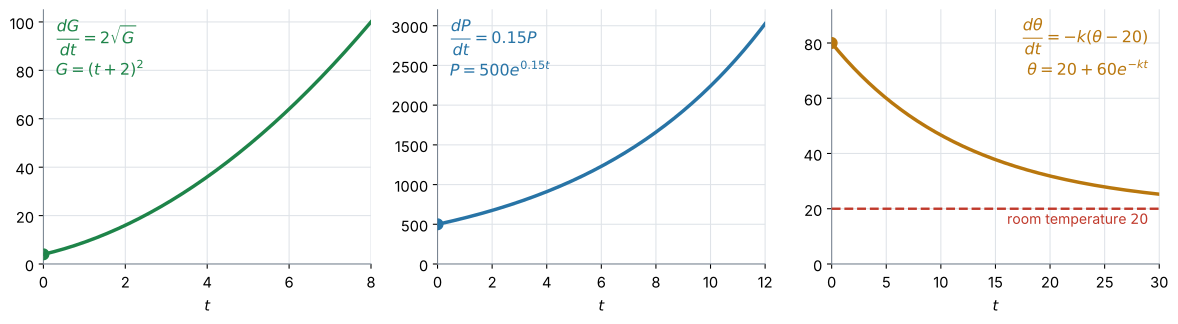
図 3 を見てください。右辺が違えば、解の形がまるごと違います。 \(k\sqrt{G}\) では放物線、\(kP\) では指数関数、\(-k(\theta - 20)\) では \(0\) ではなく \(20\) に近づいていく指数関数になります。
\(P\) が「個体数」、\(t\) が「年」なら、答えにも単位が要ります。
\(k\) にも単位があります。 \(\dfrac{dP}{dt} = kP\) で \(t\) が年なら、\(k\) の単位は「\(1\) 年あたり」(\(\text{year}^{-1}\))です。
Find the value of \(k\) と聞かれたら、数だけでなく単位も書けると安全です。
\(P = Ae^{kt}\) は、\(A > 0\) かつ \(k > 0\) ならどこまでも増えます(個体数のモデルなので \(A > 0\) です)。現実には、そうはなりません。
Comment on the validity of the model for large \(t\) と問われたら、そこを書きます。
試験ではこう書く
The model predicts that the population keeps growing without limit as \(t\) increases.
In reality food, space or other resources would limit the population, so the model is not reasonable for large values of \(t\).
(このモデルは \(t\) が増えると個体数が限りなく増え続けると予測する。実際には食料や空間などの資源が個体数を制限するので、\(t\) が大きいところではこのモデルは妥当でない、という意味です。)
例題 4 A cup of coffee is placed in a room at a constant temperature of \(20\ ^\circ\)C. The temperature of the coffee, \(\theta\ ^\circ\)C after \(t\) minutes, falls at a rate proportional to the difference between \(\theta\) and \(20\).
Initially the coffee is at \(80\ ^\circ\)C, and after \(5\) minutes it is at \(60\ ^\circ\)C.
(a) Write down a differential equation for \(\theta\).
(b) Show that \(\theta = 20 + Ae^{-kt}\).
(c) Find the values of \(A\) and \(k\).
(d) Find the temperature of the coffee after \(15\) minutes.
日本語訳
\(1\) 杯のコーヒーが、一定の温度 \(20\ ^\circ\)C の部屋に置かれています。\(t\) 分後のコーヒーの温度 \(\theta\ ^\circ\)C は、\(\theta\) と \(20\) の差に比例する割合で下がります。
はじめコーヒーは \(80\ ^\circ\)C で、\(5\) 分後には \(60\ ^\circ\)C です。
(a) \(\theta\) についての微分方程式を書きなさい。
(b) \(\theta = 20 + Ae^{-kt}\) となることを示しなさい。
(c) \(A\) と \(k\) の値を求めなさい。
(d) \(15\) 分後のコーヒーの温度を求めなさい。
(a) 差に比例し、下がるので
\[ \frac{d\theta}{dt} = -k(\theta - 20) \]
(b) 変数分離します。
\[ \int \frac{1}{\theta - 20}\, d\theta = \int -k\, dt \]
\[ \ln|\theta - 20| = -kt + C \]
\[ \theta - 20 = e^{-kt + C} = Ae^{-kt} \]
\[ \theta = 20 + Ae^{-kt} \]
コーヒーは室温より熱いので \(\theta > 20\) で、絶対値は外れます。
(c) \(t = 0\) のとき \(\theta = 80\):
\[ 80 = 20 + A \ \Longrightarrow \ A = 60 \]
\(t = 5\) のとき \(\theta = 60\):
\[ 60 = 20 + 60e^{-5k} \ \Longrightarrow \ 40 = 60e^{-5k} \ \Longrightarrow \ e^{-5k} = \frac{2}{3} \]
\[ -5k = \ln\frac{2}{3} \ \Longrightarrow \ k = \frac{1}{5}\ln\frac{3}{2} = 0.0811 \]
(d)
\[ \theta = 20 + 60e^{-0.0811 \times 15} = 20 + 60(0.2963\ldots) = 37.8 \]
\(15\) 分後、およそ \(37.8\ ^\circ\)C です。
検算。 \(5\) 分で \(80 \to 60\)、つまり差が \(60 \to 40\) で \(\dfrac{2}{3}\) 倍になりました。\(15\) 分は \(5\) 分の \(3\) 倍なので、差は \(\left(\dfrac{2}{3}\right)^3 = \dfrac{8}{27}\) 倍です。
\[ 20 + 60 \times \frac{8}{27} = 20 + 17.78 = 37.8 \]
✓ 一致しました。
中身が \(\theta\) ではなく \(\theta - 20\) ですが、\(\theta\) で微分すると \(1\) なので、そのまま \(\ln\) になります。
\[ \frac{d}{d\theta}\ln|\theta - 20| = \frac{1}{\theta - 20} \]
中身の微分が \(1\) でないときは、そうはなりません。 たとえば \(\dfrac{1}{2\theta - 20}\) なら \(\dfrac{1}{2}\ln|2\theta - 20|\) です(AHL 5.11 の integration by substitution(置換積分))。
\(t\) を大きくすると \(e^{-kt} \to 0\) なので、\(\theta \to 20\) です。
室温で止まります。 図 3 の右のグラフが、その様子です。
\(\theta = 20 + Ae^{-kt}\) の \(20\) は、この「行き着く先」を表しています。指数の項だけの \(\theta = Ae^{-kt}\) だと \(0\) に向かってしまい、場面に合いません。
(a) \[ \frac{d\theta}{dt} = -k(\theta - 20) \]
(b) \[ \int \frac{1}{\theta - 20}\, d\theta = \int -k\, dt \] \[ \ln|\theta - 20| = -kt + C \] \[ \theta - 20 = Ae^{-kt}, \qquad \theta = 20 + Ae^{-kt} \quad \text{where } A \text{ is a constant} \]
(c) When \(t = 0\), \(\theta = 80\): \(\ 80 = 20 + A\), so \(A = 60\).
When \(t = 5\), \(\theta = 60\): \[ 40 = 60e^{-5k}, \qquad e^{-5k} = \frac{2}{3} \] \[ k = \frac{1}{5}\ln\frac{3}{2} = 0.0811 \]
(d) \[ \theta = 20 + 60e^{-0.0811 \times 15} = 37.8\ ^\circ\text{C} \]
Why it works
なぜ \(dy\) と \(dx\) を分けてよいのか
\(\dfrac{dy}{dx}\) は分数ではありません。それなのに、なぜ分数のように動かせるのでしょうか。
本当にやっているのは、両辺を \(x\) で積分することです。
\[ \frac{dy}{dx} = f(x)\,g(y) \]
両辺を \(g(y)\) で割ります。
\[ \frac{1}{g(y)} \cdot \frac{dy}{dx} = f(x) \]
両辺を \(x\) で積分します。
\[ \int \frac{1}{g(y)} \cdot \frac{dy}{dx}\, dx = \int f(x)\, dx \]
左辺に注目してください。\(y\) は \(x\) の関数なので、これは chain rule の逆の形です。\(\dfrac{1}{g(y)}\) の原始関数を \(H(y)\) とすると、\(\dfrac{d}{dx}H(y) = \dfrac{1}{g(y)} \cdot \dfrac{dy}{dx}\) ですから、左辺は \(H(y)\) です。
\[ \int \frac{1}{g(y)}\, dy = \int f(x)\, dx \]
と書いたものと、同じ結果になります。
「\(dy\) を移項する」は、この計算の短い書き方です。分数の計算をしているのではなく、chain rule を逆向きに使っています。
だから、\(g(y) = 0\) のところは別あつかいです
上の \(1\) 行目で \(g(y)\) で割りました。\(g(y) = 0\) になる \(y\) では、この計算は使えません。
\(\dfrac{dy}{dx} = ky\) なら \(y = 0\) がそれにあたります。\(y = 0\)(ずっと \(0\) のまま)も、実はこの微分方程式の解です。
第6節で \(A\) を符号こみの任意の定数として置いたので、\(A = 0\) とすれば \(y = 0\) が出てきます。結果としては拾えています。 AI HL では、ここを気にする必要はありません。
Common errors
\(-k(\theta - 20)\) です。\(-k\theta - 20\) ではありません(第2節)。
\(k\) を正の定数として置いたなら、減るときは \(-k\) です(第3節)。
答えの向きで気づけます。 冷めるはずのコーヒーが熱くなったら、符号が違っています。
\(P\) に比例するのか、\(t\) に比例するのか、\(\sqrt{P}\) に比例するのか。proportional to の直後を見てください(表 2)。
\(\ln\) になるのは \(\dfrac{1}{y}\) だけです。\(\dfrac{1}{\sqrt{y}} = y^{-\frac{1}{2}}\) はべき乗の公式です(例 2)。
\(y\) について解けていません。\(y = Ae^{kx}\) まで進めてください(第6節)。
指数法則は \(e^{a+b} = e^a \times e^b\) です。足し算ではありません(AHL 1.9)。
indefinite integral(不定積分)には必ず \(C\) が要ります(SL 5.5)。\(C\) がないと、条件を使えません。
general solution を聞かれて、\(C\) を消してしまう
条件が与えられていないのに \(C\) に値を入れることはできません(第5節)。
\(e^{-5k} = \dfrac{2}{3}\) から \(k\) を出すには、両辺の \(\ln\) をとります(例 4)。
\(30\) 秒でできる検算です(例 2)。微分してもとの右辺に戻れば、正しい解です。
Using your GDC (TI-Nspire CX II)
Find the general solution や Show that ... と問われたら、過程を書かないと点になりません。 電卓の答えだけでは足りません。
電卓は、答えを確かめるために使ってください。解を微分して \(1\) 点で合わせる確かめ方は、AHL 5.9a と同じです。
Exercises
1 Write down a differential equation for each situation. In each case \(k\) is a positive constant.
(a) The value, \(V\) dollars, of a car decreases at a rate proportional to \(V\).
(b) The height, \(h\) cm, of a plant increases at a rate proportional to \(\sqrt{h}\).
(c) The number of fish, \(F\), in a lake increases at a rate proportional to the square of \(F\).
(d) The amount of a drug in the blood, \(D\) mg, decreases at a rate proportional to the difference between \(D\) and \(5\) mg.
(e) The rate at which a chemical dissolves is inversely proportional to the mass, \(M\) grams, already dissolved.
(f) Water flows into a tank at a constant rate of \(5\) litres per minute, and at the same time leaks out at a rate proportional to \(\sqrt{V}\), where \(V\) litres is the volume in the tank.
日本語訳
次のそれぞれの場面について、微分方程式を書きなさい。どの場合も \(k\) は正の定数とします。
drug は「薬」、blood は「血液」という意味です。
(a) 車の価値 \(V\) ドルが、\(V\) に比例する割合で減る。
(b) 植物の高さ \(h\) cm が、\(\sqrt{h}\) に比例する割合で増える。
(c) 湖の魚の数 \(F\) が、\(F\) の \(2\) 乗に比例する割合で増える。
(d) 血液中の薬の量 \(D\) mg が、\(D\) と \(5\) mg の差に比例する割合で減る。
(e) ある化学物質が溶ける割合が、すでに溶けた質量 \(M\) グラムに反比例する。
(f) 水そうに毎分 \(5\) リットルの一定の割合で水が入り、同時に \(\sqrt{V}\) に比例する割合でもれ出す。\(V\) リットルは水そうの中の体積。
(a) \[ \frac{dV}{dt} = -kV \]
(b) \[ \frac{dh}{dt} = k\sqrt{h} \]
(c) \[ \frac{dF}{dt} = kF^2 \]
(d) \[ \frac{dD}{dt} = -k(D - 5) \]
(e) \[ \frac{dM}{dt} = \frac{k}{M} \]
(f) \[ \frac{dV}{dt} = 5 - k\sqrt{V} \]
(a) 「減る」のでマイナス(第3節)。
(b) 「増える」のでそのまま。比例するのは \(\sqrt{h}\) です。
(c) the square of \(F\) は \(F^2\) です。\(\sqrt{F}\) ではありません。 英語をよく読んでください。
(d) 差なのでカッコで囲みます(第2節)。
(e) inversely proportional to \(M\) は、\(M\) で割るという意味です(表 2)。
\[ \frac{dM}{dt} = k \times \frac{1}{M} = \frac{k}{M} \]
\(-kM\) ではありません。 「反比例」と「減る」は別のことです。この場合、\(M\) が増えるほど溶けるのが遅くなりますが、\(M\) 自体は増え続けます。
(f) \(2\) つの流れがあります。 入るぶんと、出るぶんです。
\[ \frac{dV}{dt} = (\text{入る割合}) - (\text{出る割合}) = 5 - k\sqrt{V} \]
入る割合は「毎分 \(5\) リットル」で一定なので、\(V\) が付きません。出る割合は \(\sqrt{V}\) に比例します。
引き算の順を逆にしないでください。 \(\dfrac{dV}{dt}\) は「増える向き」を正にとるので、入る \(-\) 出るです。
検算。 (d) で \(D > 5\) なら \(-k(D-5) < 0\) で減ります ✓ 薬は体から抜けていくので、正しい向きです。\(D\) は \(5\) mg に近づいて止まります。
- で \(5 = k\sqrt{V}\) になると \(\dfrac{dV}{dt} = 0\) で、水位が止まります ✓ 入る量と出る量がつり合った状態です。
2 A population \(P\) satisfies \(\dfrac{dP}{dt} = 0.08P\), where \(t\) is measured in years. When \(t = 0\), \(P = 2000\).
(a) Find \(P\) in terms of \(t\).
(b) Find the population when \(t = 10\).
(c) Find the time taken for the population to double.
日本語訳
個体数 \(P\) が \(\dfrac{dP}{dt} = 0.08P\) を満たします。\(t\) は年で測ります。\(t = 0\) のとき \(P = 2000\) です。
(a) \(P\) を \(t\) の式で表しなさい。
(b) \(t = 10\) のときの個体数を求めなさい。
(c) 個体数が \(2\) 倍になるのにかかる時間を求めなさい。
(a) \[ \int \frac{1}{P}\, dP = \int 0.08\, dt \] \[ \ln|P| = 0.08t + C, \qquad P = Ae^{0.08t} \quad \text{where } A \text{ is a constant} \] When \(t = 0\), \(P = 2000\), so \(A = 2000\). \[ P = 2000e^{0.08t} \]
(b) \[ P = 2000e^{0.8} = 4450 \]
(c) \[ 4000 = 2000e^{0.08t}, \qquad 2 = e^{0.08t} \] \[ t = \frac{\ln 2}{0.08} = 8.66 \ \text{years} \]
(a) \(\dfrac{dP}{dt} = kP\) の形なので、答えは \(Ae^{kt}\) です(第6節)。\(k = 0.08\) がすでに与えられています。
\(t = 0\) を入れると \(e^0 = 1\) なので、\(A\) は最初の値そのものです。
(b) \(2000e^{0.8} = 4451.08\ldots\) です。個体数なので \(3\) 桁で \(4450\)、あるいは「およそ \(4450\) 匹」と書きます。
(c) \(A\) は約分で消えます(例 3)。
検算。 \(t = 8.66\) を (a) の式に入れると \(2000e^{0.08 \times 8.66} = 3998.6\ldots\) です。丸める前の \(t = 8.6643\) なら \(4000.0\) ✓
3 Water leaks from a tank. The volume of water, \(V\) litres after \(t\) minutes, decreases at a rate proportional to \(\sqrt{V}\).
When \(t = 0\), \(V = 400\), and when \(t = 10\), \(V = 100\).
(a) Show that \(V = (20 - t)^2\).
(b) Find the time at which the tank becomes empty.
日本語訳
水そうから水がもれています。\(t\) 分後の水の体積 \(V\) リットルは、\(\sqrt{V}\) に比例する割合で減ります。
\(t = 0\) のとき \(V = 400\)、\(t = 10\) のとき \(V = 100\) です。
(a) \(V = (20 - t)^2\) となることを示しなさい。
(b) 水そうが空になる時刻を求めなさい。
(a) \[ \frac{dV}{dt} = -k\sqrt{V} \] \[ \int V^{-\frac{1}{2}}\, dV = \int -k\, dt \] \[ 2\sqrt{V} = -kt + C \] When \(t = 0\), \(V = 400\): \(\ 2(20) = C\), so \(C = 40\).
When \(t = 10\), \(V = 100\): \(\ 2(10) = -10k + 40\), so \(k = 2\). \[ 2\sqrt{V} = -2t + 40, \qquad \sqrt{V} = 20 - t \] \[ V = (20 - t)^2 \]
(b) The tank is empty when \(V = 0\): \[ (20 - t)^2 = 0 \ \Longrightarrow \ t = 20 \ \text{minutes} \]
例 2 と同じ形で、符号だけが逆です。減るのでマイナスが付きます。
\[ 2\sqrt{V} = -kt + C \]
検算。 \(V = (20-t)^2\) を微分すると \(\dfrac{dV}{dt} = -2(20-t)\) です。いっぽう \(-k\sqrt{V} = -2(20-t)\) ✓
(b) \(\sqrt{V} = 20 - t\) なので、\(t = 20\) で \(\sqrt{V} = 0\)、つまり \(V = 0\) です。
\(t = 25\) を入れると \(V = 25\) となり、水が増えてしまいます。 空になったあとは、この式は場面に合いません。
State the range of values of \(t\) for which the model is valid と問われたら、こう書きます。
The model is valid for \(0 \leq t \leq 20\).
After \(t = 20\) the tank is empty, but the equation would predict the volume increasing again, which cannot happen.
(このモデルは \(0 \leq t \leq 20\) で妥当である。\(t = 20\) より後は水そうが空だが、この式は体積がまた増えると予測してしまい、それは起こりえない、という意味です。)
4 Consider the differential equation \(\dfrac{dy}{dx} = ky\), where \(k\) is a constant.
(a) Find the general solution.
(b) Given that the constant of integration \(A\) satisfies \(A > 0\), describe the behaviour of \(y\) as \(x\) increases when (i) \(k > 0\) and (ii) \(k < 0\).
日本語訳
微分方程式 \(\dfrac{dy}{dx} = ky\)(\(k\) は定数)を考えます。
(a) 一般解を求めなさい。
(b) 積分定数 \(A\) が \(A > 0\) を満たすとして、\(x\) が増えるときの \(y\) のふるまいを、(i) \(k > 0\) のとき、(ii) \(k < 0\) のときについて述べなさい。
(a) \[ \int \frac{1}{y}\, dy = \int k\, dx \] \[ \ln|y| = kx + C \] \[ y = Ae^{kx} \quad \text{where } A \text{ is a constant} \]
(b) (i)
Assuming \(A > 0\): when \(k > 0\) the exponent \(kx\) increases as \(x\) increases, so \(y\) increases without limit.
This is exponential growth.
(\(A > 0\) とすると、\(k > 0\) のとき \(x\) が増えると指数 \(kx\) も増えるので、\(y\) は限りなく増える。これは指数的増加である、という意味です。)
(b) (ii)
Assuming \(A > 0\): when \(k < 0\) the exponent \(kx\) decreases as \(x\) increases, so \(y\) tends towards \(0\) but never reaches it.
This is exponential decay.
(\(A > 0\) とすると、\(k < 0\) のとき \(x\) が増えると指数 \(kx\) は減るので、\(y\) は \(0\) に近づくが決して \(0\) にはならない。これは指数的減衰である、という意味です。)
(a) この項目の中心になる形です(第6節)。この導き方は、そのまま書けるようにしてください。
general solution と聞かれているので、\(A\) は残したままが答えです(第5節)。
(b) ことばで答える問いなので、.model-answer の型で書きます。
(ii) で「\(0\) になる」と書かないでください。 \(e^{kx}\) は正の数なので、\(0\) にはなりません。近づくだけです。
この問題は \(A > 0\) と指定してあります。\(A\) の符号で話が変わるからです。
- \(A > 0\) … いまの説明のとおりの exponential growth / decay
- \(A < 0\) … 曲線は \(x\) 軸の下側にあり、増減の向きが逆になります(\(k > 0\) なら限りなく減り、\(k < 0\) なら下から \(0\) に近づきます)
- \(A = 0\) … \(y = 0\) が恒等的に成り立ちます(increasing でも decreasing でもありません)
答案でも、\(A > 0\) を前提に書くときは Assuming \(A > 0\) の \(1\) 語を添えるのが安全です。
5 A metal bar is taken out of a furnace into a room at \(18\ ^\circ\)C. Its temperature, \(\theta\ ^\circ\)C after \(t\) minutes, satisfies \(\dfrac{d\theta}{dt} = -k(\theta - 18)\).
Initially \(\theta = 90\), and when \(t = 4\), \(\theta = 66\).
(a) Find \(\theta\) in terms of \(t\).
(b) Find the temperature of the bar after \(10\) minutes.
日本語訳
金属の棒が炉から取り出され、\(18\ ^\circ\)C の部屋に置かれます。\(t\) 分後の温度 \(\theta\ ^\circ\)C は \(\dfrac{d\theta}{dt} = -k(\theta - 18)\) を満たします。
furnace は「炉」という意味です。
はじめ \(\theta = 90\) で、\(t = 4\) のとき \(\theta = 66\) です。
(a) \(\theta\) を \(t\) の式で表しなさい。
(b) \(10\) 分後の棒の温度を求めなさい。
(a) \[ \int \frac{1}{\theta - 18}\, d\theta = \int -k\, dt \] \[ \ln|\theta - 18| = -kt + C, \qquad \theta = 18 + Ae^{-kt} \quad \text{where } A \text{ is a constant} \] When \(t = 0\), \(\theta = 90\): \(\ A = 72\).
When \(t = 4\), \(\theta = 66\): \[ 48 = 72e^{-4k}, \qquad e^{-4k} = \frac{2}{3}, \qquad k = \frac{1}{4}\ln\frac{3}{2} = 0.101 \ (3 \text{ s.f.}) \] \[ \theta = 18 + 72e^{-kt} \]
(b) Using the unrounded value of \(k\): \[ \theta = 18 + 72\left(\tfrac{2}{3}\right)^{2.5} = 44.1\ ^\circ\text{C} \]
例 4 とまったく同じ形です。室温が \(20\) から \(18\) に変わっただけです。
\[ k = \frac{1}{4}\ln\frac{3}{2} = 0.101366\ldots \]
(b) では、丸める前の \(k\) を使ってください。\(0.101\) で計算すると \(44.2\) となり、\(3\) 桁目がずれます。
検算。 \(4\) 分で差が \(72 \to 48\)、つまり \(\dfrac{2}{3}\) 倍でした。\(10\) 分は \(4\) 分の \(2.5\) 倍なので、差は \(\left(\dfrac{2}{3}\right)^{2.5}\) 倍です。
\[ 18 + 72 \times \left(\frac{2}{3}\right)^{2.5} = 18 + 26.13 = 44.1 \]
✓ 一致しました。
6 A radioactive substance decays so that its mass, \(m\) grams after \(t\) days, satisfies \(\dfrac{dm}{dt} = -km\). Initially the mass is \(50\) grams, and the half-life of the substance is \(8\) days.
(a) Find the value of \(k\).
(b) Find the mass remaining after \(20\) days.
日本語訳
ある放射性物質が崩壊し、\(t\) 日後の質量 \(m\) グラムは \(\dfrac{dm}{dt} = -km\) を満たします。はじめの質量は \(50\) グラムで、この物質の半減期は \(8\) 日です。
decay は「崩壊する」、half-life は「半減期」(質量が半分になるのにかかる時間)という意味です。
(a) \(k\) の値を求めなさい。
(b) \(20\) 日後に残っている質量を求めなさい。
(a) The general solution is \(m = Ae^{-kt}\), and \(A = 50\). \[ 25 = 50e^{-8k}, \qquad e^{-8k} = \frac{1}{2} \] \[ 8k = \ln 2, \qquad k = \frac{\ln 2}{8} = 0.0866 \ \text{per day} \]
(b) \[ m = 50e^{-0.0866434 \times 20} = 8.84 \ \text{grams} \]
(a) 半減期とは「\(m\) が半分になるまでの時間」です。\(t = 8\) のとき \(m = 25\) と読みかえます。
\[ e^{-8k} = \frac{1}{2} \]
両辺の \(\ln\) をとります。\(\ln\dfrac{1}{2} = -\ln 2\) なので、\(-8k = -\ln 2\)、つまり \(k = \dfrac{\ln 2}{8}\) です。
単位は「\(1\) 日あたり」です(第7節)。
(b) \(20\) 日は半減期 \(2.5\) 個ぶんです。
\[ m = 50 \times \left(\frac{1}{2}\right)^{2.5} = 8.8388\ldots \]
\(3\) 桁で \(8.84\) グラムです。
検算。 \(e\) を使って \(50e^{-0.0866434 \times 20}\) としても \(8.8388\ldots\) です ✓ 半減期で数える方法と、指数で計算する方法が一致しています。
\[ \frac{A}{2} = Ae^{-kt} \ \Longrightarrow \ \frac{1}{2} = e^{-kt} \]
\(A\) が消えます。例 3 の「倍になる時間」と同じ理屈です。
7 The number of people, \(N\), who have heard a rumour in a town increases at a rate proportional to \(N\). When \(t = 0\) days, \(N = 40\), and when \(t = 3\), \(N = 160\).
(a) Find \(N\) in terms of \(t\).
(b) Find the number of people who have heard the rumour after \(5\) days.
(c) Explain why this model cannot be reasonable for large values of \(t\).
日本語訳
ある町でうわさを聞いた人の数 \(N\) は、\(N\) に比例する割合で増えます。\(t = 0\) 日のとき \(N = 40\)、\(t = 3\) のとき \(N = 160\) です。
rumour は「うわさ」という意味です。
(a) \(N\) を \(t\) の式で表しなさい。
(b) \(5\) 日後にうわさを聞いた人の数を求めなさい。
(c) このモデルが \(t\) の大きいところで妥当でない理由を説明しなさい。
(a) \(\dfrac{dN}{dt} = kN\), so \(N = Ae^{kt}\) and \(A = 40\). \[ 160 = 40e^{3k}, \qquad e^{3k} = 4, \qquad k = \frac{\ln 4}{3} = 0.462 \] \[ N = 40e^{0.462t} \]
(b) \[ N = 40e^{5k} = 40 \times 10.08 = 403 \ \text{people} \]
(c)
The model predicts that \(N\) grows without limit, but the number of people who can hear the rumour cannot exceed the population of the town.
Once most of the town has heard it, the number who have not yet heard it becomes small, so the rate of increase must slow down rather than keep growing.
(このモデルは \(N\) が限りなく増えると予測するが、うわさを聞ける人の数は町の人口を超えられない。町のほとんどが聞いてしまえば、まだ聞いていない人の数が少なくなるので、増える割合は増え続けるのではなく遅くなるはずである、という意味です。)
(a) \(3\) 日で \(40 \to 160\)、つまり \(4\) 倍です。
\[ e^{3k} = 4 \ \Longrightarrow \ k = \frac{\ln 4}{3} = 0.4620981\ldots \]
(b) 丸める前の \(k\) で計算します。\(40e^{5k} = 40 \times 4^{\frac{5}{3}} = 403.17\ldots\) で、人数なので \(403\) 人です。
検算。 \(3\) 日で \(4\) 倍なので、\(6\) 日なら \(16\) 倍で \(640\) 人。\(5\) 日はその手前なので、\(403\) は妥当な位置です ✓
(c) 第7節の内容です。
「限りなく増えるから」だけでは足りません。 「なぜ現実にはそうならないか」——人口という上限があることまで書いてください。
「聞いていない人が減るから、増える速さも落ちるはず」まで書ければ十分です。
8 A student solves \(\dfrac{dy}{dx} = 3y\) and writes:
“\(\ln y = 3x + C\), so \(y = e^{3x} + e^{C}\).”
(a) Identify the error.
(b) Write down the correct general solution.
日本語訳
ある生徒が \(\dfrac{dy}{dx} = 3y\) を解いて、次のように書きました。
「\(\ln y = 3x + C\)、よって \(y = e^{3x} + e^{C}\)」
(a) 誤りを指摘しなさい。
(b) 正しい一般解を書きなさい。
(a)
The student has written \(e^{3x + C}\) as \(e^{3x} + e^{C}\).
The law of exponents gives \(e^{a+b} = e^{a} \times e^{b}\), a product and not a sum, so \(e^{3x+C} = e^{C}e^{3x}\).
(この生徒は \(e^{3x+C}\) を \(e^{3x} + e^{C}\) と書いてしまっている。指数法則は \(e^{a+b} = e^a \times e^b\) で、和ではなく積なので、\(e^{3x+C} = e^{C}e^{3x}\) である、という意味です。)
(b) \[ y = Ae^{3x} \quad \text{where } A \text{ is a constant} \]
指数法則の間違いです(AHL 1.9)。
\[ e^{a+b} = e^{a} \times e^{b} \qquad (\text{積です}) \]
すぐ気づく方法があります。 \(y = e^{3x} + e^C\) を微分してみてください。
\[ \frac{dy}{dx} = 3e^{3x} \]
いっぽう \(3y = 3e^{3x} + 3e^{C}\) です。\(3e^C\) の分だけ合いません。
検算。 正しい \(y = Ae^{3x}\) なら \(\dfrac{dy}{dx} = 3Ae^{3x} = 3y\) ✓ ぴったり合います。
微分して確かめるという習慣があれば、この種の間違いは自分で見つけられます。
9 The mass of a chemical, \(M\) kg, in a reaction changes at a rate proportional to \(M\). The mass is measured in kilograms and the time \(t\) in hours.
(a) Write down the differential equation, taking \(k\) to be a positive constant, given that the mass is decreasing.
(b) State the units of \(k\).
(c) The mass falls from \(30\) kg to \(12\) kg in \(6\) hours. Find the value of \(k\).
日本語訳
ある反応における化学物質の質量 \(M\) kg は、\(M\) に比例する割合で変化します。質量はキログラム、時間 \(t\) は時間(hour)で測ります。
chemical は「化学物質」、reaction は「反応」という意味です。
(a) 質量が減っているとして、\(k\) を正の定数とする微分方程式を書きなさい。
(b) \(k\) の単位を述べなさい。
(c) 質量が \(6\) 時間で \(30\) kg から \(12\) kg に減りました。\(k\) の値を求めなさい。
(a) \[ \frac{dM}{dt} = -kM \]
(b)
\(\dfrac{dM}{dt}\) has units of kg per hour and \(M\) has units of kg, so \(k\) has units of per hour (hour\(^{-1}\)).
(\(\dfrac{dM}{dt}\) の単位は kg 毎時、\(M\) の単位は kg なので、\(k\) の単位は毎時(hour\(^{-1}\))である、という意味です。)
(c) \(M = 30e^{-kt}\) \[ 12 = 30e^{-6k}, \qquad e^{-6k} = 0.4 \] \[ k = -\frac{\ln 0.4}{6} = \frac{\ln 2.5}{6} = 0.153 \ \text{per hour} \]
(b) 単位は、式の両辺で合わせて考えます(第7節)。
\[ \underbrace{\frac{dM}{dt}}_{\text{kg/hour}} = -k \times \underbrace{M}_{\text{kg}} \]
\(k\) が kg を kg/hour に変えるので、\(k\) の単位は \(\text{hour}^{-1}\) です。
\(k\) に単位がない、と考えないでください。 比例定数にも単位があります。
(c) \(\dfrac{12}{30} = 0.4\) です。
\[ e^{-6k} = 0.4 \ \Longrightarrow \ -6k = \ln 0.4 \]
\(\ln 0.4\) は負の数なので、\(k\) は正になります。\(\ln 0.4 = -\ln 2.5\) と書きかえると、マイナスが消えて見やすくなります。
\[ k = \frac{\ln 2.5}{6} = 0.15272\ldots \]
検算。 \(30e^{-0.15272 \times 6} = 30 \times 0.4 = 12\) ✓
10 The population of a town, \(P\), grows at a rate proportional to \(P\). In the year \(2020\) the population was \(8000\), and in \(2026\) it was \(12\,000\). Let \(t\) be the number of years after \(2020\).
(a) Find \(P\) in terms of \(t\).
(b) Predict the population in \(2035\).
(c) Find the year in which the population is predicted to reach \(20\,000\).
日本語訳
ある町の人口 \(P\) は、\(P\) に比例する割合で増えます。\(2020\) 年の人口は \(8000\) 人、\(2026\) 年には \(12\,000\) 人でした。\(t\) を \(2020\) 年からの経過年数とします。
(a) \(P\) を \(t\) の式で表しなさい。
(b) \(2035\) 年の人口を予測しなさい。
(c) 人口が \(20\,000\) 人に達すると予測される年を求めなさい。
(a) \(\dfrac{dP}{dt} = kP\), so \(P = Ae^{kt}\) and \(A = 8000\). \[ 12\,000 = 8000e^{6k}, \qquad e^{6k} = 1.5 \] \[ k = \frac{\ln 1.5}{6} = 0.0676 \ \text{per year (3 s.f.)} \] \[ P = 8000e^{kt} \]
(b) In \(2035\), \(t = 15\). Using the unrounded value of \(k\): \[ P = 8000 \times 1.5^{2.5} = 22\,045 \approx 22\,000 \]
(c) \[ 20\,000 = 8000e^{kt}, \qquad e^{kt} = 2.5 \] \[ t = \frac{\ln 2.5}{k} = 13.6 \] Since \(t = 0\) is \(2020\), the population reaches \(20\,000\) when \(t = 13.6\), that is during \(2033\).
(a) \(t\) の原点をどこに置くかを、まず決めます。 問題文が「\(2020\) 年からの経過年数」と指定しているので、\(2020\) 年が \(t = 0\)、\(2026\) 年が \(t = 6\) です。
\[ \frac{12\,000}{8000} = 1.5 \ \Longrightarrow \ e^{6k} = 1.5 \]
(b) \(2035\) 年は \(t = 15\) です。\(8000 \times 1.5^{2.5} = 22\,045.4\ldots\) で、人口なので \(22\,000\) 人ほどと書きます。
(c) \(t = 13.55\ldots\) です。
問われているのは年です。(b) と同じで、\(2020 + t\) が年になります。
\[ 2020 + 13.6 = 2033.6 \]
\(2033\) 年の途中です。\(t = 13\) が \(2033\) 年のはじめ、\(t = 14\) が \(2034\) 年のはじめで、\(13.6\) はそのあいだにあります。まだ \(2034\) 年には入っていません。
答えは \(2033\) 年です。
Find the year と問われたら、年で答えてください。 \(t\) の値のままでは答えになっていません。
検算。 \(2020\) 年に \(8000\) 人、\(6\) 年で \(1.5\) 倍。\(12\) 年で \(2.25\) 倍の \(18\,000\) 人、\(18\) 年で \(3.375\) 倍の \(27\,000\) 人です。\(20\,000\) 人はその間にあり、\(13.6\) 年という答えは正しい位置にあります ✓