SL 1.4 — Financial applications of geometric sequences(複利・減価償却・実質価値)
- compound interest(複利)が geometric sequence であることが分かる。
- 公式集の \(FV = PV\left(1 + \dfrac{r}{100k}\right)^{kn}\) を、\(k\) に気をつけて使える。
- simple interest(単利)と compound interest のちがいを説明できる。
- annual depreciation(毎年の価値の目減り)を、同じ式で扱える。
- inflation(インフレ)を考えた real value(実質価値)を求められる。
- 「何年で \(\ldots\) を超えるか」を、手で調べられる。
The idea
1. Compound interest(利息が、利息を生む)
SL 1.2 の simple interest(単利)では、利息はいつも元金に対して計算されました。ですから毎年、同じ額が加わります。
compound interest(複利)は違います。利息が元金に組み入れられ、次の年はその合計に対して利息が付きます。
\(\$1000\) を年 \(10\%\) で預けた場合を、\(3\) 年ぶん書いてみます。
| 年 | 計算 | 年末の金額 |
|---|---|---|
| \(1\) | \(1000 \times 1.1\) | \(1100\) |
| \(2\) | \(1100 \times 1.1\) | \(1210\) |
| \(3\) | \(1210 \times 1.1\) | \(1331\) |
毎年 \(1.1\) 倍しています。同じ数を掛け続けているので、これは geometric sequence(等比数列)です。common ratio(公比)は \(r = 1.1\) です。
\(0.1\) 倍ではありません(SL 1.3 第 7 節)。
もとの \(1\) に、増える分の \(0.1\) を足して \(1.1\) です。この \(1.1\) を growth factor(増加倍率)と呼ぶことがあります。
growth rate(増加率)とは別のものです。増加率は \(10\%\)、増加倍率は \(1.1\) です。混同しないでください。
2. The compound interest formula(複利の公式)
compound interest で、\(n\) 年後の額 \(FV\) を求める公式は、次のとおりです。
\[ FV = PV \times \left(1 + \frac{r}{100k}\right)^{kn} \tag{1}\]
公式集の 1.4 の欄に Compound interest として印刷されています。記号の意味も、英語で書かれています(下の表)。
depreciation の式は、公式集にありません。 同じ式で \(r\) を負にします(第 5 節)。
記号を、日本語で並べておきます。
| 記号 | 英語 | 意味 |
|---|---|---|
| \(PV\) | present value | いま預ける額 |
| \(FV\) | future value | \(n\) 年後の額 |
| \(r\) | nominal annual rate of interest | 名目年利。パーセントの数字(\(10\%\) なら \(10\)) |
| \(n\) | number of years | 年数 |
| \(k\) | compounding periods per year | \(1\) 年に利息が付く回数 |
\(10\%\) なら \(r = 10\) であって、\(0.1\) ではありません。\(100k\) で割るところで、パーセントが小数に直ります。
\(k = 1\)、\(r = 10\) なら \(\dfrac{10}{100 \times 1} = 0.1\) となり、\((1 + 0.1)^{n} = 1.1^{n}\) です。表 1 と合います。
3. Compounding periods per year(\(1\) 年に利息が付く回数)
利息が \(1\) 年に何回付くかで、計算がどう変わるかを見ます。図は、\(1\) 年を \(k\) 個の等しい期間に分けたものです。
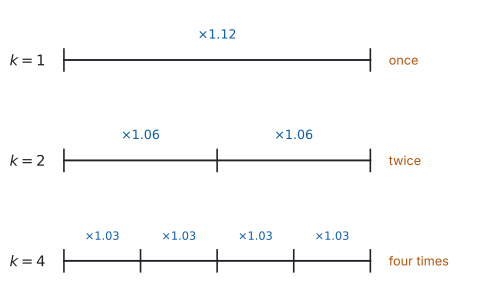
利息が付くのは、\(1\) 年に \(1\) 回とは限りません。半年ごと、\(3\) か月ごと、\(1\) か月ごとに付くこともあります。この回数を compounding periods per year(\(1\) 年に利息が付く回数)と言い、\(k\) で表します。
| 英語 | 意味 | \(k\) |
|---|---|---|
| yearly | \(1\) 年に \(1\) 回 | \(1\) |
| half-yearly | 半年に \(1\) 回 | \(2\) |
| quarterly | \(3\) か月に \(1\) 回 | \(4\) |
| monthly | \(1\) か月に \(1\) 回 | \(12\) |
\(k\) は、指数と分母の両方に影響します。
\[ \left(1 + \underbrace{\frac{r}{100k}}_{1 \text{ 回あたりの利率}}\right)^{\overbrace{kn}^{\text{回数}}} \]
\(1\) 回あたりの利率は小さくなりますが、回数が増えます。両方を同時に直してください。 片方だけ直すのが、この項目でいちばん多い誤りです。
図 1 が、その様子です。図は名目年利 \(12\%\) の場合で、\(k\) が増えると \(1\) 回あたりの倍率が小さくなり、掛ける回数が増えます。
例題 1 Mei invests \(\$4000\) at a nominal annual interest rate of \(20\%\) for \(2\) years.
(a) Find the value of the investment if interest is compounded yearly.
(b) Find the value of the investment if interest is compounded half-yearly.
(c) Explain why compounding half-yearly gives a larger value, even though the nominal rate is the same.
日本語訳
Mei は \(\$4000\) を、名目年利 \(20\%\) で \(2\) 年間預けます。
(a) 利息が \(1\) 年に \(1\) 回つく場合の金額を求めなさい。
(b) 利息が半年に \(1\) 回つく場合の金額を求めなさい。
(c) 名目年利が同じなのに、半年に \(1\) 回のほうが大きくなる理由を説明しなさい。
(a) \(k = 1\) です。
\[ FV = 4000\left(1 + \frac{20}{100}\right)^{2} = 4000(1.2)^{2} = 4000 \times 1.44 = 5760 \]
(b) \(k = 2\) です。分母と指数の両方が変わります(第 3 節)。
\[ FV = 4000\left(1 + \frac{20}{100 \times 2}\right)^{2 \times 2} = 4000(1.1)^{4} \]
\(1.1^{4} = 1.1^{2} \times 1.1^{2} = 1.21 \times 1.21 = 1.4641\) なので
\[ FV = 4000 \times 1.4641 = 5856.40 \]
(c) Explain why なので、英語で理由を書きます。
試験ではこう書く
Compounding half-yearly splits the year into two periods, each at \(10\%\), with interest paid after six months and again at the end of the year.
The interest paid after six months is added to the balance, so during the second half of the year interest is earned on that interest as well.
Over two years this happens four times instead of twice, so the final value is larger.
The nominal rate is the same, but the money starts earning interest sooner.
(半年ごとの複利は、\(20\%\) を \(10\%\) ずつ \(2\) 回に分ける。半年後に付いた利息は残高に組み入れられるので、後半の半年では、その利息にも利息が付く。\(2\) 年では、これが \(2\) 回ではなく \(4\) 回起こるので、最後の金額が大きくなる。名目年利は同じだが、お金が利息を生みはじめる時期が早い、という意味です。)
検算((b) について)。 半年ごとに \(1\) 回ずつ追います。
\[ 4000 \to 4400 \to 4840 \to 5324 \to 5856.40 \]
合いました ✓ これは \(1.4641\) を経由しない別の道すじです。
\(k\) を分母だけ直して \(4000(1.1)^{2} = 4840\) としていたら、\(1\) 年ぶんの値です。指数だけ直して \(4000(1.2)^{4} = 8294.40\) としていたら、\(2\) 年で \(2\) 倍以上になり、\(20\%\) の利率としては大きすぎます。
検算((a)(b) の関係について)。 (b) は (a) より大きく、しかもわずかに大きいはずです。\(5856.40 - 5760 = 96.40\) で、\(5760\) の \(2\%\) にも届きません ✓ もし何倍もちがっていたら、\(k\) の入れ方が違います。
(a) \[FV = 4000(1.2)^{2} = \$5760\]
(b) \[FV = 4000\left(1 + \frac{20}{200}\right)^{4} = 4000(1.1)^{4} = \$5856.40\]
(c) The year is split into two periods, each at \(10\%\), so interest is added sooner and then earns interest itself. Over two years this happens four times instead of twice.
4. Simple and compound interest(単利と複利のちがい)
利息の付き方には \(2\) 種類あります。ここでは、単利と複利を並べて比べます。
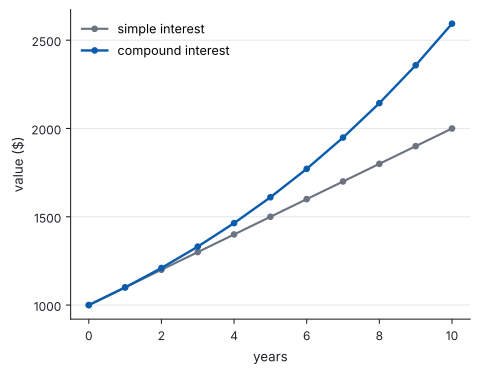
図 2 が、\(\$1000\) を年 \(10\%\) で預けたときの \(2\) つのちがいです。
| simple interest | compound interest | |
|---|---|---|
| 利息のもと | いつも元金 | そのときの残高 |
| 毎年 | 同じ額が加わる | 同じ倍率を掛ける |
| 数列 | arithmetic(等差数列) | geometric(等比数列) |
| グラフ | まっすぐ | だんだん急に上がる |
年 \(1\) 回の複利(\(k = 1\))なら、はじめの \(1\) 年はまったく同じです。差がつくのは \(2\) 年目からで、年数が長いほど差が開きます。
(\(k\) が \(2\) 以上なら、\(1\) 年目からもう差がつきます。)
例題 2 Ken invests \(\$2000\) at a nominal annual interest rate of \(10\%\), compounded yearly.
(a) Find the value of the investment after \(3\) years.
(b) Find the total interest earned over the \(3\) years.
(c) Find the total interest that would be earned if the account paid \(10\%\) simple interest instead.
(d) Explain why compound interest earns more than simple interest over the \(3\) years.
日本語訳
Ken は \(\$2000\) を、名目年利 \(10\%\)、\(1\) 年に \(1\) 回の複利で預けます。
(a) \(3\) 年後の金額を求めなさい。
(b) その \(3\) 年で得た利息の合計を求めなさい。
(c) もし年 \(10\%\) の単利だったら得られたはずの利息の合計を求めなさい。
(d) \(3\) 年では複利のほうが単利より多く増える理由を説明しなさい。
(a) \(k = 1\)、\(r = 10\)、\(n = 3\) です(式 1)。
\[ FV = 2000\left(1 + \frac{10}{100}\right)^{3} = 2000(1.1)^{3} = 2000 \times 1.331 = 2662 \]
\(1.1^{3}\) は、\(1.1 \times 1.1 = 1.21\)、\(1.21 \times 1.1 = 1.331\) と \(2\) 回で出せます。
(b) 利息は、増えた分です。
\[ 2662 - 2000 = \$662 \]
(c) 単利なら、毎年 \(2000 \times 0.1 = 200\) が加わります(SL 1.2)。
\[ 3 \times 200 = \$600 \]
(d) Explain why なので、英語で理由を書きます。
試験ではこう書く
With simple interest the interest is always \(10\%\) of the original \(\$2000\), so \(\$200\) is added every year. With compound interest the interest is \(10\%\) of the current balance, and after the first year that balance is larger than \(\$2000\). In year \(2\) the interest is \(10\%\) of \(\$2200\), which is \(\$220\), and in year \(3\) it is \(10\%\) of \(\$2420\), which is \(\$242\). Because interest is earned on interest already added, the compound total of \(\$662\) is larger than the simple total of \(\$600\). The two are equal only in the first year.
(単利では、利息はつねに元金 \(\$2000\) の \(10\%\) なので、毎年 \(\$200\) が加わる。複利では、利息はそのときの残高の \(10\%\) であり、\(1\) 年目のあとその残高は \(\$2000\) より大きい。\(2\) 年目の利息は \(\$2200\) の \(10\%\) で \(\$220\)、\(3\) 年目は \(\$2420\) の \(10\%\) で \(\$242\) である。すでに付いた利息にも利息が付くので、複利の合計 \(\$662\) は単利の合計 \(\$600\) より大きい。\(2\) つが等しいのは \(1\) 年目だけである、という意味です。)
検算((a) について)。 \(1\) 年ずつ追います。
\[ 2000 \to 2200 \to 2420 \to 2662 \]
合いました ✓ これは \(1.331\) を経由しない別の道すじです。 指数を \(1.1^{2}\) と取りちがえていたら \(2420\) になり、\(1\) 年ずつ追った値と合いません。
検算((b)(c) について)。 単利の \(600\) と複利の \(662\) の差は \(62\) です。これは、\(2\) 年目に増えた \(20\) と \(3\) 年目に増えた \(42\) の合計です。\(20 + 42 = 62\) ✓ 「利息に付いた利息」だけを数えても、同じ値になります。
(a) \[FV = 2000(1.1)^{3} = 2000 \times 1.331 = \$2662\]
(b) \[2662 - 2000 = \$662\]
(c) \[2000 \times 0.1 \times 3 = \$600\]
(d) Simple interest always uses the original \(\$2000\), so \(\$200\) is added each year. Compound interest uses the current balance, which grows, so the interest added grows too: \(\$200\), \(\$220\), \(\$242\).
5. Depreciation(価値が減る場合)
annual depreciation(毎年の価値の目減り)は、複利の裏返しです。
車や機械の価値が毎年 \(25\%\) ずつ減るなら、残るのは \(75\%\)、つまり \(0.75\) 倍です。
\[ \text{value after } n \text{ years} = PV \times (0.75)^{n} \]
公式集の式で言えば、\(r = -25\)、\(k = 1\) としたものです。
\[ \left(1 + \frac{-25}{100 \times 1}\right)^{n} = (1 - 0.25)^{n} = 0.75^{n} \]
\(25\%\) 減るなら、掛けるのは \(0.75\) です。\(0.25\) ではありません。
\(0.25\) を掛けたら、\(1\) 年で \(4\) 分の \(1\) になってしまいます。
「減る」と書いてあったら、\(1\) から引いてから掛ける、と手を動かしてください。
6. Inflation and real value(インフレと実質価値)
物の値段が全体に上がっていくことを inflation(インフレ)と言います。お金が増えても、物の値段も上がっていたら、買えるものは増えていません。
そこで、将来の金額を「いまのお金でいうといくらか」に直します。これが real value(実質価値)です。
\[ \text{real value} = \frac{FV}{\left(1 + \dfrac{f}{100}\right)^{n}} \tag{2}\]
\(f\) は inflation rate(インフレ率、パーセントの数字)です。
公式集の 1.4 の欄にあるのは Compound interest の \(FV\) の式だけです。この割り戻しの式は印刷されていないので、覚える必要があります。
\(f\) は年のインフレ率なので、\(n\) 年ぶん割り戻します。複利が \(1\) 年に \(k\) 回ついていても、インフレ側の指数は \(n\) のままです。
\(k\) を指数に入れるのは、\(FV\) を出す式(式 1)のほうだけです。
年 \(1\) 回の複利で、利率とインフレ率が同じなら、実質価値は最初の額のままです。\(\$2500\) を年 \(20\%\) で \(2\) 年預け、インフレも年 \(20\%\) なら
\[ FV = 2500 \times 1.2^{2} = 3600, \qquad \text{real value} = \frac{3600}{1.2^{2}} = 2500 \]
金額は \(3600\) に増えたのに、買えるものは増えていません。
上の例では、\(20\% - 20\% = 0\%\) と考えても答えが合います。けれども、それはたまたまです。
\(2\) つの割合がちがうと、答えがずれます(例 3 の解説で、実際の数で見ます)。
real value は、いつも \(2\) 段階です。 ① \(FV\) を出す ② インフレ率で割る。
例題 3 Ana invests \(\$10\,000\) at a nominal annual interest rate of \(10\%\), compounded yearly, for \(2\) years. Over the same \(2\) years the annual inflation rate is \(10\%\).
(a) Find the value of the investment after \(2\) years.
(b) Find the real value of the investment after \(2\) years.
(c) Comment on what your answer to (b) tells Ana about her investment.
日本語訳
Ana は \(\$10\,000\) を、名目年利 \(10\%\)、\(1\) 年に \(1\) 回の複利で \(2\) 年間預けます。同じ \(2\) 年間の年間インフレ率は \(10\%\) です。
(a) \(2\) 年後の金額を求めなさい。
(b) \(2\) 年後の real value(実質価値)を求めなさい。
(c) (b) の答えが、Ana の投資について何を意味するかを述べなさい。
(a) \(k = 1\)、\(r = 10\)、\(n = 2\) です。
\[ FV = 10\,000(1.1)^{2} = 10\,000 \times 1.21 = 12\,100 \]
(b) インフレ率で割ります(式 2)。\(f = 10\)、\(n = 2\) です。
\[ \text{real value} = \frac{12\,100}{(1.1)^{2}} = \frac{12\,100}{1.21} = 10\,000 \]
(c) Comment on なので、英語で述べます。
試験ではこう書く
In real terms the investment is worth exactly what Ana started with.
The balance has grown from \(\$10\,000\) to \(\$12\,100\), but prices have risen by the same \(10\%\) each year, so the extra \(\$2100\) buys nothing more than the original \(\$10\,000\) would have bought two years earlier. Her money has kept its purchasing power, but she has gained nothing in real terms.
(実質で見ると、この投資は Ana が最初に入れた額とちょうど同じ価値である。残高は \(\$10\,000\) から \(\$12\,100\) に増えたが、物価も毎年同じ \(10\%\) 上がったので、増えた \(\$2100\) は、\(2\) 年前に \(\$10\,000\) で買えたもの以上のものを買えるわけではない。お金の買う力は保たれたが、実質では何も得ていない、という意味です。)
検算((b) について)。 分数のまま約分します。
\[ \frac{10\,000 \times 1.1^{2}}{1.1^{2}} = 10\,000 \]
上と下が同じ \(1.1^{2}\) なので、消えます ✓ 年 \(1\) 回の複利で利率とインフレ率が同じなら、実質価値は \(PV\) に戻ります。
「\(10\% - 10\% = 0\%\)」でも同じ答えになりますが、たまたまです。 割合がちがうと合いません。たとえば \(\$8000\)、利率 \(10\%\)、インフレ \(5\%\)、\(2\) 年なら
\[ FV = 8000 \times 1.21 = 9680, \qquad \text{real value} = \frac{9680}{1.1025} = 8780.04\ldots \]
ですが、「差の \(5\%\)」で計算すると \(8000 \times 1.1025 = 8820\) となり、\(40\) ほどずれます(第 6 節)。
(a) \[FV = 10\,000(1.1)^{2} = \$12\,100\]
(b) \[\text{real value} = \frac{12\,100}{1.1^{2}} = \frac{12\,100}{1.21} = \$10\,000\]
(c) The real value equals the amount invested, so the investment has kept its purchasing power but gained nothing in real terms.
7. Finding the number of years(何年で超えるか)
「何年で \(\ldots\) を超えるか」には、答え方が \(2\) つあります。 \(1\) 年ずつ調べる方法と、方程式にして解く方法です。
\(\$1500\) が年 \(10\%\) で、いつ \(\$2000\) を超えるか。
| \(n\) | \(1.1^{n}\) | 金額 |
|---|---|---|
| \(2\) | \(1.21\) | \(1815\) |
| \(3\) | \(1.331\) | \(1996.50\) |
| \(4\) | \(1.4641\) | \(2196.15\) |
\(3\) 年目では届かず、\(4\) 年目で超えます。答えは \(4\) 年です。
\(1.1\) を \(1\) 回ずつ掛けていくのが、いちばん確実です。\(1.21 \times 1.1 = 1.331\)、\(1.331 \times 1.1 = 1.4641\)。
\(n = 3\) で届かないこと、\(n = 4\) で超えることの両方を見せて、はじめて「\(4\) 年が最小」と言えます。
片方だけでは、答えの根拠になりません。
もう \(1\) つは、方程式にして解く方法です。 ちょうど \(\$2000\) になるときの \(n\) を求めます。
\[ 1500 \times 1.1^{\,n} = 2000 \]
グラフで解けます。 \(y = 1500 \times 1.1^{x}\) と \(y = 2000\) を同じ画面にかいて、交点の \(x\) を読むと \(x = 3.02\ldots\) です。
nSolve でも解けます。 nSolve は menu → Algebra → Numerical Solve から入れられます。
出てくるのは小数です。 \(n = 3.02\ldots\) は「\(3\) 年ではまだ届いていない」という意味なので、答えは \(4\) 年です。切り上げます。
どちらも電卓の機能なので、Paper 2 の方法です。 Paper 1 では、上の表のように \(1\) 年ずつ調べます。
Paper 1 では使えませんが、Paper 2 では電卓の Finance Solver が使えます。
menu → Finance → Finance Solver| 欄 | 入れるもの |
|---|---|
N |
期間の回数(\(k \times n\)。年数ではありません) |
I(%) |
名目年利 \(r\) |
PV |
\(-\)(預ける額) |
Pmt |
\(0\) |
FV |
求めたい欄(カーソルを置いて enter) |
PpY、CpY |
どちらも \(k\) |
符号のきまりが関門です。 自分から出ていくお金は負、入ってくるお金は正です。預金なら \(PV\) が負、\(FV\) が正になります。両方同じ符号にすると、エラーか、意味のない値が返ります。
N は年数ではありません。 quarterly で \(5\) 年なら \(N = 20\) です。PpY、CpY、N の \(3\) つはセットで動きます。
例題 4 A machine is bought for \(\$12\,000\). Its value depreciates by \(25\%\) each year.
(a) Find the value of the machine after \(3\) years.
(b) Show that after \(3\) years the machine is worth less than half its original value.
(c) Find the number of years it takes for the value of the machine to fall below \(\$4000\).
日本語訳
ある機械を \(\$12\,000\) で買いました。価値は毎年 \(25\%\) ずつ減ります。
(a) \(3\) 年後の機械の価値を求めなさい。
(b) \(3\) 年後には、買ったときの半分より安くなっていることを示しなさい。
(c) 機械の価値が \(\$4000\) を下回るまでに何年かかるかを求めなさい。
(a) \(25\%\) 減るので、残るのは \(0.75\) 倍です(第 5 節)。
\[ 12\,000 \times (0.75)^{3} = 12\,000 \times \frac{27}{64} = \frac{324\,000}{64} = 5062.50 \]
\(0.75 = \dfrac{3}{4}\) と分数で書くと、\(\left(\dfrac{3}{4}\right)^{3} = \dfrac{27}{64}\) となって手で計算できます。
(b) Show that なので、くらべて見せます。買ったときの半分は \(6000\) です。
\[ 5062.50 < 6000 \]
ですから、半分より安くなっています。
(c) \(1\) 年ずつ調べます(第 7 節)。
| \(n\) | 価値 |
|---|---|
| \(3\) | \(5062.50\) |
| \(4\) | \(3796.88\)(正確には \(3796.875\)) |
\(3\) 年目は \(\$4000\) より上、\(4\) 年目で下回ります。答えは \(4\) 年目です。
検算((a) について)。 \(1\) 年ずつ追います。
\[ 12\,000 \to 9000 \to 6750 \to 5062.50 \]
合いました ✓ \(0.25\) を掛けていたら \(12\,000 \to 3000 \to 750 \to 187.50\) となり、\(1\) 年で \(4\) 分の \(1\) になってしまいます。「減る割合」と「残る割合」の取りちがえは、\(1\) 年ぶん追うだけで見つかります。
検算((c) について)。 \(4\) 年目の値を、\(1\) 年ずつではなく累乗から出します。
\[ 12\,000 \times (0.75)^{4} = 12\,000 \times \frac{81}{256} = \frac{972\,000}{256} = 3796.875 \]
合いました ✓ \(5062.50\) に \(0.75\) を掛けるのとは別の道すじです。 境目の両側(\(5062.50 > 4000\)、\(3796.875 < 4000\))がそろって、はじめて「\(4\) 年目が最初」と言えます。
(a) \[12\,000 \times (0.75)^{3} = 12\,000 \times \frac{27}{64} = \$5062.50\]
(b) \[\frac{12\,000}{2} = 6000, \qquad 5062.50 < 6000\]
(c) \[n = 3: \ \$5062.50, \qquad n = 4: \ \$3796.88\] The value first falls below \(\$4000\) after \(4\) years.
Why it works
なぜ \(\left(1 + \dfrac{r}{100k}\right)^{kn}\) なのか。(この導き方は、試験では問われません。)
\(1\) 年に \(k\) 回、利息が付くとします。\(1\) 回あたりの利率は、年利を \(k\) 等分した
\[ \frac{r}{100k} \]
です。\(1\) 回ごとに、残高は \(\left(1 + \dfrac{r}{100k}\right)\) 倍になります。
\(n\) 年のあいだに、利息が付く回数は \(k \times n\) 回です。同じ倍率を \(kn\) 回掛けるので、指数が \(kn\) になります。
\[ FV = PV \times \underbrace{\left(1 + \frac{r}{100k}\right) \times \cdots \times \left(1 + \frac{r}{100k}\right)}_{kn \text{ 個}} \]
なぜ、\(k\) が大きいほど \(FV\) も大きくなるのか。
\(1\) 回あたりの利率は \(\dfrac{1}{k}\) になりますが、回数は \(k\) 倍になります。もし利息が単利のように働くなら、これで打ち消し合って同じになるはずです。
打ち消し合わないのは、早くついた利息にも、その先で利息が付くからです。\(k\) を大きくすると、利息が「働きはじめる」時期が早くなります。ですから、\(FV\) は少しだけ大きくなります。
\(\$800\)、年 \(12\%\)、\(1\) 年で見ると
\[ \begin{aligned} k = 1 &: \quad 800(1.12) = 896 \\[2pt] k = 2 &: \quad 800(1.06)^{2} = 898.88 \\[2pt] k = 4 &: \quad 800(1.03)^{4} = 900.4070\ldots \end{aligned} \]
増えますが、増え方はごくわずかです。\(k\) を \(4\) 倍にしても、\(4\) 倍増えるわけではありません。
Common errors
公式集の \(r\) はパーセントの数字です(表 2)。\(10\%\) なら \(r = 10\) です。
\(r = 0.1\) と入れると、\(\dfrac{0.1}{100} = 0.001\) となり、\(0.1\%\) の計算になってしまいます。
答えがほとんど増えていなかったら、ここを疑ってください。
\(k\) は両方に影響します(第 3 節)。
half-yearly で \(2\) 年なら、\(\left(1 + \dfrac{r}{200}\right)^{4}\) です。
\(\left(1 + \dfrac{r}{200}\right)^{2}\) は \(1\) 年ぶん、\(\left(1 + \dfrac{r}{100}\right)^{4}\) は年利を \(2\) 倍にしたのと同じです。
\(25\%\) 減るなら、残るのは \(0.75\) です(第 5 節)。
\(0.25\) を掛けると、\(1\) 年で \(4\) 分の \(1\) になります。
\(1\) 年ぶんだけ手で追えば、すぐ気づけます。
\(2\) 段階です。① \(FV\) を出す ② インフレ率で割る(第 6 節)。
差を取る方法は、\(2\) つの割合が同じときだけ、たまたま合います。
問題文に inflation が出てきたら、割り算がもう \(1\) 回ある、と思ってください。
\(n = 4\) で超えることを書いても、\(n = 3\) で届かないことを書かなければ、最小である根拠になりません(第 7 節)。
表で両側を見せるのが、いちばん確実です。
「何年かかるか」を聞かれているので、答えは整数の年です。
Exercises
1 Find the value of \(\$2500\) invested for \(2\) years at a nominal annual interest rate of \(8\%\), compounded yearly.
日本語訳
\(\$2500\) を、名目年利 \(8\%\)、\(1\) 年に \(1\) 回の複利で \(2\) 年間預けたときの金額を求めなさい。
\[FV = 2500(1.08)^{2} = 2500 \times 1.1664 = \$2916\]
\(k = 1\) なので、\(\left(1 + \dfrac{8}{100}\right)^{2} = 1.08^{2}\) です。\(1.08^{2} = 1.1664\) は、\(1.08 \times 1.08\) を筆算で出せます。
検算。 \(1\) 年ずつ追います。\(2500 \to 2700 \to 2916\) ✓ これは \(1.1664\) を経由しない別の道すじです。
\(1.08^{2}\) を \(1.16\) としていたら(\(0.08\) を \(2\) 回足した値)、\(2900\) となり、\(1\) 年ずつ追った値と合いません。複利では、倍率を足すのではなく掛けます。
2 Sam invests \(\$5000\) for \(2\) years at a nominal annual interest rate of \(20\%\), compounded yearly.
(a) Find the value of the investment after \(2\) years.
(b) Find the interest earned.
日本語訳
Sam は \(\$5000\) を、名目年利 \(20\%\)、\(1\) 年に \(1\) 回の複利で \(2\) 年間預けます。
(a) \(2\) 年後の金額を求めなさい。
(b) 得た利息を求めなさい。
(a) \[FV = 5000(1.2)^{2} = 5000 \times 1.44 = \$7200\]
(b) \[7200 - 5000 = \$2200\]
(b) 利息は「増えた分」です。\(FV\) をそのまま答えにしないでください。
検算。 \(1\) 年ずつ追います。\(5000 \to 6000 \to 7200\) ✓
利息の側からも確かめられます。 \(1\) 年目の利息は \(1000\)、\(2\) 年目は \(6000\) の \(20\%\) で \(1200\)。合わせて \(2200\) ✓ 単利なら \(2000\) なので、\(200\) だけ多いはずです。これは「利息に付いた利息」です。
3 Find the value of \(\$2000\) invested for \(2\) years at a nominal annual interest rate of \(20\%\), compounded half-yearly.
日本語訳
\(\$2000\) を、名目年利 \(20\%\)、半年に \(1\) 回の複利で \(2\) 年間預けたときの金額を求めなさい。
\[FV = 2000\left(1 + \frac{20}{100 \times 2}\right)^{2 \times 2} = 2000(1.1)^{4} = 2000 \times 1.4641 = \$2928.20\]
half-yearly なので \(k = 2\) です。分母が \(200\)、指数が \(4\) になります(第 3 節)。
検算。 半年ごとに追います。\(2000 \to 2200 \to 2420 \to 2662 \to 2928.20\) ✓
yearly の場合と見くらべることもできます。\(2000(1.2)^{2} = 2880\) で、half-yearly のほうが \(48.20\) だけ大きい ✓ \(k\) を大きくすると少しだけ増える、という関係と合っています。
4 A machine costs \(\$8000\). Its value depreciates by \(25\%\) each year. Find its value after \(3\) years.
日本語訳
ある機械の価格は \(\$8000\) です。価値は毎年 \(25\%\) 減ります。\(3\) 年後の価値を求めなさい。
\[8000 \times (0.75)^{3} = 8000 \times \frac{27}{64} = \$3375\]
残るのは \(0.75\) 倍です(第 5 節)。\(\left(\dfrac{3}{4}\right)^{3} = \dfrac{27}{64}\) と分数で計算すると、割り切れます。
検算。 \(1\) 年ずつ追います。\(8000 \to 6000 \to 4500 \to 3375\) ✓
\(3\) 年で半分より少し下になっているのも、目安になります。\(0.75^{3} = 0.421875\) で、\(42\%\) ほどです。
5 A car is bought for \(\$10\,000\) and loses \(20\%\) of its value each year. Find the number of years it takes for the value of the car to fall below \(\$5000\).
日本語訳
ある車を \(\$10\,000\) で買いました。価値は毎年 \(20\%\) ずつ減ります。車の価値が \(\$5000\) を下回るまでに何年かかるかを求めなさい。
\[10\,000 \to 8000 \to 6400 \to 5120 \to 4096\]
At the end of year \(3\) the value is \(\$5120\), which is above \(\$5000\), and at the end of year \(4\) it is \(\$4096\), which is below. The value first falls below \(\$5000\) after \(4\) years.
残るのは \(0.8\) 倍です。\(1\) 年ずつ掛けるのが、いちばん速いです(第 7 節)。
境目の両側を、両方書いてください。 \(3\) 年目で \(\$5120\)(まだ上)、\(4\) 年目で \(\$4096\)(下回る)。
検算。 公式でも出します。\(10\,000 \times 0.8^{4} = 10\,000 \times 0.4096 = 4096\) ✓ \(0.8^{2} = 0.64\)、\(0.8^{4} = 0.64^{2} = 0.4096\) です。
\(0.8^{3} = 0.512\) で、まだ半分より上であることも見えます。半分になるのは \(3\) 年目と \(4\) 年目のあいだです。
6 Nina invests \(\$4000\) for \(3\) years at a nominal annual interest rate of \(10\%\).
(a) Find the interest earned if the interest is simple.
(b) Find the interest earned if the interest is compounded yearly.
(c) Find the difference between the two amounts of interest.
日本語訳
Nina は \(\$4000\) を、名目年利 \(10\%\) で \(3\) 年間預けます。
(a) 単利のときに得られる利息を求めなさい。
(b) \(1\) 年に \(1\) 回の複利のときに得られる利息を求めなさい。
(c) \(2\) つの利息の差を求めなさい。
(a) \[4000 \times 0.1 \times 3 = \$1200\]
(b) \[4000(1.1)^{3} - 4000 = 5324 - 4000 = \$1324\]
(c) \[1324 - 1200 = \$124\]
(a) 単利は毎年 \(400\) です(SL 1.2)。
(b) \(4000 \times 1.331 = 5324\) から、元金を引きます。
検算。 利息を \(1\) 年ずつ出します。\(400\)、\(440\)(\(4400\) の \(10\%\))、\(484\)(\(4840\) の \(10\%\))。合わせて \(1324\) ✓ これは \(1.331\) を経由しない別の道すじです。
差の \(124\) も、\(0 + 40 + 84 = 124\) と、単利との差だけを足して確かめられます ✓
7 Leo invests \(\$5000\) at a nominal annual interest rate of \(8\%\), compounded yearly, for \(1\) year. The inflation rate for that year is \(4\%\).
(a) Find the value of the investment after \(1\) year.
(b) Find the real value of the investment after \(1\) year, correct to two decimal places.
日本語訳
Leo は \(\$5000\) を、名目年利 \(8\%\)、\(1\) 年に \(1\) 回の複利で \(1\) 年間預けます。その年のインフレ率は \(4\%\) です。
(a) \(1\) 年後の金額を求めなさい。
(b) \(1\) 年後の real value(実質価値)を、小数第 \(2\) 位まで求めなさい。
(a) \[FV = 5000(1.08)^{1} = \$5400\]
(b) \[\text{real value} = \frac{5400}{1.04} = \$5192.31\]
\(2\) 段階です。 ① \(FV\) を出す ② インフレ率で割る(第 6 節)。
\(\dfrac{5400}{1.04} = \dfrac{540\,000}{104}\) です。上下を \(8\) で約分すると \(\dfrac{67\,500}{13}\) になり、\(13\) で割るだけの筆算になります。\(13 \times 5192 = 67\,496\)、余り \(4\) なので \(5192.307\ldots\) です。小数第 \(2\) 位までなので \(5192.31\) です。
検算。 出した実質価値に、インフレ率を掛け戻します。\(5192.31 \times 1.04 = 5400.0024\) で、\(5400\) に戻ります ✓(\(0.01\) 単位に丸めたぶんのずれです。)
「\(8\% - 4\% = 4\%\)」で計算していたら \(5000 \times 1.04 = 5200\) となり、\(7.69\) ずれます。割合がちがうときは、差を取る方法は使えません。
8 Tom invests \(\$2000\) at a nominal annual interest rate of \(20\%\), compounded yearly. Find the number of years it takes for the value of the investment to exceed \(\$4000\).
日本語訳
Tom は \(\$2000\) を、名目年利 \(20\%\)、\(1\) 年に \(1\) 回の複利で預けます。金額が \(\$4000\) を超えるまでに何年かかるかを求めなさい。
\[2000 \to 2400 \to 2880 \to 3456 \to 4147.20\]
At the end of year \(3\) the value is \(\$3456\), which is below \(\$4000\), and at the end of year \(4\) it is \(\$4147.20\), which is above. The value first exceeds \(\$4000\) after \(4\) years.
\(1\) 年ずつ掛けます(第 7 節)。\(1.2\) を \(1\) 回ずつ掛けるほうが、累乗を計算するより速いです。
境目の両側を書いてください。 \(3\) 年目は \(\$3456\)、\(4\) 年目は \(\$4147.20\) です。
検算。 公式でも出します。\(2000 \times 1.2^{4} = 2000 \times 2.0736 = 4147.20\) ✓ \(1.2^{2} = 1.44\)、\(1.2^{4} = 1.44^{2} = 2.0736\) です。
「\(2\) 倍になるのは \(5\) 年」と見当をつけていたなら、\(20\%\) ずつ \(5\) 回で \(2.49\) 倍なので、少し遅すぎます。\(4\) 年でちょうど \(2\) 倍を少し超える、が正しい感覚です。
9 Ravi invests \(\$1000\) for \(1\) year at a nominal annual interest rate of \(20\%\).
(a) Find the value after \(1\) year if interest is compounded yearly.
(b) Find the value after \(1\) year if interest is compounded half-yearly.
(c) Comment on the size of the difference between your two answers.
日本語訳
Ravi は \(\$1000\) を、名目年利 \(20\%\) で \(1\) 年間預けます。
(a) \(1\) 年に \(1\) 回の複利のときの、\(1\) 年後の金額を求めなさい。
(b) 半年に \(1\) 回の複利のときの、\(1\) 年後の金額を求めなさい。
(c) \(2\) つの答えの差の大きさについて、述べなさい。
(a) \[1000(1.2)^{1} = \$1200\]
(b) \[1000\left(1 + \frac{20}{200}\right)^{2} = 1000(1.1)^{2} = \$1210\]
(c) The difference is only \(\$10\), which is \(1\%\) of the amount invested. Compounding twice a year rather than once does increase the value, because the interest paid after six months earns interest for the rest of the year, but the effect is small compared with the \(\$200\) earned from the interest rate itself.
(b) \(k = 2\) なので、分母は \(200\)、指数は \(2\) です。
(c) Comment on なので、英語で述べます。「大きくなる」だけでは足りません。 どれくらい大きいのかに触れてください。
検算((b) について)。 半年ごとに追います。\(1000 \to 1100 \to 1210\) ✓
差の \(10\) は、半年後に付いた利息 \(\$100\) に、後半の半年ぶんの利率 \(10\%\) が付いたものです。\(100 \times 0.1 = 10\) ✓ 「利息に付いた利息」だけを取り出しても、同じ \(10\) になります。
試験ではこう書く
Compounding half-yearly gives \(\$1210\) instead of \(\$1200\), a difference of only \(\$10\) on an investment of \(\$1000\). The gain comes from the \(\$100\) of interest paid after six months, which itself earns \(10\%\) for the second half of the year. Compared with the \(\$200\) earned from the nominal rate, the effect of compounding more often is small.
10 A student is asked to find the value of \(\$5000\) invested for \(2\) years at a nominal annual interest rate of \(20\%\), compounded half-yearly, and writes
\[ FV = 5000(1.2)^{4} = 10\,368 \]
Identify the error and give the correct value.
日本語訳
ある生徒が、\(\$5000\) を名目年利 \(20\%\)、半年に \(1\) 回の複利で \(2\) 年間預けたときの金額を求めるように言われ、上のように書きました。
誤りを指摘し、正しい金額を書きなさい。
The student changed the index to \(kn = 4\) but not the rate. With \(k = 2\) the rate per period is \(\frac{20}{100 \times 2} = 0.1\), not \(0.2\).
\[FV = 5000\left(1 + \frac{20}{200}\right)^{4} = 5000(1.1)^{4} = 5000 \times 1.4641 = \$7320.50\]
Identify the error なので、どこが違うのかを名指ししてから、正しい答えを書きます。
\(k\) は分母と指数の両方に影響します(第 3 節)。生徒は指数だけ直しました。
検算。 生徒の答えの大きさを見ます。\(10\,368\) は元金の \(2\) 倍以上です。年 \(20\%\) で \(2\) 年なら、\(2\) 倍にはなりません(\(1.2^{2} = 1.44\))。ここで気づけます。
正しい答えは、半年ごとに追っても出せます。\(5000 \to 5500 \to 6050 \to 6655 \to 7320.50\) ✓
試験ではこう書く
With \(k = 2\) the interest rate per period is \(\frac{20}{100 \times 2} = 10\%\), so the factor is \(1.1\), not \(1.2\).
The student used the yearly factor \(1.2\) together with the half-yearly index \(4\), which is the same as doubling the nominal rate.
The correct value is \(5000(1.1)^{4} = \$7320.50\). A quick check confirms the error: under yearly compounding the value would be \(5000 \times 1.44 = \$7200\), and compounding more often changes this only a little, so \(\$10\,368\) is far too large.